When Ismael Saibari pulled up with a thigh injury just 22 minutes into Morocco's round-of-16 clash against Canada, fears spread quickly among Atlas Lions fans. Losing their top scorer in a tournament where finishing chances had already been a struggle seemed like a devastating blow.
Enter Soufiane Rahimi.
The Al-Ain forward had barely featured before that match, logging just 61 minutes of action across the tournament. He was a squad player for a national team he only joined in early 2024, though a brief cameo against Haiti—producing a goal and an assist—had already hinted at his potential. But delivering on the knockout stage, thrust into action earlier than planned? That was a different challenge entirely.
Yet Rahimi has spent his entire career defying expectations.
"Soufiane Rahimi represents hope," said FIFA content producer and Morocco supporter Tim Argane. "He proves that a kid playing street football in Morocco—the 'drouba'—can dream of representing his country on the biggest stage."
Rahimi is one of just seven homegrown players in Morocco's 2026 squad. He has never played in Europe, building his career entirely at Raja Casablanca and Al-Ain. For Argane, that background is what makes this Morocco team so special.
"I don't buy the argument that Morocco just 'recruits' players from abroad—we're all Moroccan," Argane told Arab News. "What Morocco has done brilliantly is create multiple pathways to the national team. You have players like Rahimi who came through the local league, academy graduates, and those developed in Europe. They all share the same identity and love for the Kingdom."
Without the diaspora label or European media spotlight, Rahimi had to forge his own path. His story begins with his father, Mohammed "Youari" Rahimi, a former goalkeeper whose playing career ended in a car accident. Youari never left Raja Casablanca, working for nearly 50 years as a baggage carrier and kit man, even raising his family at the club's Oasis Sports Complex.
"Youari was more than a baggage handler—he was an adviser, a psychologist, a father figure," said former club general manager Mohamed Naciri in 2015. "His loyalty and dedication to Raja are etched in the club's history."
But Youari had one dream: to see his son play for Raja. His eldest, Amin, tried first before stepping into his father's role when Youari retired in 2015. That left Soufiane, who joined Raja's youth setup in 2006 at age 10.
His path was far from smooth. In 2017, Raja sent him on loan to third-tier EJS Casablanca rather than promoting him. He returned with 17 goals in 28 games, won back-to-back Botola Pro Player of the Season awards, and helped Raja lift the CAF Confederation Cup. His father's dream was finally fulfilled.
A move to Al-Ain followed, where he finished as the 2023-24 AFC Champions League top scorer and led the club to their first continental title since 2003.
Then came a record-breaking 2024 Olympics campaign: six straight matches with goals, eight total—the most since Carlos Tevez in 2004—and the first African and Arab player to finish as Olympic top scorer.
Still, a senior squad place remained uncertain. Saibari's rapid rise limited Rahimi to just 77 minutes at the 2025 Africa Cup of Nations.
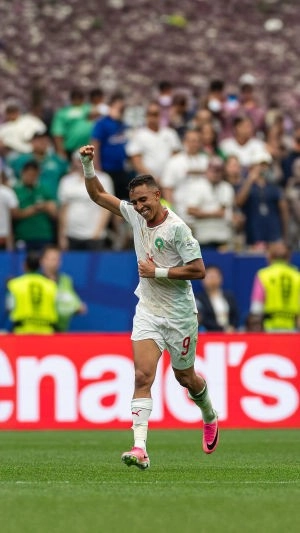
But at this World Cup, he built momentum quietly—from seven minutes across the first two group games to a match-winning cameo against Haiti. When Saibari went down against Canada, Rahimi was ready.
"It comes down to belief," Argane said. "Every player in this team feels they can make a difference. No one is made to feel less important."
Rahimi's impact was immediate. His long runs stretched Canada's defense, drawing the foul that led to Azzedine Ounahi's opener. He nearly added a third with a header that hit the crossbar, then broke clear in the dying moments to seal Morocco's place in the quarterfinals for only the second time in their history.
"You saw it with Issa Diop replacing Aguerd and scoring against the Netherlands, and you saw it with Rahimi against Canada," Argane said. "When their moment came, they were ready. That trust across the squad is one of Morocco's biggest strengths."
Once unsure if he would ever fulfill his father's dream of playing for Raja, Soufiane Rahimi is now writing his own chapter in Moroccan football history—helping lead his country to the World Cup quarterfinals.