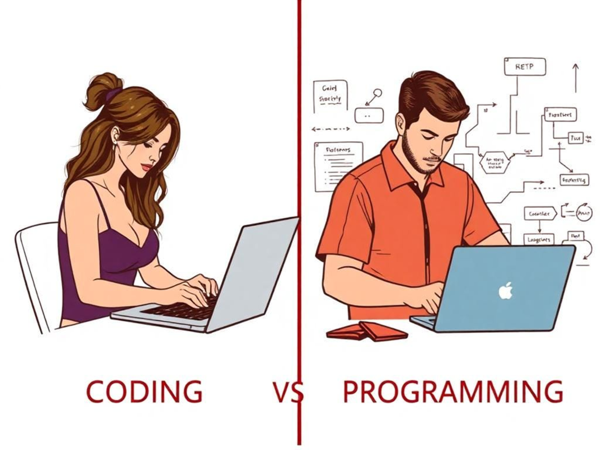
Coding vs. Programming: In the digital age, when discussing apps, websites, or software, two terms are frequently heard: coding and programming. From school children to young professionals in major companies, everyone uses these terms freely. Most people mistake them for the same thing, believing that simply typing colorful text on a computer constitutes both coding and programming. However, if you are stepping into the world of technology, it is essential to understand the difference between them.
There is a subtle distinction between coding and programming. You can understand it this way: every programmer is necessarily a coder, but not every coder is necessarily a programmer. The textbook definitions found on the internet can make this distinction so complex that it leaves the average person bewildered. For the sake of general knowledge, let us understand the difference—and the respective roles they play in software development—using simple, straightforward examples.
What is the difference between coding and programming?
It is a major mistake to consider coding and programming as the same thing. There are several fundamental differences between them, and one should understand these before entering the tech world.
What is coding? What do coders do?
Coding means translating one language into another. Computers do not understand languages like Hindi or English; they only understand binary language (0s and 1s). Since it is impossible for humans to communicate using 0s and 1s, we use programming languages like Java, Python, or C++. A coder's job is to write our instructions in the code of these languages so the computer understands what needs to be done. You can view a coder as a 'translator' who converts human communication into computer language.
What is programming? What do programmers do?
Programming is a much broader and more comprehensive term; coding is merely a small part of it. Programming is not merely about writing code; it is a journey that spans from understanding a problem to developing a complete solution. A programmer's role encompasses designing the app's architecture, determining its functionality, anticipating potential issues and their fixes, and ensuring a user-friendly experience—all of which fall under the umbrella of programming.
Understanding the difference between coding and programming with an example
To grasp the distinction between coding and programming, let’s consider the example of building a house.
Coding: Laying bricks one by one with cement to erect a wall is ‘coding.’ This task is performed according to specific instructions.
Programming: Deciding the house's layout, determining the foundation depth, estimating the budget, planning electrical and plumbing fittings, and visualizing the finished home—this planning and management constitutes ‘programming.’
Coding vs. Programming: What is the difference?
The table below outlines the differences between coding and programming based on several key factors:
**Feature** | **Coding** | **Programming**
--- | --- | ---
**Primary Task** | Translating human instructions into computer code. | Analyzing the entire problem and developing software.
**Scope** | It is an initial phase of programming. | It is a comprehensive process that includes coding.
**Required Tools** | Requires only a text editor and knowledge of a language. | Requires analysis tools, testing tools, and frameworks.
**Skills** | Basic understanding of a coding language. | Data structures, algorithms, logic, and problem-solving skills.
**Output** | A few lines of code or a small function. | Fully functional software, an app, or a website.
**Tech Tip:** If you are new to this field, you start with coding; you will need to learn a specific language. However, to secure a lucrative package, you must evolve into a programmer by applying logical thinking.
Disclaimer: This content has been sourced and edited from News18 Hindi. While we have made modifications for clarity and presentation, the original content belongs to its respective authors and website. We do not claim ownership of the content.