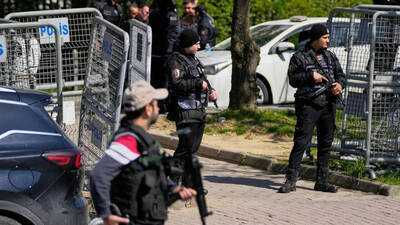
In anticipation of the NATO Summit scheduled for July 7-8, Turkey is implementing a comprehensive security operation in Ankara. This includes the deployment of tens of thousands of police officers, heightened air defense readiness, and extensive restrictions across the capital, which is home to nearly six million residents. Leaders from all 32 NATO member nations, including US President Donald Trump, are expected to attend. Trump's previous criticisms of NATO allies and threats to diminish US involvement have raised concerns regarding the alliance's future.
Access to roads will be limited, public gatherings prohibited, and significant locations will be under strict security as Turkey gears up to host one of the most politically sensitive NATO meetings in recent memory. The security measures extend beyond the presidential complex where the summit will occur, with restrictions planned around airports, hotels for foreign delegations, and major traffic routes in Ankara. A former military airfield has been repurposed into a VIP airport for NATO leaders, with runway expansions and facility upgrades completed ahead of the summit. Additionally, facades of homes along the airport route have been painted as part of a beautification initiative, contrasting sharply with the stringent security measures in place.
During the NATO Summit, demonstrations, concerts, and graduation ceremonies have been prohibited, and non-essential government employees have been granted leave to alleviate congestion. Turkish authorities have detained over 200 individuals suspected of connections to extremist groups, including the Islamic State. Reports indicate that activists, lawyers, and an academic were also caught in the broader crackdown. Given Ankara's history of terrorist incidents, such heightened security is not unprecedented; however, even seasoned observers note that the current measures are unprecedented in their intensity. Namik Tan, a former Turkish ambassador and opposition member, remarked that the security protocols in Ankara for this summit are the most stringent ever witnessed.
Moreover, a Turkish court has blocked access to websites critical of NATO and the summit, citing security and public order concerns. Several journalists from opposition media outlets have faced accreditation denials, drawing criticism from media rights organizations and adding to the ongoing debate about freedom of expression amidst the security preparations.
The backdrop of this extensive security operation is a politically charged meeting where NATO members are expected to discuss alliance unity, defense expenditures, and the evolving role of the United States. Trump has voiced concerns about allies not supporting US-led initiatives, particularly regarding Iran and the Strait of Hormuz, further complicating the alliance's dynamics. Fatih Ceylan, a former Turkish ambassador to NATO, emphasized that the summit's significance lies in whether the US and Europe can bridge their differences. While he does not anticipate miraculous outcomes, any convergence on NATO's importance would be a positive development.
Trump's participation has drawn scrutiny to Turkey's role as host, especially given his close ties with President Recep Tayyip Erdogan. Trump noted that he might not have attended if the summit were not hosted by Erdogan. Erdogan has positioned Turkey as a reliable ally on NATO's southeastern border and aims for the summit to be a pivotal moment in NATO's history. As a NATO member since 1952, Turkey boasts the second-largest army in the alliance, a rapidly growing defense sector, and a strategic location connecting Europe, the Middle East, the Black Sea, and the Caucasus, making it a crucial player in the alliance.