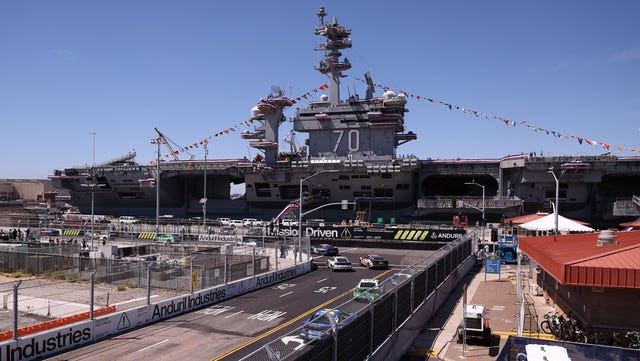
Two weeks ago, NASCAR conducted all three of its national-level series events on a specially designed street circuit built around a U.S. Navy base. The race held at Coronado faced certain challenges, but it also offered some of the most spectacular and distinctive views ever witnessed at a temporary racing venue. In a video released last week, NASCAR officials detailed the process of constructing and operating the racetrack within an active military installation.
The footage begins with construction already in progress, just 72 hours before the cars took to the track for the first time. Additional clips throughout the video show different stages of the circuit’s development, but the most insightful moments come from interviews with those who managed the complex construction project.
According to Tristen Lora, the director of operations for the race, the event demanded an enormous logistical effort, involving about 1,700 truckloads of equipment and materials to bring it to life. For perspective, Lora noted that the large-scale music festival Lollapalooza typically requires only around 200 trucks. Among the supplies brought in were 18.5 miles of temporary fencing—significantly more than the seven miles used for the earlier Chicago street circuit event.
A significant part of the challenge stemmed from coordinating construction and race activities around ongoing Navy operations in the same area. Two massive half-cylinder hangars located along the track’s perimeter—historically used to store seaplanes—are now used for helicopters. During the race weekend, these helicopters had to be temporarily relocated to another section of the base. The hangars themselves, which reverted to regular Navy use immediately after the race, were transformed into trackside hospitality venues for the event.
Having access to Navy resources also brought valuable assistance in building the course and its supporting infrastructure. Track president Amy Lupo mentioned that Amphibious Construction Battalion 1, the same team responsible for recovering the capsule used in NASA’s first manned Artemis mission earlier this year, played a direct role in helping to assemble the track facilities.
While NASCAR has not officially announced a return to San Diego, Lupo told the San Diego Union-Tribune that the organization is “really hopeful to be back [on the base] in 2027.” Should the event return, the experience and data gathered from this year’s race are expected to help address the issues drivers encountered on the temporary circuit.