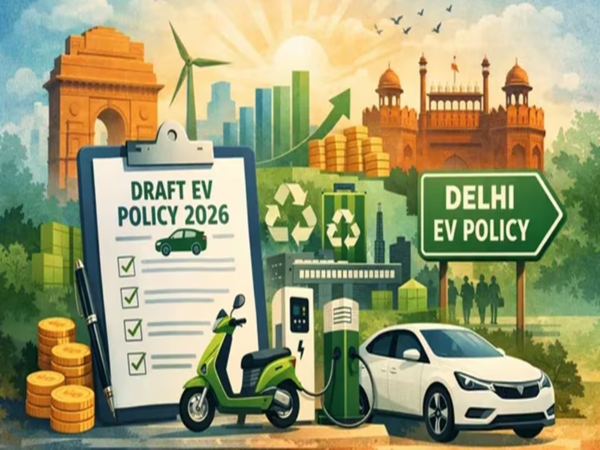
Delhi EV Policy: The Delhi government has implemented the Delhi EV Policy 2026, effective from July 1. This policy has come into force immediately and will remain valid until March 31, 2030.
The government's objective is to promote electric vehicles in Delhi. To achieve this, charging and battery-swapping networks will be expanded. Additionally, the entire EV ecosystem will be strengthened to reduce pollution and decrease reliance on petrol and diesel. The new policy offers various benefits, such as subsidies, scrappage incentives, and waivers on road tax and registration fees.
Benefits of Scrapping Old Vehicles
Under the new policy, anyone who scraps a BS-IV or older car to purchase an electric car will receive a scrappage incentive of up to ₹1 lakh.
Scrapping an old two-wheeler to buy a new electric two-wheeler entitles the buyer to an additional scrappage incentive of ₹10,000. Similarly, scrapping an old three-wheeler to purchase an electric three-wheeler offers an additional incentive of ₹25,000.
Rules for Two-Wheelers and Three-Wheelers
Under the new policy, buyers of electric two-wheelers will receive a subsidy of ₹30,000 in the first year, ₹20,000 in the second year, and ₹10,000 in the third year.
Buyers of electric three-wheelers or e-autos will receive an incentive of ₹50,000 in the first year, ₹40,000 in the second year, and ₹30,000 in the third year.
Rules for Electric Trucks and Cars
Buyers of N1 category electric trucks will receive a purchase incentive of up to ₹1 lakh. Furthermore, a 100% waiver on road tax and registration fees will apply to all electric cars with an ex-showroom price of up to ₹30 lakh. This exemption applies only to vehicles registered in Delhi.
How to Apply for the Subsidy? The Delhi government launched the Delhi EV Subsidy Portal on July 3. Applications for the subsidy must be submitted through this portal. Applicants will need to provide documents such as an Aadhaar card, Registration Certificate (RC), and Voter ID. Identity verification will then be completed using an OTP sent to the mobile number.
According to the government, the application must be submitted within 30 days of purchasing the vehicle and receiving the RC. If the application is approved, the subsidy amount will be transferred directly to the bank account via Direct Benefit Transfer (DBT) within 60 days. The application status can also be tracked online via the portal.
How will the new policy be implemented?
Delhi Chief Minister Rekha Gupta stated that the Transport Department would be responsible for implementing this policy. A dedicated EV Cell will be established for this purpose. This cell will oversee the entire policy, issue guidelines as needed, and coordinate between various departments. The government will also appoint a Project Management Consultant (PMC).
Who will receive the subsidy?
The government will also constitute a Model Approval Committee. This committee will determine which EV models are eligible for government subsidies and incentives. It will evaluate EV models based on technical standards and other regulations. Only approved models will be eligible to avail of the government subsidy.
What will change under the new policy?
Under the new policy, only e-autos will be registered in Delhi starting January 1, 2027. Meanwhile, the registration of new petrol and CNG two-wheelers will be gradually phased out starting April 1, 2028; thereafter, only electric two-wheelers will be registered.
Rules for subsidy beneficiaries
The government has introduced a three-year lock-in period under the new policy. If an EV is purchased using the government subsidy, it cannot be registered in another state for the first three years. The objective is to ensure that people do not simply avail of the subsidy and immediately resell the vehicle in other states.
Disclaimer: This content has been sourced and edited from Money Control. While we have made modifications for clarity and presentation, the original content belongs to its respective authors and website. We do not claim ownership of the content.