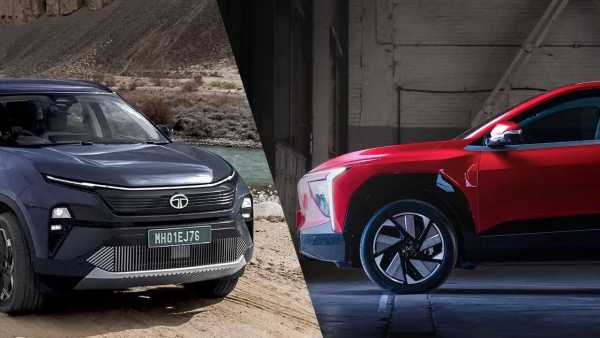
Mahindra & Mahindra and Tata Motors are adopting completely different strategies to strengthen their hold in India's growing electric vehicle (EV) market. Mahindra is betting on premium e-SUV and profits, while Tata is focusing on a strategy of multiple products and powertrains to achieve scale. The annual reports of these automakers for FY 2026 and the information released for investors show that both the companies have completely different views on how the Indian EV market will grow in the coming years. Mahindra expects the share of e-SUV in its total EV sales to be 18-20 percent in the next five years. At the same time, Tata's target is that by the end of the decade the share of EV in the total sales of its passenger vehicles should be around 30 percent.
This difference is clearly visible in their financial information also. Mahindra's e-SUV business earned revenue of Rs 15,089 crore from sales of 50,835 vehicles in FY 2026, of which the share of EV revenue was 34.8 percent. Also, the company's EBITDA margin was 9.1 percent and EBIT margin was 2 percent. The company also said that it has become India's number 1 e-SUV company in terms of revenue market share. Experts say that companies are adopting different strategies, but both want to benefit from more electrification.
In contrast, Tata Motors' electric passenger vehicle (PV) business earned revenue of Rs 13,410 crore in FY26, which is 63.8 percent more than the previous year. At the same time, the number of sales increased by 43 percent to 92,179 units, making it the largest passenger EV business in the country. Unlike Mahindra's way of reporting EVs separately, Tata only reports EV profits as a part of its larger PV operations.
Mahindra's strategy focuses on 'born-electric' e-SUV, premium positioning and platform-based capability. The company plans to introduce six BEVs or born-electric e-SUVs by financial year 2031. This means that its roadmap will include six new e-SUVs in addition to the FY 2026 launch base. The company hopes that higher priced products and platform economics will help it maintain profits as competition increases.
Tata is working on a comprehensive strategy to expand the EV market. At a media briefing ahead of the launch of the electric Sierra SUV in Mumbai last week, Tata Passenger Electric Mobility MD Shailesh Chandra said the company measures success on the basis of customer adoption. He emphasized that its revenue market share is growing faster than its volume share. He said that as the market becomes premium, Tata's portfolio strategy will also change with the change in the average price point of the market. This will result in revenue growth faster than volume growth as demand is shifting towards higher priced vehicles.
Experts are divided on which strategy will create more value for shareholders. An expert said that if electrification increases, Tata will benefit from its larger portfolio and higher volume capacity. Another expert said that Mahindra's EV line-up, which is based on the born-electric platform, will be able to face the competition better.