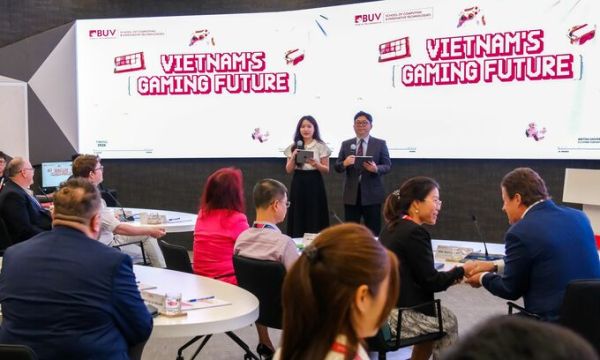
The forum, Vietnam’s Gaming Future: Industry, Education, and Innovation in Partnership, brought together representatives from the Ministry of Education and Training, the National Innovation Center (NIC), game studios, and technology companies to discuss workforce development and innovation.
|
A forum brought together policymakers, educators, and industry leaders to discuss solutions to Vietnam’s growing demand for game development talent. Photo courtesy of the university |
Participants said stronger partnerships between government, universities, and businesses are needed to narrow the gap between academic training and industry requirements, particularly after gaming was identified as one of Vietnam’s six priority cultural industries for 2025-2030.
Meeting demand for skilled professionals
Speaking at the forum, To Hong Nam, Deputy Director General of the Department of Science, Technology and Innovation under the Ministry of Education and Training, said developing skilled talent will be essential for Vietnam to produce games that can compete internationally.
With the industry expected to require around 30,000 additional professionals over the next two to three years, he said the government is continuing to improve the regulatory framework while encouraging public-private collaboration to support long-term workforce development.
 |
|
To Hong Nam, Deputy Director General of the Department of Science, Technology and Innovation under the Ministry of Education and Training, highlighted the importance of collaboration between government, universities, and businesses in advancing Vietnam’s gaming industry. Photo courtesy of the university |
“Building a sustainable gaming industry requires close collaboration between government, universities, and businesses,” Nam said. “The Ministry of Education and Training is committed to supporting these partnership models and encourages institutions and industry partners to develop programmes that respond to the sector’s evolving needs.”
Preparing graduates for industry needs
Speakers also said game education needs to evolve as Vietnam’s gaming industry shifts from outsourcing toward developing original intellectual property while incorporating artificial intelligence and more advanced production models.
Employers are increasingly seeking graduates with technical expertise as well as skills in creativity, product design, and project management.
At the forum, BUV introduced its Bachelor of Computer Science (Game Innovation) programme, which aims to combine technical, creative, and commercial skills for careers in game development.
|
Professor Rick Bennett introduces BUV’s Bachelor of Computer Science (Game Innovation) program. Photo courtesy of the university |
Professor Rick Bennett, Deputy Vice-Chancellor and Vice-President of BUV, said the programme was developed in consultation with industry.
“The programme was built around one simple question: What does the gaming industry need? Our ambition is to equip students with the capabilities employers will be looking for over the next five to 10 years,” he said.
The curriculum covers game design, programming, and game art, alongside AI, esports, studio management, and business models. Students will work with platforms such as Unity and Unreal Engine 5, participate in industry projects, and complete internships through the university’s corporate partner network.
|
A BUV’s program is introduced to combine technical expertise, creative development, and industry experience to prepare students for careers in game development. Photo courtesy of the university |
The programme comes as Vietnam’s gaming industry continues to expand. According to figures presented at Vietnam GameVerse 2026, the domestic gaming market generated an estimated US$1.66 billion in 2025 and recorded annual growth of 9.77%, above the global average. Industry representatives said sustaining that growth will require a larger pool of professionals capable of developing globally competitive games.
Nguyen Thi Le Quyen, Head of Enterprise Support at the National Innovation Center, said closer links between education and industry will help prepare graduates for the sector’s changing needs.
The forum concluded with participants agreeing that stronger cooperation among government, universities, and businesses will help develop talent, support the creation of Vietnamese-made games, and strengthen the country’s position in the global gaming industry.
Learn more about the Bachelor of Computer Science (Game Innovation) program here.