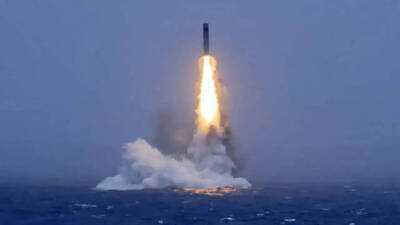
This week, China alarmed nations across the Pacific by conducting a test of a submarine-launched ballistic missile, prompting immediate backlash from New Zealand, Australia, and Japan, who labeled the test a threat to regional stability. As reported by a major news outlet, a submarine from China's People's Liberation Army Navy successfully launched a strategic missile with a dummy warhead into the Pacific Ocean on Monday. Senior Captain Wang Xuemeng, a navy spokesperson, confirmed that the missile landed precisely in the designated area. He characterized the launch as routine, stating it was part of China's annual military training schedule and that prior notifications were sent to other nations before the test occurred. Wang asserted, "The operation adhered to international law and did not target any specific nation or objective."
Missile Specifications
China's navy operates two types of submarine-launched ballistic missiles, the JL-2 and JL-3. Experts mentioned in the report indicated that the JL-3 possesses sufficient range to reach the continental United States, even when launched from waters near China's coastline, including the South China Sea. However, it remains unclear which missile was utilized in the recent test. The submarine responsible for these launches is the Type 094, also known as the Jin class, with China currently operating six of these submarines.
New Zealand's Strong Opposition
New Zealand's Minister of Foreign Affairs, Winston Peters, expressed the strongest objections, noting that the missile landed within the South Pacific Nuclear Free Zone, established by the 1986 Treaty of Rarotonga. China had signed two components of this treaty in 1987, which prohibit nuclear testing and threats within the zone. Peters stated, "Earlier today, China informed us of its plans to launch a long-range ballistic missile into the South Pacific. New Zealand views this as an unwelcome and concerning development. We, along with our Pacific neighbors, do not support China using the South Pacific as a missile testing ground."
Australia and Japan Respond
Australia's Foreign Minister, Penny Wong, echoed similar sentiments, describing the test as "destabilizing to the region" and linking it to a broader trend of Chinese military expansion that lacks the expected transparency. Japan also expressed serious concerns regarding China's increasingly active military operations, urging Beijing to reconsider any further ballistic missile tests. In response, China's foreign ministry spokesperson Mao Ning stated that the launch was conducted safely and professionally, urging other nations not to overreact to the situation. With three governments publicly voicing their objections, this missile test has intensified ongoing tensions regarding China's military presence in the Pacific.