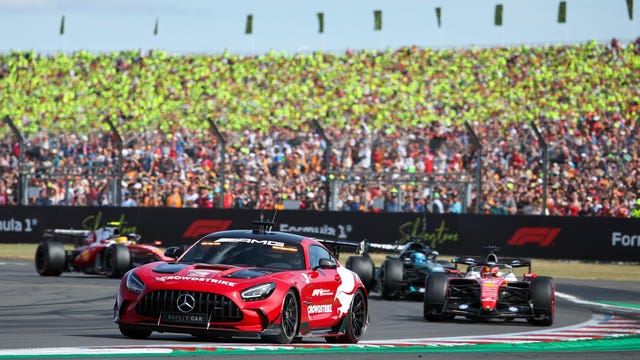
The British Grand Prix on Sunday concluded with a familiar controversy. A late incident involving Max Verstappen brought out the safety car with just four laps to go, forcing teams to decide whether to sacrifice track position for fresh tyres in anticipation of a possible one-lap shootout. Lewis Hamilton opted to pit, dropping to third—a move that appeared brilliant when television graphics suggested a restart might allow him to avenge the events of Abu Dhabi 2021. Instead, the race concluded behind the safety car, leaving Hamilton having lost second place to his championship rival George Russell without any gain.
Formula 1 later attributed the confusion in the broadcast to a software malfunction. Because the automated system mandates that one full lap must be completed after the unlapping process, the anticipated restart was never legally possible—contradicting the 2021 decisions made by then-race director Michael Masi. The result deprived Hamilton of an opportunity to reclaim second or even challenge for victory. Yet, the issue runs deeper than the outcome of a single race.
In Formula 1, unlike in many American racing series, the pit lane remains open when a safety car is deployed. This rule makes pitting under such conditions highly advantageous. The open pit lane alters which drivers can stop without losing position, giving those with a comfortable gap behind them the chance to change tyres with minimal risk and react strategically based on whether their rivals have already pitted.
Under normal race circumstances, this approach tends to make safety car timing fairer rather than less so. By keeping the pit lane open, drivers are less severely penalised if a crash happens between their own pit window and that of their competitors. However, this balance changes completely in the closing laps, when tyre changes become last-minute strategy gambles rather than part of a long-term race plan.
When a safety car appears near the end of a race, a driver running second with a significant cushion to third suddenly gains a strategic advantage over the leader. If the leader pits, the second-place driver can stay out and potentially inherit the win by chance—as George Russell did at Silverstone. If the leader stays out, the driver behind can pit for fresh tyres and be perfectly positioned for a final-lap sprint—much like Verstappen at Abu Dhabi. Essentially, the safety car creates two artificial opportunities to win that wouldn’t exist otherwise.
To address this, Formula 1 could simply close the pit lane during the final few laps when the safety car is deployed. Exceptions could be made only for emergency repairs. Drivers who have yet to fulfil the rule of using two tyre compounds could be allowed to pit once the field has formed behind the safety car, similar to the approach used in IndyCar or IMSA. The penalty for doing so would be significant, but Formula 1 is no stranger to high-stakes consequences from late-race safety cars—Kimi Antonelli’s five-second penalty in Sunday’s British Grand Prix became particularly costly under those conditions.
There is already precedent for modifying safety car regulations late in endurance and professional racing. IMSA, for instance, uses ‘fast yellows’ near the end of races to skip lengthy safety car pit procedures and return to green-flag racing more quickly. The FIA World Endurance Championship employs a complex three-group unlapping and merging system at Le Mans but suspends it in the final hour to preserve the flow of the race. Formula 1 could follow similar logic, making slight adjustments to its safety car operations to maintain the integrity and excitement of its show.
This change would immediately eliminate the element of chance that currently forces teams into risky tyre decisions. By keeping drivers on the same tyres they were using before the safety car, late-race restarts would be more authentic and better reflect the competition that was unfolding prior to the interruption. Not only would this enhance the sporting fairness of Formula 1, but it would also spare fans from yet another debate over the controversial and damaging events of Abu Dhabi 2021. By fixing the underlying issue that caused that debacle—instead of merely tweaking procedures—Formula 1 can ensure a fairer, purer version of the flat-out sprint racing that defines its essence.