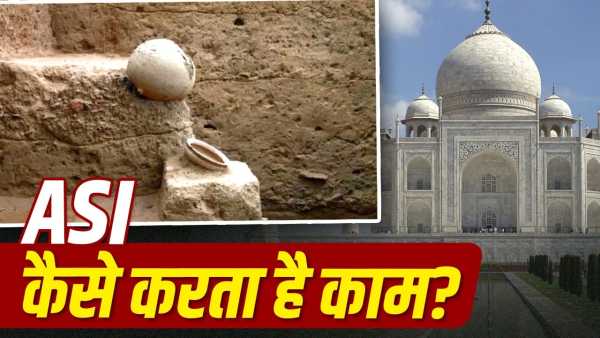
Taj Mahal has once again become a topic of discussion in the court. On Monday, June 06, Allahabad High Court heard the petition regarding the claim of 'Tejo Mahalaya' being a Shiva temple in Taj Mahal and conducting a survey. The court has directed the Central Government and the Archaeological Survey of India (ASI) to file their counter affidavit in this case. This petition was filed in the court on July 3 on behalf of 5 people including Agreshwar Mahadev Nagnatheshwar Virajman Tejo Mahalaya Temple, Senior Advocate Hari Shankar Jain.
A case was registered in 2015 regarding Taj Mahal. In this case, a demand has been made to declare that the temple of Agreshwar Mahadev Nagnatheshwar Virajman Tejo Mahalaya is present in the premises of Taj Mahal. An application was filed to conduct a survey and appoint an Advocate Commissioner for the early disposal of the case. But the district court had rejected it. This decision of the district court was challenged in the High Court.
In the instructions issued by the court, the Archaeological Survey of India (ASI) has been asked to file its counter affidavit. The work of this organization is to investigate the thousands of years old history buried in the soil of the country, to provide information about its reality and to take care of the historical buildings. Let us know how ASI reveals the reality of the temple-mosque being a structure thousands of years old.
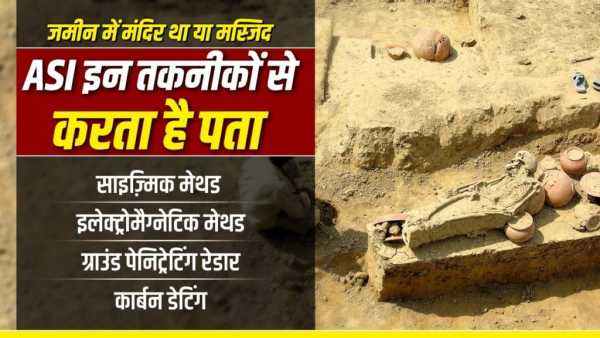
To find out the authenticity of a structure thousands of years ago, many scientific techniques are adopted. First of all he finds out whether there is something worth digging under the structure or not. If, on the basis of techniques, he gets solid information about the density, shape and material of the structure or the remains of the ground, then only he moves ahead for the further process.
By using the above mentioned techniques, complete confirmation is obtained about the structures built under the ground, only then the Archaeological Department of India conducts excavations to find out the authenticity of the structures. For this, the marked land is divided into small squares. Then digging is done slowly and cautiously. Then the department finds remains, walls, roads or the entire city under the ground. The use of any technology like seismic, electromagnetic, ground penetrating radar does not harm the structures built above or below the ground.
The technique of carbon dating is also used to estimate the age of ancient objects found from structures during excavation. However, this only reveals the reality and age of those materials in which life (carbon) once existed. In ancient buildings, organic materials were used to make lime mortar; when this mortar dries, it absorbs carbon dioxide from the air. Apart from this, an attempt can be made to find out the age of the structure by examining the wood, bones, coal, stone or metal found during excavation.
At the time of excavation, information about its time period can be obtained with the help of scripts written on rocks or walls. From this we can find out how old this script is and to which reign it belongs. The structure buried under the ground may also be from the same period. Apart from this, the coins found in the excavation also give possible information about its time period.