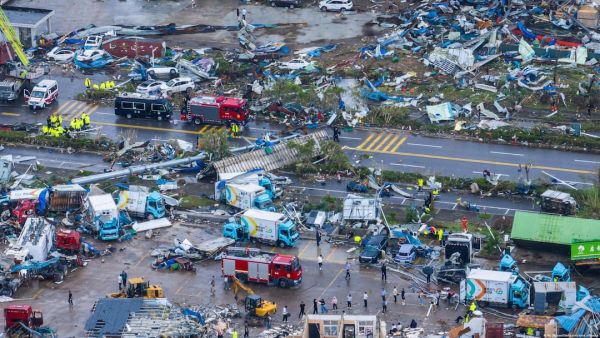
The death toll in China climbed to at least 11 on Tuesday after multiple extreme weather events battered the country, triggering evacuations and major rescue operations.
Chinese President Xi Jinping urged officials to "go all out" to rescue those affected by the storms.
He also called for resources to be mobilized for "treating the injured, resettling affected residents, and carrying out disaster prevention and relief work effectively," state media channel CCTV reported.
At least 11 people have died and over 330 were injured in the central Hubei province, state news agency Xinhua reported, where "severe convective weather" hit cities. One person remains missing.
Some parts of the province also saw tornadoes which are a rare occurrence in Hubei. The last time such a phenomenon was seen there was May 2021.
"Thunderstorms and strong winds hit Huangshi, Huanggang, Ezhou, and Xianning, with two townships seeing gales reaching level 13," Xinhua reported.
The level 13 gales on the 0-17 extended Beaufort wind force scale resulted in overturned cars and ripped roofs from buildings.
The storms also tore down 22 residential buildings and damaged another 4,855 in the area.
Meanwhile, China's southern Guangxi and Guangdong provinces upgraded their flood alerts to the highest level on Tuesday morning.
The region is already reeling from torrential rain brought by Typhoon Maysak, which hit Nanning on Saturday and again on Monday.
In a press conference on Monday, Guangxi authorities reported at least two deaths. About 55,000 were affected after the heavy rainfall led to breached water reservoirs in the provincial capital, Nanning. Some 48,000 people have been evacuated from the province, they said according to Xinhua.
In the northwestern Gansu Province, a landslide on Tuesday morning buried 33 people. As per Xinhua, 17 people have been rescued while another 16 remain trapped.
Authorities did not specify what triggered the landslide.
China's National Meteorological Center warned that the central and southern provinces should prepare for more torrential rainfall on Tuesday.
At the same time, China is bracing for another storm, Super Typhoon Bavi, which is tracking across the Pacific towards Taiwan and forecast to make landfall along China's eastern coast later this week.
The storm swept across US Pacific Islands of Guam, Tinian, Saipan and Rota on Monday, causing widespread destruction but no loss of life.
Disclaimer: This report first appeared on Deutsche Welle, and has been republished on ABP Live as part of a special arrangement. Apart from the headline, no changes have been made in the report by ABP Live.