When Prime Minister Narendra Modi landed in Jakarta for his state visit this week, the spotlight naturally fell on defence agreements, maritime cooperation, trade and regional security. Yet, beyond the official ceremonies and strategic announcements, another conversation resurfaced on social media and among history enthusiasts—the remarkable story of Lord Ganesha once featuring on an Indonesian banknote.
For many Indians, it remains one of the most fascinating examples of how history often outlives politics.
Indonesia, home to nearly 280 million people and the world’s largest Muslim population, has long embraced a cultural identity shaped by centuries of Hindu-Buddhist influence. Its monuments, literature, language, national symbols and performing arts continue to reflect a civilisational dialogue with India that began over two thousand years ago.
Prime Minister Modi’s visit comes at a time when both nations are strengthening their Comprehensive Strategic Partnership, proving that while diplomacy is driven by present-day interests, it is often sustained by shared history.
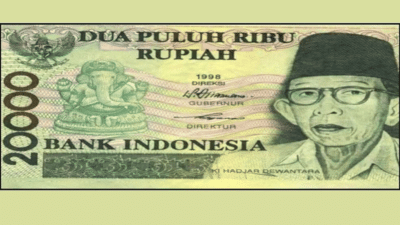
The story behind Lord Ganesha on Indonesia’s currencyAmong Indonesia’s most memorable banknotes was the 20,000 rupiah note issued in 1998.
The front carried the portrait of Ki Hadjar Dewantara, Indonesia’s National Education Hero and founder of the Taman Siswa educational movement. On the reverse appeared an image of Lord Ganesha, accompanied by a classroom scene.
The choice was deliberate.
In Indonesian culture, Ganesha is regarded as a universal symbol of wisdom, intellect and education. His appearance on the currency note was intended to represent the nation’s commitment to learning rather than any particular religion.
Although the banknote was later withdrawn as part of Indonesia’s routine currency redesign, it continues to attract global attention as a powerful symbol of the country’s multicultural identity.
Muslim-majority nation that celebrates an ancient heritageIndonesia is often described through the prism of its religious demography. Nearly 87 per cent of its population follows Islam, making it the largest Muslim-majority country in the world.
Yet the country’s cultural identity tells a much older story.
Long before Islam arrived in the Indonesian archipelago, powerful Hindu and Buddhist kingdoms such as Srivijaya, Mataram and Majapahit flourished across the region. These kingdoms transformed trade, governance, literature and architecture, leaving behind a legacy that remains deeply embedded in Indonesian society.
Today, the influence is visible everywhere—from the magnificent Prambanan Temple, the largest Hindu temple complex in Indonesia, to the island of Bali, where Hindu traditions continue to thrive.
Even Indonesia’s national emblem, Garuda Pancasila, derives its name and inspiration from Garuda, the mythical bird and divine mount of Lord Vishnu in Hindu mythology.
Modi’s visit adds a new chapter to an ancient relationshipPrime Minister Narendra Modi’s visit to Indonesia has reaffirmed that this centuries-old cultural connection is now matched by an ambitious strategic partnership.
During bilateral talks with Indonesian President Prabowo Subianto, the two leaders reviewed cooperation across defence, maritime security, cybersecurity, digital public infrastructure, artificial intelligence, healthcare, education, critical minerals, trade and investment.
A key highlight of the visit was the strengthening of defence ties, including Indonesia’s decision to acquire India’s BrahMos supersonic cruise missile system, signalling growing confidence in India’s indigenous defence capabilities.
In another historic moment, Prime Minister Modi became the first Indian Prime Minister to address the Indonesian Parliament. Speaking before lawmakers, he highlighted the shared civilisational heritage of the two countries, called for reforms in global governance institutions, advocated for a free, open and inclusive Indo-Pacific, and reiterated India’s commitment to peace, development and cooperation.
Addressing members of the Indian diaspora in Jakarta, Modi described India and Indonesia as “civilisational partners” whose relationship is rooted not merely in diplomacy but in centuries of people-to-people connections.
In an era where international relations are often defined by strategic calculations, the India-Indonesia story serves as a reminder that the strongest partnerships are sometimes built not only on shared interests, but also on a shared civilisation. And perhaps that is why, decades after it disappeared from circulation, the image of Lord Ganesha on an Indonesian banknote continues to resonate.