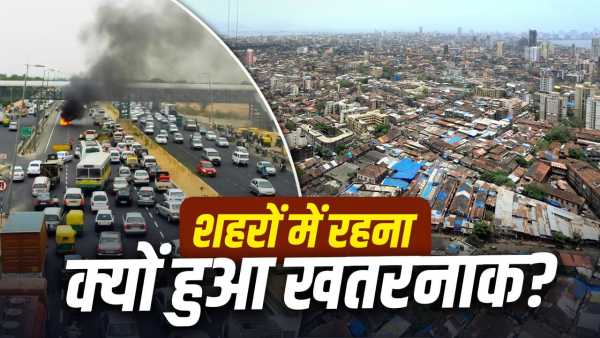
The death of 15 students in a massive fire that broke out in a coaching center building in Lucknow on June 22 raised serious questions on the security arrangements of Indian cities. This accident showed that violation of building rules and post-accident wake-up systems remain a big problem even today. On the other hand, the government is citing rapid development and urbanization of cities as the path to the country's progress, but the ground picture tells a different story. The 2024 report of the National Crime Records Bureau (NCRB) shows that 69,378 people died accidentally in 53 big cities of the country within a year. Among these, most of the lives were lost in road accidents, fires, railway accidents and suicides. Let us understand in simple language why this crisis is increasing in the cities of India and what reasons the report gives behind it.
According to NCRB's “Accidental Deaths and Suicides in India 2024” report, 53 cities of the country, whose population is 10 lakh or more, recorded accidental deaths of 69,378 people in the year 2024. According to the report, the rate of accidental deaths per 1 lakh population in these cities was 43.2, while the average of the entire country is 33.3 per lakh. That means the risk of death from accidents in big cities is much higher than the national average. The report says that the rapid urban development is not sufficient in terms of security.
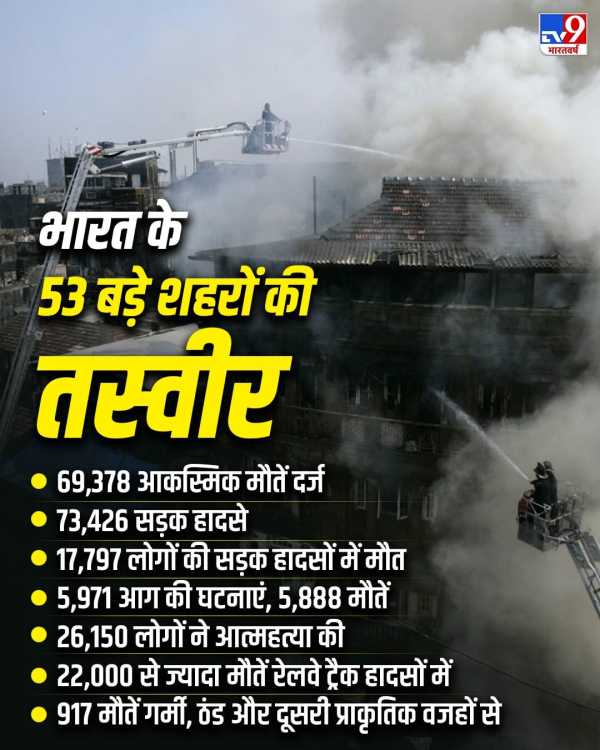
According to the report, 73,426 road accidents were recorded in 53 big cities. Of these, 63,519 people were injured and 17,797 people died. About 40.3 percent of the total road accidents occurred in urban areas and about one-third of these accidents occurred near residential areas. The highest number of road accident deaths were recorded in Delhi, followed by Jaipur and Bengaluru. According to the report, 52.8 percent of the accidents were due to speeding, 30.1 percent were due to careless driving and only 2.6 percent of the accidents were found to be related to drunk driving.
The report shows that in 2024, 5,888 people died in 5,971 fire incidents across the country. More than 60 percent of these deaths occurred due to fires in houses and residential buildings. According to the report, illegal construction, poor maintenance, lack of fire safety and closure of emergency roads are the major reasons for such incidents. There were more than 25 thousand accidents on railway tracks and railway premises, in which more than 22 thousand people lost their lives. Most of these people died due to falling from the train or being hit by the train while crossing the tracks.
According to NCRB report. The suicide rate in cities in 2024 was 16.3 per lakh population, while the national average is 12.2 per lakh. Of the 1,70,746 suicides recorded across the country, 26,150 cases were reported from 53 big cities. Nearly one-third of total urban suicides were recorded in Delhi, Bengaluru, Chennai and Mumbai. According to the report, most of the suicides were committed by daily wage workers. After this, self-employed, employed people, unemployed and students were included. The report also links it to economic and social pressure.
Under the “Forces of Nature” category, the report recorded 917 deaths in 2024 due to events like heat stroke, cold, floods and lightning. The report also shows that many deaths due to heat stroke are not recorded and deaths due to pollution are also not included in this. According to the report, climate-related risks are not only the result of natural causes, but city planning, housing, public facilities and social inequality also have a major impact on these events.
According to the report, urban development in India cannot be limited only to new buildings, wide roads and faster traffic. Researchers believe that cities need to pay more attention to safe roads, strong fire safety, better public transport, facilities for pedestrians, affordable and safe housing, climate-friendly planning and mental health services. The report also says that if people's safety is not given priority in city planning, then such accidents will continue to increase despite development.