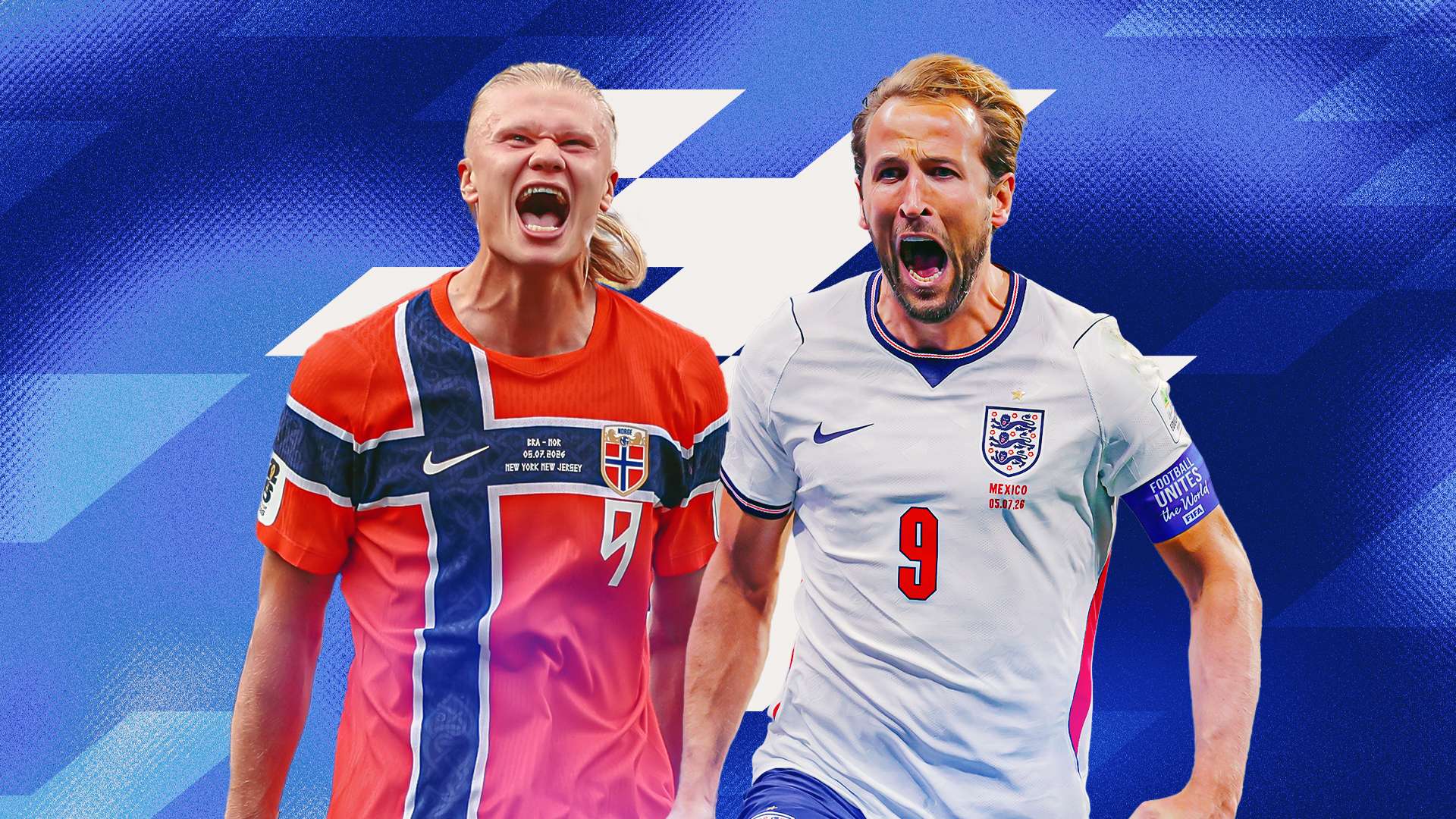
England’s upcoming World Cup quarter-final clash against Norway on Saturday evening promises to be a captivating encounter. The fixture is loaded with storylines: England boast star power across several positions, while Norway rely on a more unified system built around a single talisman. England have triumphed at the Azteca. Norway famously eliminated Brazil. England have lifted the World Cup; Norway are still chasing that dream.
Yet, perhaps the most intriguing aspect of the matchup lies in the showdown between the two leading men in attack. Few would contest that Erling Haaland and Harry Kane are the two finest No.9s in modern football (and for clarity, Kylian Mbappe doesn’t quite fit that category). At present, their supremacy is almost unquestioned.
Despite sharing a position, their interpretations of the role could hardly be more distinct. Haaland thrives on minimal touches, converting nearly every opportunity into a goal. He is a ruthless finisher within the penalty box. Kane, on the other hand, is a deeper-lying striker — a creative distributor who could easily function as a No.10.
Their personalities differ just as much. Kane exudes composure and professionalism, while Haaland brings raw energy and youthful exuberance — he’s nearly a decade younger and perhaps more of a showman. But who truly edges the other? Making such comparisons is never straightforward, yet GOAL attempts to evaluate them category by category...
Finishing: Harry Kane
This is arguably the most difficult category to judge. Kane and Haaland are distinct types of forwards. Kane’s game extends beyond the traditional striker’s remit, while Haaland is the archetypal penalty-box predator. By that logic, Haaland should hold the advantage, excelling at converting chances close to goal — and he does so at an elite level.
However, Kane’s finishing range is broader. There is no specific ‘Kane goal’ — which speaks volumes about his versatility. He’s equally comfortable shooting with either foot, strong in aerial duels, and capable of scoring from distance. Haaland may possess sharper instincts, but in terms of variety and technique, Kane takes the honours here.
Heading: Erling Haaland
Haaland’s first goal for Norway against Brazil felt almost inevitable. As play developed down the left flank, Haaland loitered near the penalty spot, seemingly disengaged. When Andreas Schjelderup delivered the cross, Haaland exploded into action, outjumping Gabriel — one of football’s best aerial defenders — to head home clinically. Norway led 1-0, mission accomplished.
This sequence encapsulates Haaland’s aerial brilliance. Standing six feet five inches tall, blessed with athleticism and impeccable timing, he dominates in the air. Since joining Manchester City, no player in England has scored more headed goals. Kane remains strong aerially, but Haaland’s record is exceptional.
Speed: Erling Haaland
Footballers rarely hit their absolute top speeds in matches, as the sport relies more on short bursts than sustained sprints. Kane’s lack of pace is often cited as his main drawback (though he’s far from sluggish). Haaland, however, operates on another level entirely.
In 2025, Haaland recorded the highest sprinting speed in the UEFA Champions League — an astonishing 22.9 miles per hour — faster than both Achraf Hakimi and Kylian Mbappe. His acceleration and power make him terrifying in transition.
Movement: Erling Haaland
For someone of his size, Haaland’s ability to vanish from defenders’ sightlines is remarkable. His genius lies in his subtle drifting — conserving energy until the perfect moment to pounce. When he does make his run, defenders are often left helpless.
This might seem unfair to Kane, who thrives on involvement and often drops deep to orchestrate play. Haaland, meanwhile, is lethal without needing constant possession. Averaging a goal every 13 touches tells its own story — a masterclass in movement without the ball.
All-round game: Harry Kane
Roy Keane once provocatively labelled Erling Haaland a “League Two player” during a Sky Sports debate following a subdued Manchester City performance. While the comment was clearly exaggerated, it sparked discussion. Haaland’s technical ability is often underestimated; he’s capable with the ball but doesn’t depend on it.
Kane, conversely, is the quintessential modern forward — a playmaking striker who could easily slot in as an attacking midfielder. The tactical dream scenario might see him operating behind a more mobile frontman. Until then, he remains a No.9 who frequently drops deep. It can be frustrating to see him defending his own box, as he did late in England’s 3-2 win over Croatia, but his versatility allows him to contribute anywhere on the pitch.
Leadership: Harry Kane
This category is straightforward. Kane has captained England nearly 100 times and previously served as vice-captain at Tottenham Hotspur under Hugo Lloris. He has often credited Wayne Rooney and David Beckham as inspirations. Recently, an Oxfordshire MP even proposed awarding him a knighthood.
Kane has embraced the modern trend of motivational team huddles, and his leadership clearly resonates with teammates. He’s diligent in media duties and presents himself as a model professional — the embodiment of a captain. Haaland, while charismatic, has never truly held that same leadership mantle. Although Pep Guardiola includes him in Manchester City’s “leadership group,” he has yet to display Kane’s commanding presence. There’s still time for that evolution, though.