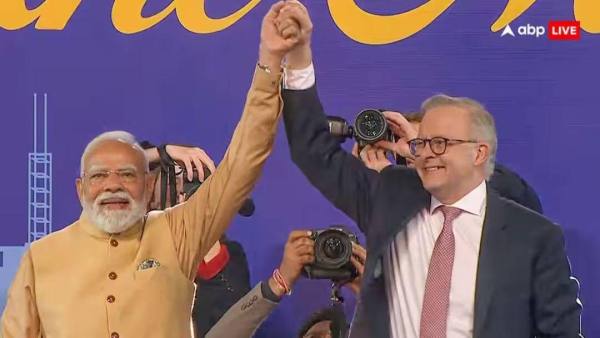
Prime Minister Narendra Modi received a warm welcome after arriving in Australia from Indonesia, where he signed a significant agreement with Australia on uranium supplies. The pact is being viewed as a major boost to India's clean energy ambitions.
The agreement is expected to support India's growing electricity requirements as it expands its nuclear power capacity to meet rising energy demand.
India and Australia issued a joint statement confirming that uranium supplied under the agreement will be exported only for long-term peaceful purposes and in accordance with the safety standards laid down by the International Atomic Energy Agency (IAEA).
Australia holds 28 per cent of the world's known uranium reserves. While it neither uses nuclear power nor manufactures nuclear weapons, it exports its uranium.
India, home to a population of 1.4 billion, has set a target of installing 100 gigawatts of nuclear power capacity by 2047, enough to supply electricity to around 60 million homes.
Although India has doubled its nuclear power capacity over the past decade, nuclear energy currently contributes only 3 per cent of the country's total electricity generation, largely because of uranium shortages.
The two countries also agreed to jointly establish a temporary space tracking terminal on Australia's Cocos (Keeling) Islands in the Indian Ocean.
The facility will support India's spaceflight projects.
India conducted its first nuclear test in 1974. Following its 1998 nuclear tests, the country faced international technology restrictions and a ban on uranium trade.
The situation changed in 2008 when the Nuclear Suppliers Group granted India a waiver, allowing it to purchase uranium from member countries.
Australia is a signatory to the Nuclear Non-Proliferation Treaty (NPT), which recognises only the United States, China, the United Kingdom, France and Russia as nuclear weapon states.
The treaty prohibits uranium sales to nuclear-capable countries that have not signed the NPT, including India. India has consistently described the treaty as discriminatory because it grants nuclear weapon status only to countries that tested nuclear devices before 1967.
Speaking to the media, Australian Prime Minister Anthony Albanese said, "This arrangement facilitates the export of Australian uranium to India, so that non-fossil fuel power capacity can be developed."
After holding talks with Albanese, Prime Minister Narendra Modi said, "We have signed a significant agreement on nuclear energy today. This will pave the way for Australia's uranium supply to India. This will accelerate our clean energy goals."