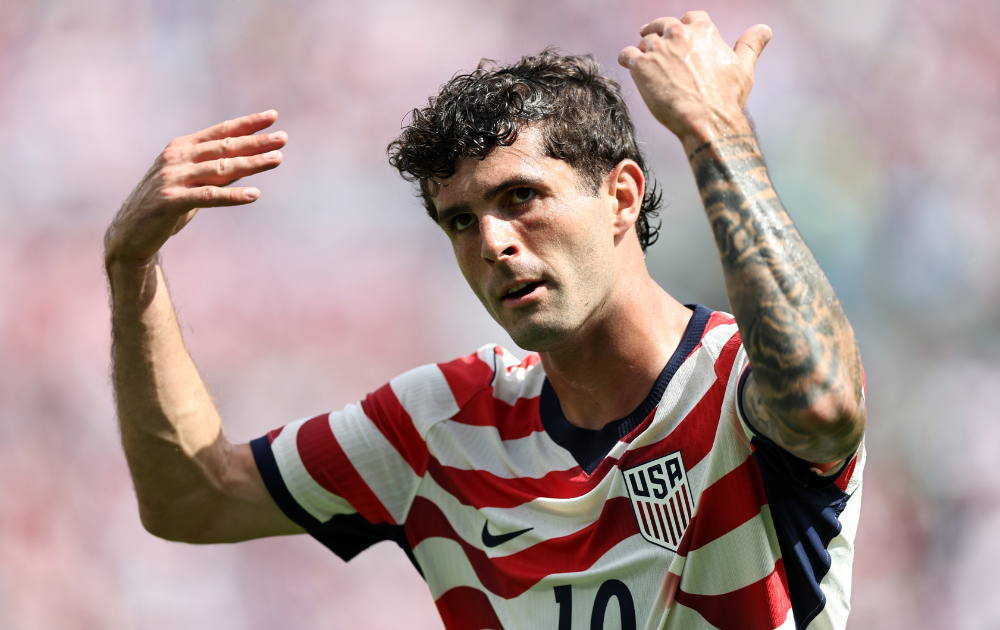
The American forward remains a gifted footballer, but one whose strengths lie in elevating his team rather than single-handedly carrying it.
Christian Pulisic has been the face of American football for nearly ten years. He has delivered memorable performances, scored numerous goals, and played for some of Europe’s most prestigious clubs. Clearly, Pulisic stands among the finest players the United States has ever produced. Yet, it is time to reassess exactly what kind of player he truly is — and what he is not.
If the United States men’s national team’s disappointing 2026 World Cup run proved anything, it’s that Pulisic is not the type of player who can consistently dictate matches. He remains a skilful attacker capable of flashes of brilliance, but he is not that dominant, game-defining figure who can repeatedly lift his side to new levels.
The Americans had long envisioned Pulisic evolving into that sort of talismanic leader, but the 27-year-old’s performances this summer — during what should be the prime of his career — made it clear he isn’t built for that role. Not only did Pulisic suffer yet another pair of minor injuries, but he also failed to score in four appearances, exiting in the Round of 16 in a heavy defeat to Belgium due to an ankle issue.
The AC Milan winger did provide an assist in the USMNT’s thrilling 4-1 opening win over Paraguay, but that proved the high point of his tournament. Overall, Pulisic’s performances highlighted that he is more of a supporting star than a central superhero — more Robin than Batman.
This conclusion doesn’t arise solely from this expanded World Cup. Across two editions of the tournament, Pulisic has managed just one goal in eight matches — a modest return for a player long billed as the one to deliver defining moments on football’s grandest stage.
His post-match interview last Monday with broadcaster Fox Sports underscored the same theme — Pulisic doesn’t project the fierce, commanding presence many Americans once expected when he first broke into the senior national team in 2016.
“It is just frustrating to end like that, of course, but now I get time to rest,” Pulisic said of his ankle injury. “Hopefully it will be okay.”
While his response was understandable on a personal level, it made him sound like a player focused on overcoming yet another physical obstacle rather than someone burning with frustration at missing a chance to make USMNT history during a once-in-a-lifetime World Cup on home soil.
That might seem harsh, but combined with his decision to skip last summer’s Concacaf Gold Cup, it reinforced the impression that he is not the kind of player who naturally leads a team — whether through personality or sheer performance.
The truth is, Pulisic has rarely looked fully comfortable being the team’s talisman. It often feels as though the responsibility was thrust upon him rather than something he actively embraced — a reflection as much on the state of the USMNT over the past decade as on Pulisic himself.
His international legacy may be shaped partly by that perception, but many top players have flourished in complementary roles. Consider Angel Di Maria or Antoine Griezmann — both world-class talents who have produced magnificent moments for their countries without ever being the singular focal point.
Di Maria perhaps serves as the best comparison. Argentina never needed him to be Lionel Messi; they needed him to complement Messi — to exploit the spaces and punish defences that concentrated too heavily on stopping the main man.
That’s not to suggest that Pulisic is at Di Maria’s level — particularly after an underwhelming Serie A campaign — or that the USMNT has a Messi-calibre player to centre its play around. Rather, it highlights that Pulisic might be best utilised in a supporting capacity, one that leverages his strengths without burdening him with unrealistic expectations.
For years, American fans have hoped Pulisic would become a transformational figure like Messi for Argentina, Kylian Mbappe for France, or Erling Haaland for Norway.
However, evidence from both club and international play indicates that this may have been a misguided expectation. Pulisic seems more effective when he’s one of several key contributors rather than the singular driving force.
Time, however, is not on his side. Pulisic will be 31 by the next World Cup — still young enough to make an impact, but likely past his physical peak.
Monaco striker Folarin Balogun, aged 25, could share the attacking load after netting three goals in this summer’s tournament. Another potential contributor is 22-year-old Real Salt Lake forward Diego Luna, who narrowly missed out on the final squad this year.
Whoever steps up, the USMNT will need more than just Pulisic to advance beyond the Round of 16 — and to help him finally deliver the sort of standout World Cup performance that has thus far eluded him.
Only then might Pulisic be evaluated for the player he truly is, rather than the one so many hoped he would become.