No Cap With Megha Prasad | Trump vs Iran Or His Own Image? How One Flight Sparked A Bigger Political Debate
Megha Prasad July 10, 2026 02:41 AM
The central question surrounding Donald Trump's latest confrontation with Iran is no longer limited to missiles, sanctions or military strategy. It is increasingly becoming a question of political image.
Trump has built his political brand on projecting strength—through aggressive rhetoric, hardline policies and an unapologetic style of leadership. But amid renewed tensions with Tehran this week, the optics surrounding his response have prompted a different debate: Is Trump battling Iran, or struggling to preserve the strongman image that has defined his presidency?
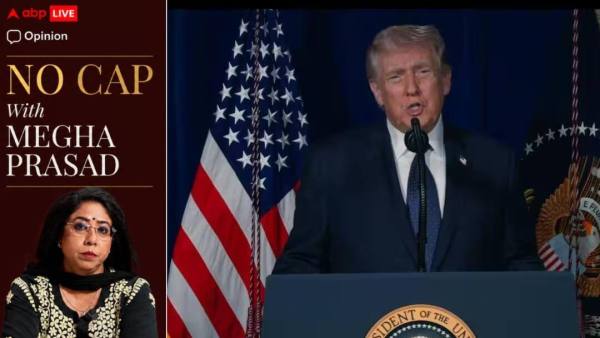
The shift began with Trump's remarks after declaring that any understanding with Iran was effectively over. Calling Iran's leaders "vicious, violent people," he escalated the rhetoric further by describing them as "scum"—a remark that quickly dominated headlines.
The language was unmistakably Trump: blunt, confrontational and designed to project resolve.
Window Blinds And Presidential Security Spark New Questions
However, another development soon overshadowed the tough talk.
While returning from the NATO summit in Türkiye, reporters travelling aboard the presidential aircraft were reportedly instructed to keep the window blinds closed. When asked about the precaution, Trump suggested it was likely because of the "sleazebags over here"—an apparent reference to Iran. He also remarked, "I have a threat all the time. I'm number one on their list."
That statement immediately created a striking contrast.
The same president who insists America can overwhelm Iran militarily was also publicly acknowledging that he remains Tehran's primary target. The juxtaposition has fuelled questions over whether Trump's messaging of absolute strength is now colliding with the realities of heightened security concerns.
Security Reality Vs Political Optics
To be clear, threats against a US president are neither unusual nor trivial. Iran has maintained hostile relations with Washington for decades, and following recent US strikes on Iranian targets, enhanced security precautions would be expected.
Yet politics is rarely driven by security measures alone. It is also shaped by perception.
Trump has spent years cultivating the image of a fearless leader who refuses to be intimidated. His supporters view that as decisive leadership, while critics argue it often blurs the line between strategy and spectacle.
This week's developments complicated that narrative.
The debate shifted away from military strikes and toward aircraft security, closed window blinds and presidential vulnerability.
The Air Force One Debate Added To Optics
The discussion intensified further because of the aircraft involved.
Trump had recently showcased a newly retrofitted Boeing 747 gifted by Qatar—a high-profile addition that symbolised prestige and power. However, reports indicated that part of his return journey was completed aboard the older Air Force One.
The White House denied that the switch had anything to do with Iran, while Trump dismissed speculation, saying it was simply "for old time's sake."
Even so, reports noted that the newer aircraft did not appear to feature the same visible missile-defence systems associated with the traditional presidential aircraft. Although there has been no official suggestion that this influenced operational decisions, the timing inevitably invited scrutiny.
In politics, perception often travels faster than official explanations.
Trump intended the aircraft to reinforce an image of American prestige. Instead, the conversation quickly shifted to presidential security.
Iran's Narrative Battle May Be Working
That may explain why this episode has generated so much attention.
Iran is not matching the United States militarily. But modern geopolitical conflicts are fought on multiple fronts, including the battle for narrative. Every statement, military response, funeral procession and carefully managed image contributes to shaping public perception.
Trump understands political theatre better than most leaders. Throughout his career, he has sought to dominate the news cycle through dramatic messaging and bold declarations.
This time, however, the narrative has been less predictable.
Rather than focusing solely on American military action, public attention has increasingly centred on Trump's own security precautions and whether they contradict his carefully crafted image of invulnerability.
Can Trump's Rhetoric Leave Room For Diplomacy?
There is also a diplomatic dimension.
Trump's repeated use of inflammatory language may energise his political base, but it also narrows the room for negotiations. Calling another country's leadership "scum" makes any future diplomatic engagement more difficult to justify politically.
Yet, despite declaring that the understanding with Iran was effectively over, Trump also appeared to leave the possibility of talks open—an approach that has become characteristic of his negotiating style: escalate publicly, maximise pressure and then signal that dialogue remains possible.
Whether that represents strategic ambiguity or political improvisation remains open to interpretation.
The Bigger Political Question For Trump
Ultimately, the larger question is not whether Donald Trump fears Iran.
It is whether the president is now confronting a challenge to the political image that has long defined him.
For Trump, image has never been secondary to policy. It has been central to his political appeal.
This week, the headlines were not only about military strikes or regional tensions. They were also about aircraft, security precautions and public perception.
Iran has not altered the military balance of power.
But it has succeeded in shifting part of the conversation—from America's military dominance to the optics surrounding the man who has built his political identity on projecting unquestioned strength.