Insurance claim rejections can often feel like the final blow that places an even greater financial burden on patients and healthcare providers. A team of university students is hoping to change that with an artificial intelligence-powered platform that predicts claim rejections before they are submitted.
Saeed Galadari, CEO of ClaimGuard AI, told Khaleej Times that he came up with the idea while taking part in Founders of Tomorrow, an initiative by Dubai SME in partnership with INJAZ UAE that helps university students transform innovative ideas into viable businesses.
The entrepreneur's team was one of the winners of Founders of Tomorrow, an initiative targeting university students who want to venture into the business world. The scheme equips participants with mentorship, guidance from government and private sector partners, and access to funding opportunities to help commercialise their ideas.
Stay up to date with the latest news. Follow KT on WhatsApp Channels.
“We realized that claim rejection is not just an administrative issue, it impacts hospital revenue, operational efficiency, and ultimately patient care,” Galadari said, which inspired him and his team members to create a proactive solution to prevent claim rejections before they happen.
Improving the insurance ecosystemClaimGuard AI analyses insurance claims before they are submitted, identifying potential errors or issues that could lead to rejection, the Emirati entrepreneur explained. This allows healthcare providers to correct claims in advance, reducing delays and improving reimbursement rates.
According to insurance broker eSanad, the most common pitfalls of claim rejections have to do with undisclosed pre-existing conditions, lack of prior authorization, and a mismatch in digital e-claim code as well as the ICD-11 international coding standards.
“By reducing claim rejections, improving financial sustainability, and providing AI-driven insights, ClaimGuard AI can help healthcare institutions enhance operational efficiency while supporting the UAE’s vision for digital transformation and artificial intelligence in healthcare,” he said.
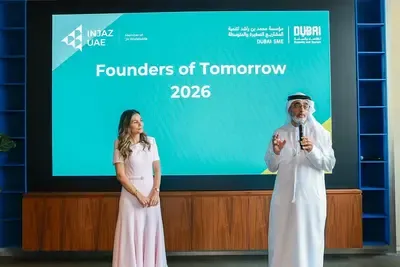
Equipping students with real-world knowledgeAbdelaziz Almaazmi, the Director of Business Incubation Department at Dubai SME, said that Founders of Tomorrow was created to bridge the gap between academic learning and real-world business challenges by connecting students with government entities and private sector partners.
"The purpose of the program is to support students among universities to transform their ideas into a business idea," he told Khaleej Times. "We work closely with the students to commercialize their ideas."
Abdelaziz Almaazmi, Director of Business Incubation Department at Dubai SME, speaking on the programme for university students
More than 20 students across nine projects participated in the latest edition of the programme, with teams developing technology-driven solutions to challenges presented by organisations including Dubai Police, Emirates Flight Catering, Dubai Air Navigation Services and American Hospital Dubai.
More than 20 students across nine projects participated in the latest edition of the programme, with teams developing technology-driven solutions to challenges presented by organisations including Dubai Police, Emirates Flight Catering, Dubai Maritime Authority and American Hospital Dubai.
Students receive mentorship from the participating organisations over a three-month period to refine their ideas and explore how they can be implemented. Dubai SME also provides continued support after the competition, including incubation services and potential funding on a case-by-case basis.
"This is not the end of the program. We will work with these students to commercialize their ideas," Almaazmi said.
The initiative is open to students from universities across the UAE, provided their projects are implemented in Dubai.
UAE’s AI startup to deliver Friday sermons in over 30 languages 'Google Maps' for buildings, AI tutor: Abu Dhabi students win awards for tech startups UAE students build AI tools to predict heart attacks, prevent amputations