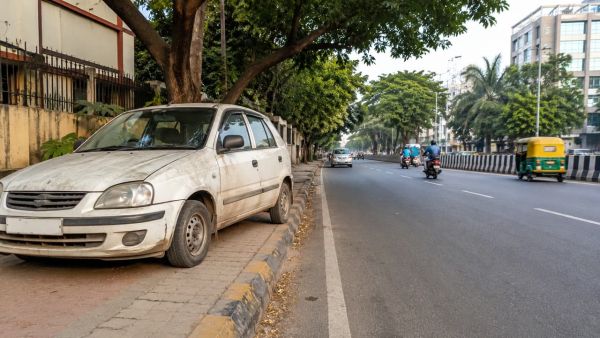
Every time a pedestrian is killed or injured after being forced to walk on the road, the same question arises: Could the tragedy have been avoided if the footpath had been free of encroachments? With illegal encroachments forcing people onto busy roads, pedestrian safety has become a growing concern in Bengaluru and several other Indian cities. Acting on Supreme Court directions and mounting public complaints, the Bruhat Bengaluru Mahanagara Palike (BBMP) has intensified its drive to clear encroachments from footpaths. While the move has drawn both support and criticism, it has also reignited a broader debate on the purpose of footpaths, the legal rights of pedestrians and the consequences of allowing public walkways to be obstructed.

The concept of footpaths dates back to the 17th and 18th centuries in Europe. As horse-drawn carriages became more common in cities such as London and Paris, pedestrians increasingly faced safety risks while sharing the same roads.
To address this problem, cities began constructing raised pathways alongside roads exclusively for pedestrians. Rome was among the earliest cities to introduce elevated stone walkways. During the 19th century, rapid urbanisation brought about by the Industrial Revolution made the separation of roads and pedestrian pathways a standard feature of city planning.
In India, the British administration introduced European-style footpaths while constructing roads in cities such as Kolkata, Mumbai and Madras, making them an integral part of urban infrastructure.
Road safety data paints a worrying picture.
Between 2019 and 2024, nearly 1.8 lakh pedestrians lost their lives in road accidents across India.
Bengaluru has also witnessed a significant number of pedestrian accidents in recent years. On average, more than 100 pedestrian accident cases have been registered every month over the past three years. More than 750 pedestrians have lost their lives during this period.
Several studies have identified encroached, damaged or poorly maintained footpaths as one of the major factors forcing pedestrians onto roads, thereby increasing the risk of accidents.
The Supreme Court and various High Courts have repeatedly held that walking safely on a footpath is a fundamental right.
The courts have ruled that footpaths are meant exclusively for pedestrians and that the right to use them forms part of the fundamental rights guaranteed under Article 19(1), which protects the freedom of movement, and Article 21, which guarantees the right to life.
The judiciary has also directed governments and civic bodies to construct and maintain safe footpaths while ensuring they remain free from encroachments.
Constructing buildings, extending shops, parking vehicles or occupying footpaths for private use has been declared illegal, and local authorities have been directed to remove such encroachments.
Pedestrian Accidents in Bengaluru
Footpaths provide pedestrians with a safe space away from moving traffic, significantly reducing the risk of accidents. They are an essential component of urban infrastructure and ensure safer mobility for children, senior citizens and persons with disabilities.
According to guidelines issued by the Indian Roads Congress (IRC) and the Ministry of Road Transport and Highways, footpaths should be constructed on both sides of roads.
They should be at least 1.8 metres wide, while footpaths in busy commercial areas should ideally be 2.5 to 3 metres wide.
The pathway should remain free of obstructions such as trees, electric poles, signboards and overhead cables. The surface should be level, free from cracks and potholes, and designed with a gentle slope towards the road to allow rainwater to drain efficiently.
A landmark Supreme Court judgment in 2014 brought national attention to pedestrian safety.
The case arose after a five-year-old boy in Tamil Nadu was fatally hit by a tanker while walking with his father on the road because the footpath was obstructed.
The boy's father approached the Supreme Court seeking justice.
On 19 June, a two-judge Bench ruled that the right to walk safely is a fundamental constitutional right. The court directed that compensation of ₹11,44,628 be paid to the family and emphasised the responsibility of governments to ensure safe and obstruction-free footpaths.
The judgment prompted several state governments and civic bodies to intensify action against footpath encroachments.
"Around 300 pedestrians die in road accidents in Bengaluru every year, while thousands suffer serious injuries. Some are left permanently disabled, while others slip into a coma. Based on the Supreme Court's directions and repeated requests from Bengaluru's residents, we have undertaken this footpath encroachment removal drive. Everyone must cooperate in building a safer and more beautiful city," said Krishna Byre Gowda, Karnataka's Minister for Bengaluru Development.
Delhi
Areas such as Connaught Place, Rajpath and parts of central Delhi have wide, wheelchair-friendly footpaths. However, markets in Old Delhi, including Chandni Chowk, continue to face heavy encroachment by street vendors. In 2023, 649 pedestrians died in 2,192 road accidents.
Mumbai
Mumbai has developed extensive footpaths with tactile paving and disabled-friendly infrastructure. However, illegal vending and high population density continue to obstruct pedestrian movement. The city recorded 365 pedestrian deaths in 2022 and 185 in 2023.
Chennai
Footpaths in many parts of Chennai remain obstructed by street vendors and illegally parked vehicles. In 2023, 520 pedestrians lost their lives in road accidents.
Kolkata
High population density and widespread street vending have made footpath encroachments a persistent issue. Authorities periodically carry out eviction drives. Of the 191 people killed in road accidents in 2023, 79 were pedestrians.
Ahmedabad
Ahmedabad introduced one of India's earliest organised footpath projects in 1925 under the leadership of Sardar Vallabhbhai Patel, then President of the Ahmedabad Municipality. Today, the city features wide pedestrian walkways with wheelchair ramps and tactile tiles along major roads. However, illegal parking and encroachments by vendors continue to create obstacles. In 2023, 180 pedestrians and 25 cyclists lost their lives in road accidents.
Overall, the experiences of major Indian cities underline the same reality: building footpaths alone is not enough. Ensuring they remain accessible, obstruction-free and well maintained is equally important to protecting pedestrians and making cities safer.