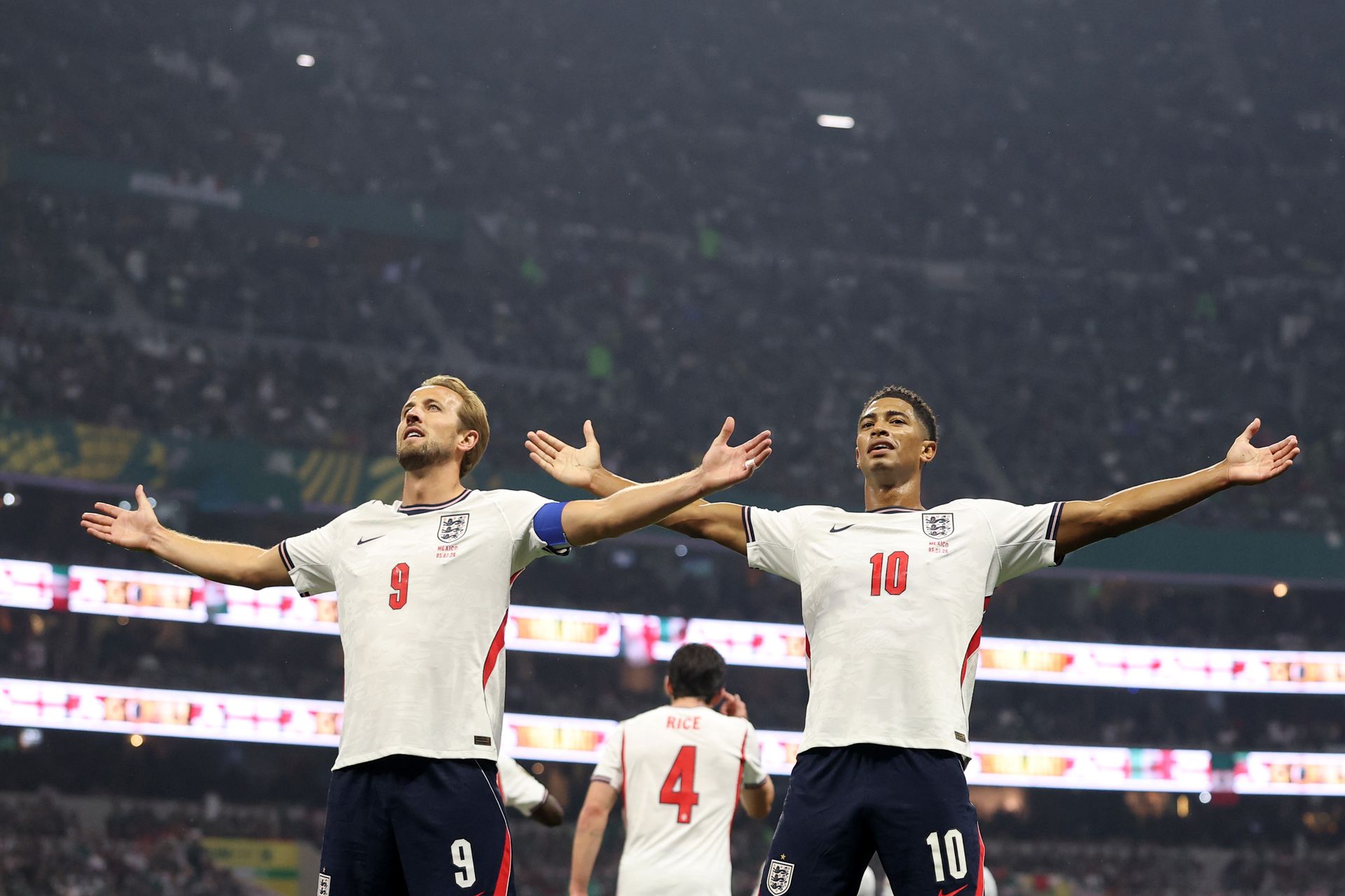
Harry Kane and Jude Bellingham have been nothing short of brilliant for England at the 2026 World Cup.
The combined goal tally of Kane and Bellingham has made England one of the most player-dependent sides in the history of the World Cup.
In the Three Lions’ tense 3-2 victory over Mexico at the iconic Azteca Stadium — a match where England were reduced to ten men — the duo scored all three goals for their team.
Bellingham netted twice in quick succession to give England a 2-0 lead, with Kane providing the assist for the Real Madrid midfielder’s second strike. But where does their share of England’s goals stand in the context of World Cup history?
The win against Mexico continued a familiar pattern for England throughout the 2026 tournament, with the pair responsible for a remarkable 10 of the Three Lions’ 11 goals so far.
It all began with Kane’s brace in the opening game against Croatia, which put England 2-1 ahead before Bellingham added another to make it 3-2.
Later, Marcus Rashford became the only other England player to score in the tournament, netting his side’s sole goal outside of the Kane-Bellingham partnership.
That match ended 4-2, and since then, Kane struck twice in a 2-1 comeback victory against DR Congo, while both he and Bellingham scored one apiece in a 2-0 win over Panama.
In total, the Kane-Bellingham duo have scored 90.9% of England’s goals across North America as the team marched into the quarter-finals — highlighting an extraordinary level of dependence on the pair. But how does this compare with England’s past World Cup campaigns and other nations’ records?
In 2022, England’s 13 goals were spread across eight different players. In 2018, their 12 goals came from six players. In 2014, two goals came from two scorers, and in 2010, three from three. In 2006, five goals were shared among four players — a stark contrast to this year’s concentration of goals.
2026: 11 goals, 3 scorers
2022: 13 goals, 8 scorers
2018: 12 goals, 6 scorers
2014: 2 goals, 2 scorers
2010: 3 goals, 3 scorers
2006: 5 goals, 4 scorers
2002: 6 goals, 5 scorers
1998: 7 goals, 5 scorers
1990: 8 goals, 3 scorers
1986: 7 goals, 2 scorers
1982: 5 goals, 3 scorers
1970: 4 goals, 4 scorers
1966: 11 goals, 4 scorers
1962: 5 goals, 4 scorers
1958: 4 goals, 3 scorers
1954: 8 goals, 5 scorers
1950: 2 goals, 2 scorers
Across World Cup history, using a minimum of five goals scored as the benchmark, only two teams have relied on fewer goal scorers than England have in 2026.
In 1986, England themselves managed seven goals between two players — Gary Lineker and Peter Beardsley — with Lineker netting six of those. Similarly, Russia in 1994 scored seven goals shared between just two players, while Switzerland in 1954 scored 11 goals between three, the same ratio as England this year.
This research, conducted by BOYLE Sports using Opta data, also revealed a similar pattern for Lionel Messi, who accounted for 61% of Argentina’s goals in this tournament.
Meanwhile, France have also been heavily reliant on a few key players across North America, with Didier Deschamps’ team scoring 14 goals through only four players — led by the tournament’s standout star, Kylian Mbappe.