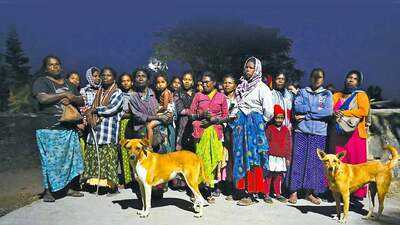
Rugmini still cannot bear to look in the direction of the small field where her husband was killed. On the morning of 7 November 2025, Dhan Nayaka, a 49-year-old marginal farmer from Eggudu village in Karnataka’s Mysuru district, left home with his pair of bulls to plough his land. This was his routine for decades. Around noon, Rugmini brought lunch. The bulls were wandering around. Her husband had disappeared. Hours later, villagers and forest officials found his remains in a neighbouring field. He had been dragged away by a tiger.
Around 120 kilometres away, across the Tamil Nadu border, another family was mourning another tiger attack. In the Niligiri’s Sigur, Nagi, a Kurumba tribal woman from MavinhallaAdivasi village, had taken her goats to graze near the forest, exactly as her family had done for generations. She never returned.
Cross into Kerala, to Chekadi village near Pulpally in Wayanad. Basavi, 65, and Kali Nooran, 80, are neighbours. Both survived elephant attacks. Both are now largely confined to their homes as their legs were broken.
These tragedies unfolded under three state governments. But they belong to one extended forest territory.
Stretching across more than 5,500 sq. km, the Nilgiri Biosphere Reserve (NBR) links Kerala’s Silent Valley National Park and the Wayanad, Aralam, and Karimpuzha wildlife sanctuaries with Karnataka's Bandipur and Nagarhole Tiger Reserves and Brahmagiri Wildlife sanctuary and Tamil Nadu’s Mudumalai and Sathyamangalam Tiger Reserves and Mukurthi Wildlife Sanctuary.
Recognised by UNESCO as India’s first Biosphere Reserve, NBR supports the country’s largest population of Asian elephants and one of the world’s highest tiger densities apart from a rich and rare list of flora and fauna. Every day, elephants, tigers, leopards and gaurs move freely across Kerala, Karnataka and Tamil Nadu. Yet each state manages conflict through separate bureaucracies, compensation policies, monitoring systems and political priorities. The result is an ecological landscape divided by administrative boundaries that wildlife neither recognises nor respects.
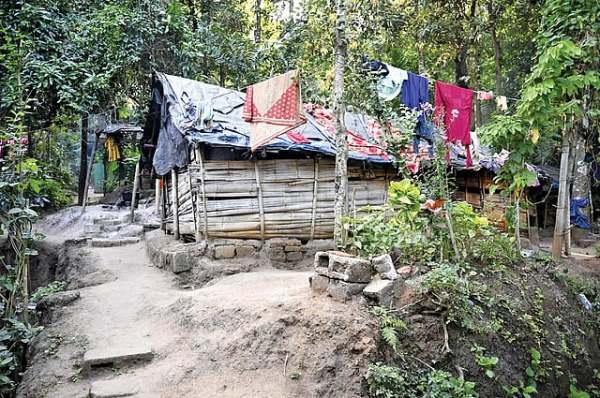 Chandroth colony near Wayanad Wildlife Sanctuary Why we should all bother about biodiversity
“Human-animal conflict is no longer a wildlife issue alone,” says N. Badusha, president of Wayanad Prakrithi Samrakshana Samithy. “It has become a governance issue. The Nilgiri landscape is one ecological unit, but Kerala, Karnataka and Tamil Nadu continue to respond as though they are dealing with three different forests. Until there is a common strategy for habitat restoration, wildlife monitoring, compensation and community participation, these tragedies will continue.”
Weeks after Dhan Nayaka’s death, Rajasekharappa, a 56-year-old farmer from nearby Bennigere village, was killed by a tiger while grazing cattle. In Badagulapura near Nanjangud, Madheva Gowda survived a tiger attack while harvesting cotton. The Karnataka government spent nearly Rs 20 lakh on treatment. Doctors saved his life but not his eyesight.
Across the Moyar Valley in Nigiri in Tamil Nadu, similar stories unfold with disturbing regularity. At Pakkana village near Gudalur, autorickshaw driver Abdul Ali recalls how a tiger killed his father four years ago. He himself had a narrow escape when a wild elephant smashed into his vehicle, leaving both legs fractured.
In adjacent Kariasholai, elephant attacks claimed the lives of Poonkodi, Alagaratnam and Sivalingam, all tea plantation workers on duty.
In Kerala’s Noolpuzha village, K. Pradeep Kumar now works as a temporary forest watcher. His father Bhaskaran was killed by a tiger doing the same job.
The victims are overwhelmingly Adivasis, marginal farmers, plantation workers and cattle grazers whose livelihoods keep them closest to the forest. Each attack frightens entire villages. Farmers avoid working alone. Plantation workers abandon isolated fields. Women hesitate to collect firewood. Children wait for adults to walk home. Why has fear become part of the landscape?
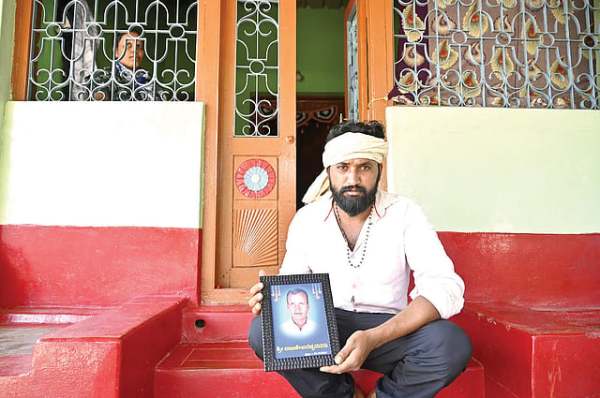 B.R. Sivanand holds a photo of his father Rajasekharappa, who was killed by a tiger Ken-Betwa project: tribals paying the price for a river-linking misadventure
Dhan Nayaka’s family insists nothing has changed in the way they cultivate their land. There have been no recent encroachments on the forest. They have always lived cheek by jowl with wildlife. His daughters lament: Since when did routine agricultural work become a death sentence? The same question echoes across villages bordering the reserve. What changed?
Scientists argue that no single factor explains the escalation. A combination of habitat fragmentation, invasive species, changing rainfall patterns, shrinking wildlife corridors, expanding plantations, roads, tourism infrastructure and the cultivation of crops that attract elephants has reshaped the relationship between people and wildlife.
“The NBR cannot be managed through isolated administrative decisions,” observes Dr C.K. Vishnudas, wildlife biology expert. “Wildlife populations have recovered because conservation has succeeded, but coexistence has not received the same attention. The next phase of conservation must focus on securing corridors, restoring degraded habitats, reducing invasive species, strengthening early warning systems and involving local communities in decision-making. Otherwise, both people and wildlife will continue to suffer.”
Scientists increasingly argue that the next phase of conservation in South India cannot be confined to protecting wildlife inside national parks and tiger reserves. The challenge now lies outside protected areas, where forests merge with villages, plantations and agricultural land.
Strengthening rapid response teams, ensuring timely compensation and recognising the ecological knowledge of tribal communities who have lived with these forests for centuries is crucial. None of these measures can succeed in isolation. They demand cooperation that goes beyond political boundaries.
“The spread of Senna spectabilis and Lantana camara has transformed large parts of the Nilgiri landscape. Native grasslands have disappeared, reducing forage for herbivores and altering wildlife movement, which in turn contributes to conflict along the forest edge” says Dr. Nagarajan Baskaran, elephant ecologist and senior scientist with the Salim Ali Centre for Ornithology and Natural History.
Kerala is now experimenting with removing jackfruits from forest-fringe homesteads to discourage elephants. Tamil Nadu has focused on removing lantana to restore grasslands inside forests. Karnataka has revived ecotourism even as anxiety rises in villages bordering Nagarhole and Bandipur. Each state is addressing one part of the problem. They are notmanaging the landscape together.
Researchers have repeatedly recommended a permanent inter-state authority bringing together Kerala, Karnataka, Tamil Nadu and the Union government to coordinate measures. Such an institution still does not exist.
“The Nilgiri is a single ecological unit. Elephants and tigers move across the three states irrespective of political boundaries. Conservation and conflict mitigation therefore have to be planned at the landscape level rather than through isolated state-level interventions,” says Dr. P. S. Easa, former Director, Kerala Forest Research Institute, and one of India’s leading wildlife biologists.
Meanwhile, survivors receive emergency treatment but little long-term rehabilitation, livelihood support or psychological care. Wildlife also pays the price. Retaliatory killings—including the recent case of a radio-collared elephant in Kerala’s Malayattur forest region who died after eating fruit with explosives hidden inside—reflect the growing frustration in conflict-hit villages.
The greatest irony is impossible to ignore. The Nilgiri Biosphere Reserve stands among India’s finest conservation achievements. Yet the people living closest to its forests increasingly feel excluded from their conservation.
Bettakurubas around Nagarhole, Kurumbas in Sigur and the Kattunaika and Paniya communities of Wayanad possess generations of ecological knowledge, but they remain marginal to policy making even as they bear the greatest risks. Their anger is rarely directed at elephants or tigers. It is directed at a system that arrives only after someone dies.
Until Kerala, Karnataka, Tamil Nadu and the Union government begin managing this extraordinary landscape as a shared ecological responsibility rather than three separate administrative territories, the next such death in Wayanad, Mysuru or Gudalur cannot be considered an accident.