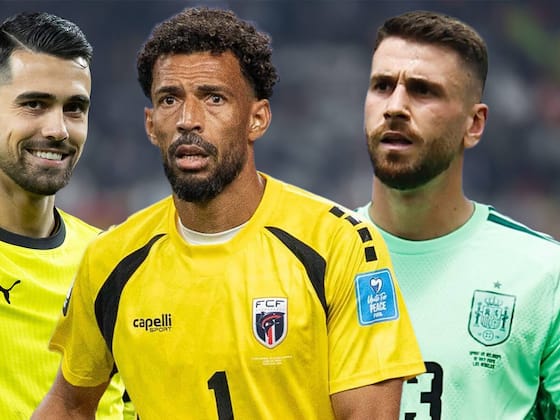
Here is our selection of the top 10 goalkeepers from the 2026 World Cup so far, with two of the top three likely being names you hadn’t come across before the tournament began.
Goalkeepers have truly been the standout performers in the 2026 World Cup, delivering match-defining moments both from established stars and from lesser-known names who have made their mark on the global stage.
Here are the 10 goalkeepers who have impressed the most so far.
We can hardly leave out Spain’s custodian after he set a new World Cup record of 650 minutes without conceding a goal. While Unai Simón hasn’t faced as much action as others — the Athletic Bilbao keeper has had to deal with only eight shots throughout the tournament — he has justified Luis de la Fuente’s unwavering trust in him since his youth days. Simón continues to keep elite goalkeepers like David Raya and Joan Garcia out of the Spain side, not purely due to his shot-stopping, but because of his exceptional positioning and ability to neutralise danger before it escalates.
At 35, Ørjan Nyland has turned in a string of solid displays, with his standout performance coming against Brazil — arguably the finest of his career. He produced a series of excellent saves, including a fingertip effort to push a deflected shot onto the post, and denied Bruno Guimarães from the spot. Although he couldn’t keep out a late penalty, his performance rattled Neymar. Considering he spent most of last season on Sevilla’s bench, featuring in just five La Liga matches, Nyland’s resurgence as a free agent — after spells with Aston Villa, Bournemouth, Norwich, and Reading — has been remarkable.
Mohamed Shobeir, son of Egypt’s Italia ’90 keeper Ahmed Shobeir, enjoyed a dream first half against Argentina. Saving Lionel Messi’s penalty was actually one of his easier stops, as he also denied Julian Álvarez with a fierce effort that nearly dislocated his shoulder. Shobeir’s save from Messi was his second penalty stop of the tournament, making him the fourth goalkeeper in World Cup history to save two penalties in a single edition — joining an elite group revealed later in this list.
For Morocco’s Yassine Bounou, the 2026 edition will forever be remembered for his penalty heroics. He saved four penalties across both shootouts and regulation time, equalling the record held by Harald Schumacher (West Germany, 1982 & 1986), Sergio Goycochea (Argentina, 1990), Danijel Subašić (Croatia, 2018), and Dominik Livaković (Croatia, 2022). His success from the spot is no coincidence — Bounou has been beaten only four times from 12 penalties in Morocco’s last three shootouts. Beyond his penalty prowess, the 35-year-old was outstanding in open play, particularly against France, when he made six saves despite Morocco’s elimination.
Japanese goalkeeper Shuichi Suzuki has drawn attention from major clubs even before his breakout showing at this tournament. Manchester United were linked with the 23-year-old soon after his 2024 move to Parma, while Leeds United and Aston Villa are reportedly competing for his signature. Suzuki’s performances — especially against Brazil, where he denied Vinícius Júnior with an acrobatic save and came close to stopping Gabriel Martinelli’s winner — have underlined his potential. Calm with the ball and commanding inside his box, Suzuki looks set for a smooth transition to the Premier League if a move materialises.
Australia’s Joe Beach was a surprise first-choice pick for Tony Popovic, having started only twice before the tournament. The decision proved inspired, as Beach impressed in every outing. However, Popovic’s gamble to switch to Mat Ryan for the penalty shootout against Egypt backfired. Prior to that, Beach had been a picture of composure — particularly in his debut against Turkey — and produced solid displays against the United States and Paraguay. Egypt were certainly relieved to see him replaced.
Gregor Kobel was named Man of the Match as Switzerland overcame Colombia to reach their first quarter-final since 1954. The Borussia Dortmund keeper made several key saves across 120 minutes and produced a vital stop in the shootout. Refreshingly, Kobel relies more on instinct than pre-match notes for shootouts. “I think there are others who are more prepared than me. Feeling plays a big part in these moments,” he explained. “I study the taker’s shape, movement, eyes — it’s all a mix. In the end, it’s about instinct, and I follow it.” Switzerland’s defensive solidity, particularly in that Colombia match, has been impressive — only the keepers from Spain, France, and Colombia have conceded fewer goals among the 32 teams that reached the knockout stage.
Just after the last World Cup, Paraguay’s Carlos Gill was selling his football kit to provide for his family and his prematurely born son. Now, three and a half years later, the 26-year-old has enjoyed a breakthrough tournament and is reportedly on Manchester United’s radar. Standing 6ft 6in tall, Gill shone against Germany in the Round of 32, making two crucial saves in the penalty shootout against Kai Havertz and Nick Woltemade. After an opening defeat to the United States — in which he was hardly at fault — the San Lorenzo keeper conceded just once across the next three matches, including extra time against Germany, saving 16 of the 17 shots he faced. Even France needed a penalty to beat him, and despite Paraguay’s exit, Gill was named Man of the Match. Among all goalkeepers, only three have faced more shots on target, but none have a better save percentage — an impressive 86.4%.
Portugal’s Diogo Costa, long admired by Chelsea, was named Man of the Match in the goalless draw with Colombia but was arguably at his best in the win over Croatia. Even in the defeat to Spain, Costa managed to save five of the six shots he faced, reinforcing why he’s regarded as one of Europe’s top young keepers.
In a tournament where goalkeepers have generally stood out, Cape Verde’s Vozinha has become the face of the 2026 World Cup. He made headlines with seven saves to keep a clean sheet against Spain on his World Cup debut — a record for a 40-plus goalkeeper since Northern Ireland’s Pat Jennings against Brazil in 1986. Vozinha went one better against Argentina, making eight saves in a memorable duel with Lionel Messi. His composure on the ball was as impressive as his reflexes, and finishing the tournament with more successful dribbles than Cristiano Ronaldo added an unexpected flourish to his remarkable campaign.