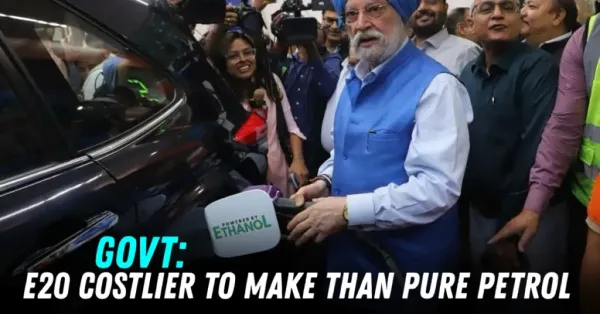
One of the first things that Union Minister Nitin Gadkari had promised while promoting ethanol and ethanol-blended fuels was that the price of petrol would come down. In fact, he even claimed once that ethanol blending would bring down the cost of petrol to Rs 15 per litre. However, the Petroleum and Natural Gas Ministry has recently come up with a statement saying that E20 petrol is currently costlier to produce than pure petrol at prevailing global crude oil prices.
The ministry said that the economics of ethanol depends on global crude oil prices. The government mentioned that it currently procures maize-based ethanol at Rs 71.86 per litre. This is actually before GST, transportation and depot handling costs.
“Therefore, if international crude oil is trading at around US$70 per barrel, E20 is actually costlier to produce than pure petrol. If crude rises to US$120-130 per barrel, the economics naturally reverse and ethanol becomes even cheaper.”
To understand it in a simpler way, let us explain. The ethanol that is currently blended into petrol is actually produced from crops like sugarcane, corn or damaged food grains. Its production costs are relatively stable and fixed because they depend on farming, distillation and domestic government-regulated pricing rather than global oil markets.
Petrol, on the other hand, is directly refined from crude oil. Its production cost fluctuates significantly based on international crude oil benchmarks.
When global crude oil prices are low, the raw material for making pure petrol is cheap. Refining a litre of pure petrol is highly cost-effective. Because the government has to pay fixed and protected rates to farmers to support the agricultural sector, it ends up being more expensive per litre to produce and blend ethanol than the cheap petrol it is replacing. Therefore, E20 costs more to manufacture than pure petrol at this price point.
At the moment, crude oil prices are lower than what they were during the West Asian conflict. However, if a similar situation arises in the future and supply shortages push crude oil prices up to US$120 or US$130 per barrel, the cost of refining pure petrol will also go up. However, because the production cost of ethanol will remain relatively stable and insulated from oil market shocks, it suddenly becomes the much cheaper component. Blending 20 percent of this cheaper ethanol into the expensive petrol pulls the overall production cost down.

The ministry mentioned that this is exactly what the government did when crude oil prices were high. This is how the ministry managed to protect consumers from the shock, or the full impact, of rising global crude oil prices.
According to the ministry, the Ethanol Blended Petrol Programme has already saved more than Rs 1.97 lakh crore in foreign exchange, substituted nearly 316 lakh metric tonnes of crude oil, reduced around 952 lakh metric tonnes of carbon dioxide emissions and transferred more than Rs 1.66 lakh crore directly to farmers.
While defending the E20 policy, the ministry admitted that E20 fuel results in lower fuel efficiency, but it rejected all claims about the fuel causing issues to vehicles. It claimed that E20 fuel underwent extensive testing for engine durability, fuel systems, material compatibility, corrosion and overall vehicle performance before being rolled out across the country.