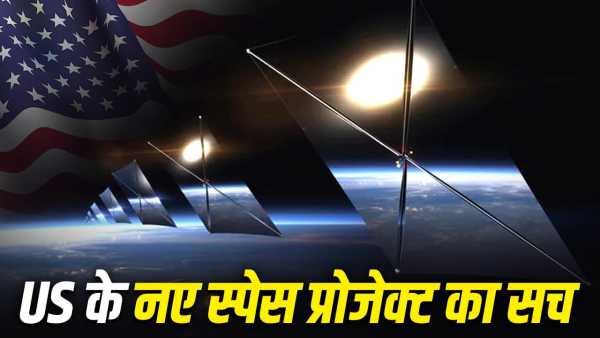
America is preparing to send a satellite into space, which will have a 60 feet wide mirror. America's Federal Communications Commission (FCC) has given approval to a California-based start-up company 'Reflect Orbital' to launch such a satellite. The purpose of this project is to illuminate selected parts of the Earth at night by reflecting sunlight from space. The glass installed in it will transmit sunlight to a specific part of the earth at night, thereby providing lighting even at night.
However, this technological leap has created an atmosphere of deep concern and fear among astronomers and environmental scientists around the world. Let us know how this technology will work, for what purposes it will be used, what can be the benefits. Why are many scientists opposing this…
Reflect Orbital has named its first test satellite Earendil-1. It will be launched in low earth orbit this year.
According to Ben Novak, CEO of Reflect Orbital, the main purpose of this technology is to sell sunlight to continue working even at night.
Scientists, astronomers and wildlife experts have lodged a strong protest against this approval. These were the main reasons for their fear
Ruhi Dalal, Public Policy Director of the American Astronomical Society, has written a letter to the FCC clearly saying that this project is not in the public interest. Scientists need dark skies to study distant stars and galaxies with powerful telescopes. A network of 50,000 shiny mirrors would ruin space science projects worth millions of dollars. Astronomer Samantha Lawler of Regina University, Canada, has warned that no one country can change the shape of the night sky of the entire world.
Earth's entire ecosystem is dependent on the natural cycle of day and night. The sleep cycle of humans will be disrupted due to sudden exposure to sunlight at night. This will cause huge disturbances in the migration of animals, food habits and blooming time of plants, which is a major threat to the environment.
Scientists have also expressed concern that the bright glow generated while changing the direction of the mirror in space can distract the pilots of commercial planes flying in the sky, due to which there is a fear of major accidents.
The FCC's clear argument is that its job is only to see that the satellite's radio frequency communication does not interfere with any other system and that the satellite can be safely destroyed after the work is completed. The FCC approved, saying that environmental regulations do not apply to activities in space. Chairman Brendan Carr has called it a major technological leap for the American space industry.
This concept is not completely new. In 1993, Russia sent an 80 feet wide mirror into space under the Janamya 2 project to increase daylight in Arctic Siberia. It threw light on the Earth for a few seconds, but due to the failure of the subsequent test flight, the project was closed forever. Now America is taking a very commercial and large-scale step in this direction.
Also read: Iran made a big mistake, now it will pay the price… US Defense Minister's threat