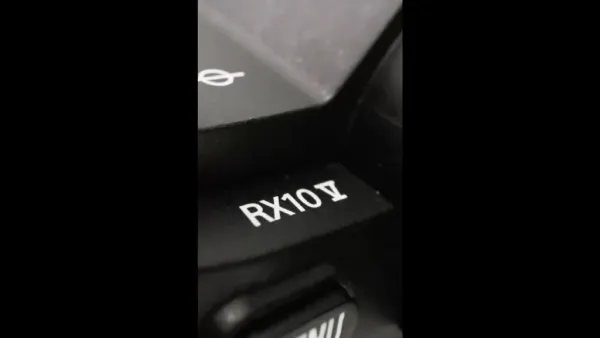
Some cameras get discontinued and quietly fade away. The Sony RX10 IV was discontinued, and its used price went up, with clean copies changing hands for as much as $3,000 because nothing else offered a 24-600mm ZEISS zoom lens in a single weatherproof body. That is the market the Sony RX10V walked into on July 9, ending a wait of almost nine years.
Sony’s own executive called the series a “cult classic” in the announcement, and for once the marketing line is accurate. Travel photographers, birders, and safari-goers kept this camera alive long after the industry decided bridge cameras were dead.
The heart of the Sony RX10 V is the same. You still get the 20.1MP 1-inch stacked Exmor RS sensor paired with the Zeiss Vario-Sonnar T* 24-600mm equivalent f/2.4-4 lens, complete with optical stabilization and that 3cm macro capability at the wide end.
I suspect this will disappoint people who wanted a bigger sensor, and the complaint is fair at this price. But the lens is the entire reason this camera exists. A larger sensor would have meant a larger, slower, or shorter lens, and then it wouldn’t be an RX10 anymore.
Everything around that core has been rebuilt. The new BIONZ XR processor carries a dedicated AI unit, bringing the Real-time Recognition autofocus from Sony’s Alpha cameras. The Sony RX10 V can now identify and track people, animals, birds, insects, cars, trains, and aircraft, and you can tap the screen to lock onto whichever subject you want.
Speed is up too. Blackout-free continuous shooting hits 30 fps, up from 24 fps, with autofocus and exposure calculations running at 60 times per second. For the birding crowd this camera quietly serves, that combination matters more than any spec on the sheet. One gap remains, though: there is still no pre-capture mode, which rivals now offer.
Video makes the biggest leap. The old model topped out at 4K 30p; the new one records at 4K 120p and adds Active Mode stabilization, Auto Framing, S-Cinetone, S-Log3, and support for 16 user LUTs. It will even live stream in 4K 30p over USB-C.
The Sony RX10 V now handles like a modern Sony. The redesigned body brings a deeper grip, a proper AF joystick, and the current menu system. The viewfinder jumps from a 2.36M-dot panel to a 3.69M-dot, 0.78x unit, and the rear screen sharpens to 1.62M dots, though it still only tilts.
Two long-overdue fixes deserve applause. Micro USB is finally gone, replaced by USB-C, and the ancient NP-FW50 battery gives way to the NP-FZ100, good for roughly 570 shots through the viewfinder and a claimed 50 percent improvement in stamina. All of it adds just 16 grams over the old body.
The Sony RX10 V costs $2,299 in the US, with shipping from early August. India pricing and availability haven’t been announced yet, and given the Sony RX10 IV’s history here, that listing will be worth watching.
The honest question is whether a 1-inch sensor camera justifies $2,299 in 2026, up from the IV’s $1,700 launch price. Critics are already asking it. My answer: judged as a camera, it’s expensive. Judged against a telephoto lens kit that costs more and weighs triple, it starts to make sense, which is exactly the argument that kept used RX10 IVs selling for $3,000.
Last updated: July 10, 2026.