As Julian Alvarez’s stunning strike curled into the top corner of Switzerland’s net — arguably the finest goal of the World Cup so far — it seemed almost poetic. The brilliance of the finish was matched only by its greater significance.
High above the euphoric Argentine celebrations, in FIFA’s exclusive VVIP box, CONMEBOL president and Gianni Infantino’s close ally Alejandro Dominguez erupted with joy. It was quite the sight from a Paraguayan, who embraced Argentina’s football chief Claudio Tapia as though he were celebrating his own nation’s triumph.
That reaction was understandable. It wasn’t just a goal that lifted fans out of their seats; it also secured South America’s presence in the semi-finals — and for FIFA, that was reason enough to cheer.
Alvarez’s moment of magic set up the dream semi-finals that many had envisioned — fittingly, on the grandest stage in the world of sport.
Football fans everywhere shared the excitement. After all, how could they not?
In a World Cup that had curiously lacked heavyweight battles — with perhaps only Spain versus Portugal standing out — we now have two colossal ‘super-clasicos’ and the promise of a blockbuster final.
FIFA has already been quick to highlight that this is the first time the semi-finals have featured the world’s top four ranked teams. It’s also the first time since 1990 that all four remaining nations are past winners.
That connection to the cherished Italia ’90 tournament feels apt, as this quartet could well be the most captivating since then — and perhaps the best ever, depending on how the matches play out.
Looking back, the 2014 semi-finals came close, but Argentina versus the Netherlands ended in a goalless draw. The 2006 edition had quality but was an all-European affair in a more conservative era.
This time, the blend of quality, contrast, star power, and narrative makes both ties irresistible.
Even before Saturday’s drama, many were already calling France versus Spain the ‘real final’, predicting that the winner would go on to lift the trophy.
Of course, football rarely follows predictions. Yet, with France boasting the best defensive record and Spain the best attacking one, these two teams have looked a cut above the rest in this tournament.
The clash also symbolises football’s philosophical divide. Spain have refined Pep Guardiola’s positional play to near-perfection, functioning as the most cohesive unit in international football. Didier Deschamps, meanwhile, has embraced an evolved form of ‘relationism’ — a tactical school that gives players greater individual freedom.
It’s the disciplined harmony of an orchestra against the unpredictability of free jazz — and that’s before considering the rivalry between neighbours and the tension that already exists. Adrien Rabiot’s comments about Lamine Yamal before the Euro 2024 semi-final — suggesting he needed to ‘do more’ — have resurfaced to add extra spice.
And yet, even all that pales beside the sheer gravitas of Argentina versus England.
The so-called ‘real final’ has already been eclipsed by a genuine epic. This meeting comes exactly 40 years after the most iconic World Cup match ever — the 1986 quarter-final — with the spirits of the Azteca Stadium still lingering.
This is the first encounter between the two nations since 2005, and their first at a World Cup since 2002.
Unsurprisingly, emotions are running high. Many Argentine chants — including the famed ‘Muchachos’ anthem from their last World Cup triumph — reference ‘Las Malvinas’, a nod to deep-seated national sentiment.
For Argentina, this match carries historical weight far beyond the sport. For England, it represents the biggest opportunity in six decades to reach another World Cup final.
Lionel Messi, facing England for the first time in his storied career, adds another layer of intrigue.
While Spain and France aim to validate their immense talent, and Messi and Kylian Mbappe seek to etch their names deeper into football history, England’s long wait for silverware — the longest among former World Cup winners — hangs heavily over their campaign.
Remarkably, this will be Messi’s first-ever appearance against England — a symbolic milestone in a fixture defined by individual brilliance. Neither Argentina nor England have displayed the tactical cohesion of Spain or France, relying instead on their superstar players to rescue them in crucial moments.
Their unpredictability, however, could make this the most chaotic, thrilling, and dramatic contest of the tournament — entirely in tune with the World Cup’s tone so far. Anything could happen: a one-sided rout or a nail-biting penalty shootout.
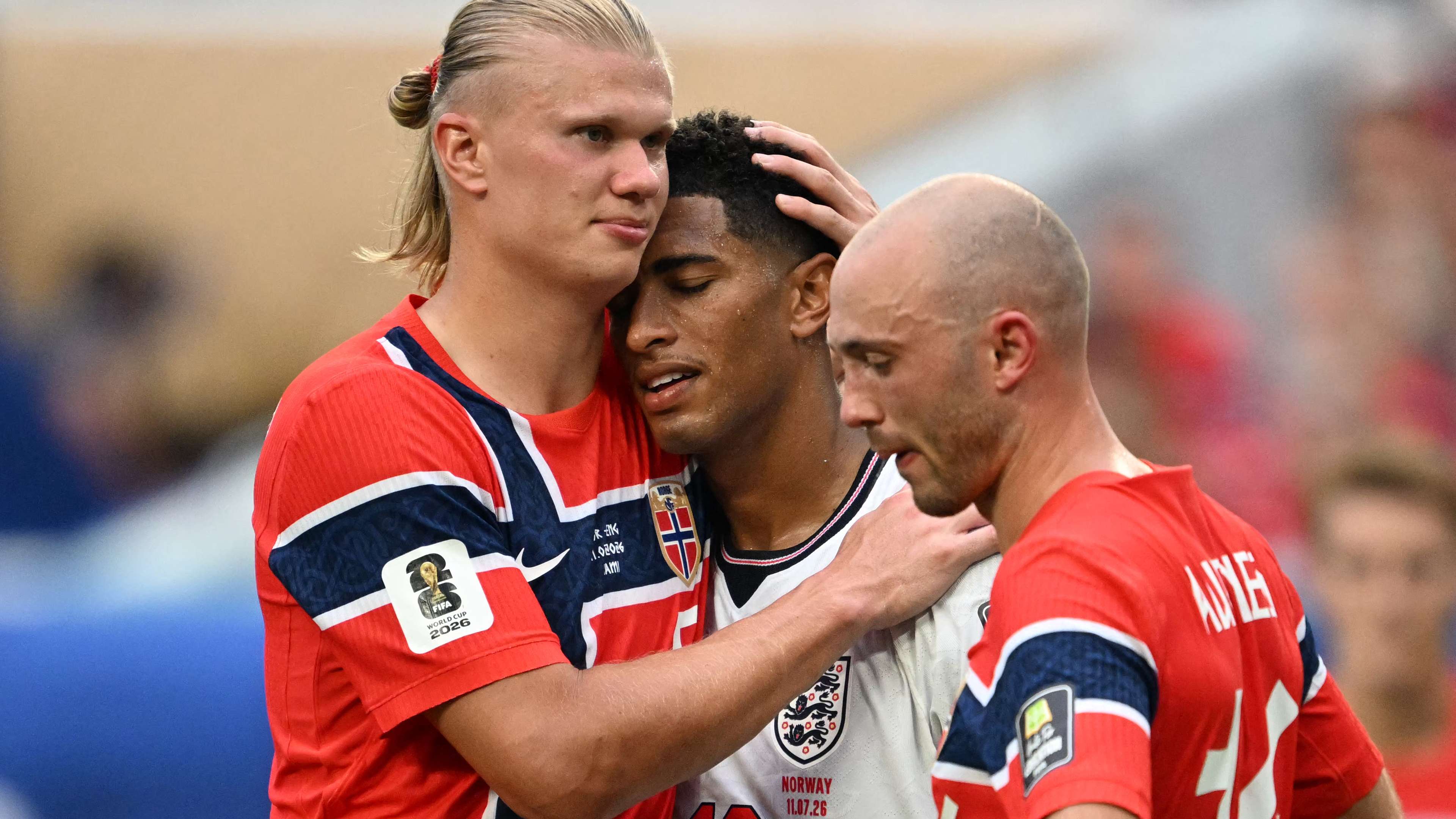
Jude Bellingham, one of the standout performers of this tournament, exemplifies the star-driven narrative that defines this World Cup.
FIFA will be pleased regardless of the outcome.
With Messi’s milestone and the presence of nearly all the tournament’s top scorers — Messi, Mbappe, Michael Olise, Ousmane Dembele, Bellingham, Harry Kane, and now Alvarez — only Erling Haaland is missing from this elite group. Fans are still awaiting Lamine Yamal’s defining moment, which he himself seems aware of.
It’s a mouthwatering line-up, with any potential final pairing promising to be just as thrilling.
And that’s even before a ball is kicked. If these heavyweight clashes live up to the World Cup’s exhilarating trend, we might genuinely witness the greatest semi-finals in history. Ultimately, it’s how a tournament ends that defines its legacy. Even the entertaining USA ’94 faded under the heat, but this one feels destined to soar.
FIFA could hardly have asked for a better outcome — though these matchups inevitably stir online speculation about controversial decisions.
The Independent firmly rejects conspiracy theories suggesting FIFA manipulated outcomes, yet acknowledges that post-Donald Trump-era scepticism has altered public perception.
It’s been a complicated week for FIFA off the pitch, even as the tournament continues to reach new heights on it.
Perhaps that’s why Infantino chose this moment to float the idea of expanding to 64 teams, a move seen by many as a diversion.
But this World Cup’s own expansion has proven that all the pre-tournament politics fade away once the knockout stages begin — when the stakes are at their highest.
There’s truly nothing like these semi-finals, and we may never see another lineup quite like it.