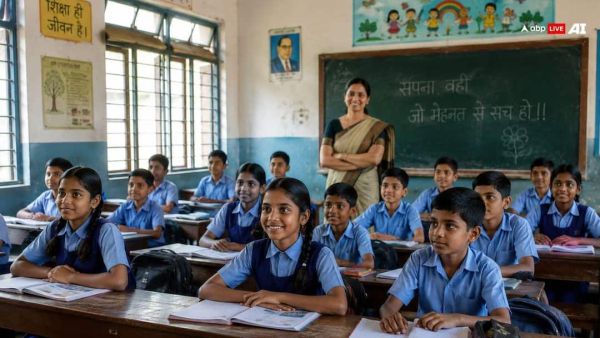
A new report on government schools has drawn nationwide attention. A large number of government schools have closed in India over the past 10 years. Additionally, a significant decline has been recorded in the number of children attending government schools. According to the NITI Aayog report, the merger of two or more schools into one, declining birth rates, and the challenge of retaining students in higher grades are the primary reasons for this change. The report also reveals key statistics related to the number of government and private schools, student enrolment, and dropout rates.
According to a NITI Aayog report, approximately 94,000 government schools have closed across the country over the last 10 years. This means that, on average, 25 government schools have closed every day. The report states that there were 1.107 million government schools in the country in 2014–15, which declined to 1.013 million in 2024–25. During the same period, the number of government-aided schools decreased from 83,000 to 79,000. Meanwhile, the number of private schools increased from 288,000 to 339,000.
According to the report, the total number of students attending schools has also declined over the past decade. Total enrolment stood at 269.5 million in 2014–15 and declined to 246.9 million in 2024–25. During this period, enrolment fell by approximately 22.6 million students.
The report states that the dropout rate at the primary level is very low. The dropout rate from Class 1 to Class 5 is only 0.3 per cent. However, it increases to 3.5 per cent from Class 6 to Class 8 and 11.5 per cent from Class 9 to Class 10. The rate of students transitioning from Class 8 to Class 9 has declined from 91.58 per cent in 2014–15 to 86.6 per cent in 2024–25. According to the report, this rate is 99.6 per cent in Puducherry and Kerala, while it is much lower in Bihar, Uttar Pradesh, Jharkhand, Madhya Pradesh, Meghalaya, Mizoram, Arunachal Pradesh and Nagaland.
According to the NITI Aayog report, School Education System in India: Temporal Analysis and Policy Roadmap for Quality Enhancement, there are several reasons for this decline. These include declining fertility rates, a shrinking population of school-age children, the closure of neighbourhood schools with fewer students and the integration of all children into one school, and the challenge of retaining students into higher grades.
According to the report, a policy was adopted to make better use of resources by merging nearby government schools with low student numbers. However, education activists believe that this has made it more difficult for children in many areas to access school. The increased distance to school, especially for girls, has affected learning and reduced enrolment in many cases.