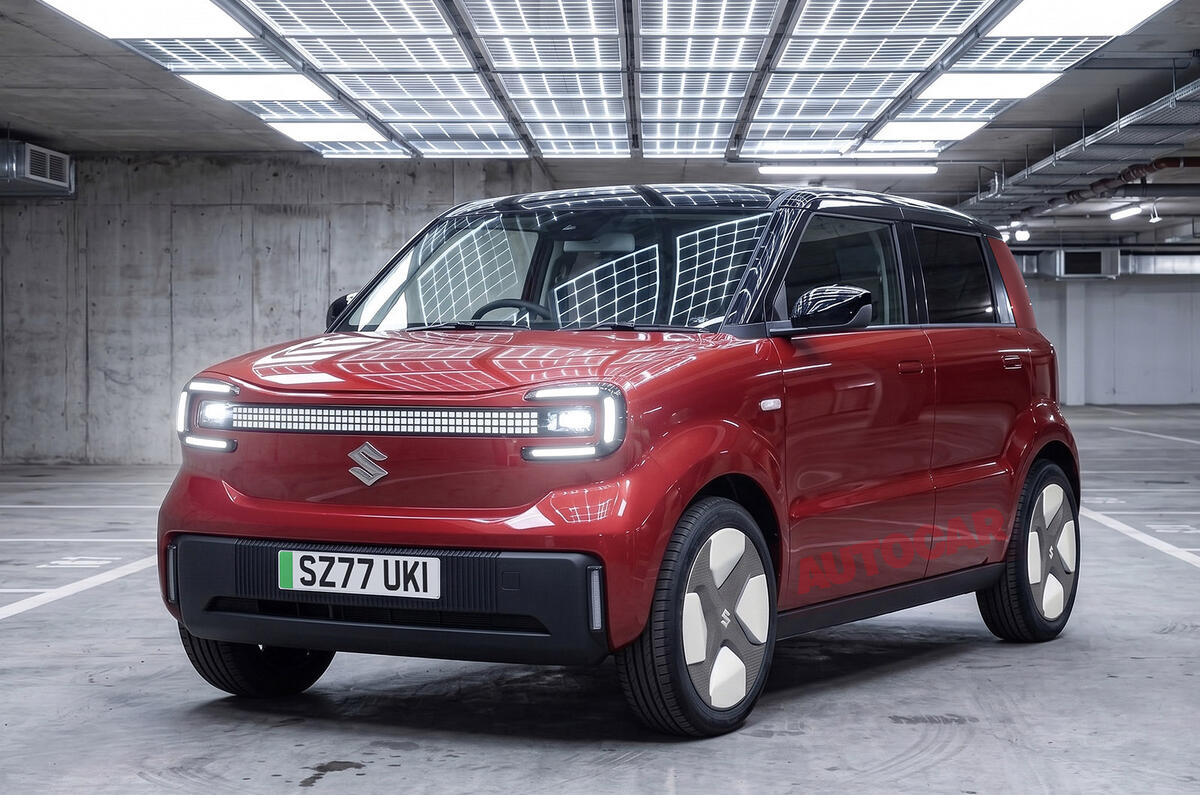
Suzuki is preparing to enter the affordable electric city car segment in 2027 with a new model priced below £20,000, aiming to rival the Renault Twingo and Honda Super-N. This move will play a key role in meeting the company’s electric vehicle (EV) sales targets in the UK.
The upcoming EV, along with rising sales of the Suzuki Swift hatchback and the introduction of a third electric model in 2029, form the foundation of Suzuki’s UK growth strategy following the challenges brought by the early phase of the zero-emission vehicle (ZEV) mandate.
According to UK Managing Director David Kateley, who assumed the role in January last year, the brand’s strategy has been realigned to adapt to the ZEV mandate. The company is focusing on boosting sales of the eVitara—Suzuki’s first all-electric model—alongside the successful Swift supermini, while maintaining its strength in private retail sales.
“I believe in focusing on what we can control. The mandate is already in place, and we all have a shared goal of protecting the environment. We are fully embracing it,” said Kateley.
This renewed focus appears to be paying off. Suzuki’s sales have grown faster than any other established car brand this year, with a 43% increase in the first five months of 2026, pushing its market share above 1% once again.
This turnaround is particularly noteworthy considering that sales had dropped to just 18,000 units in 2025, following a reduction in the internal combustion engine (ICE) line-up to comply with the ZEV mandate. The rebound highlights Suzuki’s potential for a strong future in the UK market when supported by the right product portfolio.
Central to Suzuki’s recovery is the Swift—a compact, affordable hatchback starting from £19,000—which sold 6,000 units in the first quarter of this year. “We’re thrilled with the Swift’s success,” said Kateley. “It proves there’s still a demand for small, fun-to-drive petrol cars.”
The Swift is powered by a three-cylinder 1.2-litre mild-hybrid engine with a WLTP-rated fuel efficiency of 64.2mpg and CO2 emissions of 99g/km, earning valuable ZEV credits under the Vehicle Emissions Trading Scheme.
In 2026, Suzuki expects to sell around 5,000 units of the eVitara, supported by a manufacturer contribution that matches the Electric Car Grant. Combined with sales from the Vitara and S-Cross, the company aims to return to pre-2025 levels with approximately 23,000 units sold this year.
Further momentum is expected in spring 2027 with the launch of the production version of the Vision e-Sky urban EV. Positioned within the increasingly competitive affordable electric city car segment, it will compete directly with models like the Honda Super-N, a boxy, kei-style EV.
The production version of the Vision e-Sky will retain the five-door design and tall, squared-off dimensions of the concept model. While technical details remain limited, it is likely to feature a battery capacity of around 29kWh, offering an estimated 130-mile range—typical for its class.
“The A-segment battery-electric vehicle is extremely important for us. It’s an entry into a new market category, and I’m very optimistic about its potential,” said Kateley. Given Suzuki’s strong appeal among private buyers, the e-Sky is expected to be competitively priced. For reference, Honda’s entry-level Super-N EV starts at £19,000.
The new EV will help Suzuki move closer to achieving the 2027 ZEV target ratio of two electric vehicles sold for every three ICE models. Kateley, however, declined to comment on speculation about the government possibly bringing forward a review of the mandate and how that might affect the company’s planning.
The arrival of the e-Sky will also set the stage for Suzuki’s third electric vehicle, slated for launch in 2029. This model is expected to be a B-segment SUV positioned between the e-Sky and eVitara. “It definitely won’t be an electric Swift,” Kateley confirmed.
Suzuki is also facing intensifying competition from Chinese manufacturers, which have expanded the number of car brands in the UK from 40 to 70 in recent years. Despite the influx, Kateley remains confident. “I’m not worried. We’re a 1% brand, and I think the larger, more established manufacturers will feel the impact more,” he said.
Nevertheless, Kateley described the current market environment as “3C”—“competitive, confused, and conflicted”—reflecting the complex dynamics of today’s automotive landscape.