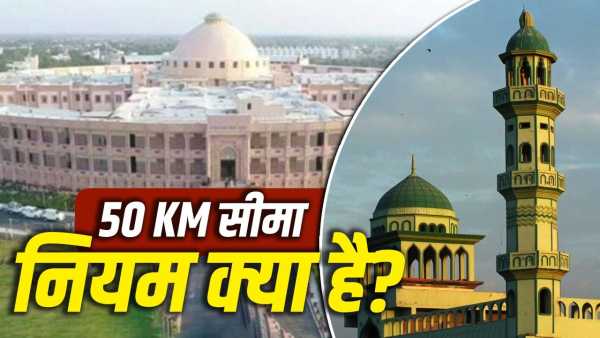
Rajasthan High Court has rejected the petitions filed against the notice issued to mosques, madrassas and dargahs located within a radius of 50 kilometers from the India-Pakistan border. After this, the most discussed question is what is the law on the basis of which the administration is taking this action. In its order, the court has specifically mentioned the Home Ministry's notification of 11 October 2021 and Section 139 of the Border Security Force i.e. BSF Act. The court said that national security is the biggest priority in the border area and that is why the powers of BSF were extended up to 50 kilometers. Under this legal framework, unauthorized constructions built in sensitive border areas are being investigated and action is being taken.
Rajasthan High Court has specifically mentioned the Home Ministry's notification of 11 October 2021 in its decision. This notification was issued under Section 139 of the Border Security Force i.e. BSF Act, 1968. Through this, the jurisdiction and operational powers of BSF were expanded up to 50 kilometers from the India-Pakistan border. The court said that this decision was not taken suddenly, but the central government had taken this step in view of the changing security situation on the border, inputs received from intelligence agencies, to stop infiltration, smuggling and anti-national activities. The court called it a deliberate policy decision taken in the interest of national security and public interest.
The High Court said that the area up to 50 kilometers from the India-Pakistan border is considered very sensitive from security point of view. Any kind of unauthorized construction or suspicious activity in such areas can be a matter of concern for security agencies. The court acknowledged that additional powers have been given to the administration to prevent smuggling, infiltration and other cross-border crimes in the border areas. Therefore, the administrative action taken in this area cannot be seen as a normal revenue dispute. The court clarified that the purpose of such action is only to strengthen border security.
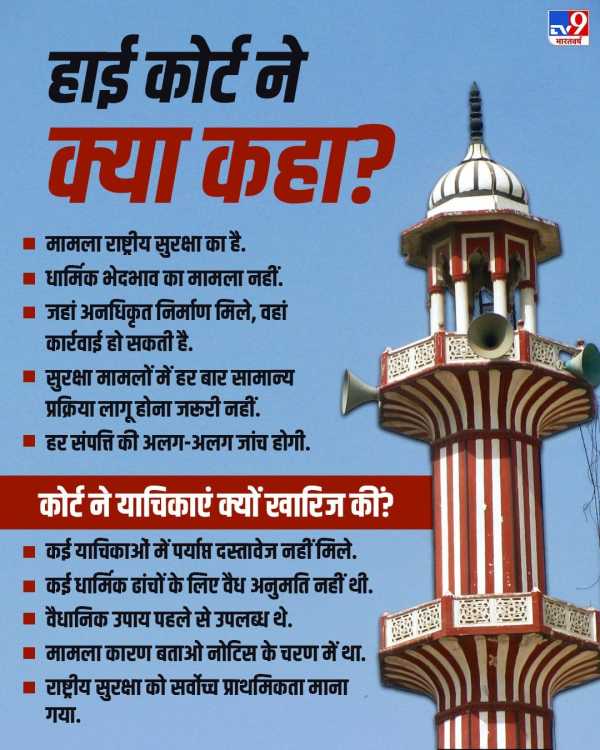
This case is related to those mosques, madrassas and dargahs which are located within a radius of about 50 kilometers from the India-Pakistan border. Show cause, eviction and eviction notices were issued to these religious places by the state government. The government said that many of these constructions have been built without valid permission, without approval and without land use change. Also, all these are located in sensitive border areas. Challenging this action, petitions were filed in the Rajasthan High Court on behalf of various mosques, madrassas and dargahs.
The state government told the court that the religious structures concerned were built without legal approval. The government said that based on available government records, documents, complaints and inputs from intelligence agencies, the existence and operation of these structures could pose a threat to national security. The government said that since all these constructions are located in a very sensitive area of the international border, the administration started action under the law. The government told the court that this action is not being taken against any particular religion, but for security and law and order.

The petitioners argued in the court that the action was being taken only by targeting religious places. But the High Court, citing the records, said that no such facts came to light which would prove that action has been taken against any one community. The court said that notices have been issued wherever unauthorized constructions were found in the sensitive border area. The court clearly wrote in its order that the attempt to give a communal color to this matter is completely wrong and beyond the facts. This matter is only about national security and compliance with legal rules.
The court found that in many petitions, sufficient documents were not provided to prove that the petitioners had a legal relationship with the concerned mosque, madrassa or dargah. In many cases, the proposal, authority letter or other valid documents of any registered organization were not kept on record. Apart from this, the court said that for the construction of many religious structures, necessary permission was not taken under Section 5 and Section 6 of the Religious Buildings Act. In such a situation, prima facie these constructions will be considered unauthorized and without permission.
The petitioners said that they were not given adequate show cause notices nor were they given a proper opportunity of personal hearing. Citing Section 90A of the Rajasthan Land Revenue Act, 1956, he said that the purpose of the law is not only to take action but also to provide an opportunity to regularize land use on the basis of prescribed conditions. His argument was that the administration did not follow this procedure properly. However, the High Court said that statutory remedies are already available in this case and the writ petition cannot be accepted directly at the stage of show cause notice.
The petitioners cited the decision of the Supreme Court in which guidelines were given regarding bulldozer action. But the Rajasthan High Court said that that decision was related to bulldozer action on the properties of criminals, accused and convicts. The court said that that case cannot be compared with the sensitive area of India-Pakistan border and this dispute related to national security. The court said that under no circumstances can this decision be compared with the present case.
The High Court said in its decision that in matters like national security, it is not necessary to follow all the rules of traditional natural justice in the same way in every situation. If the administration has sufficient material and proper basis for action, then practical method can be adopted according to the circumstances. The court held that in this case the administration followed the necessary procedure and the petitioners did not suffer any loss which could be considered a serious procedural error in the eyes of law.
Despite dismissing the petitions, the High Court also ensured that each case was investigated separately. The court directed that a joint committee of the District Collector, Superintendent of Police and representative of the Border Security Force of the concerned district should be formed. This committee will examine each property separately and then decide further action as per law. That is, on the one hand, the court gave priority to national security, while on the other hand, it also kept the way open for investigating the individual circumstances of each case.