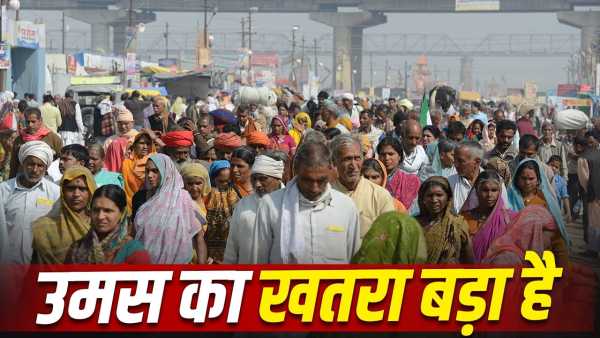
Summer in India is now becoming a challenge not only due to increasing temperature but also due to increasing humidity. This is the reason why meteorologists and health experts are now considering not just heatwave but “humid heat” as the biggest threat. A new study shows that the number of dangerously humid days is continuously increasing every year in India. On the other hand, the Indian Meteorological Department has also issued an alert of heatwave and hot and humid weather in many states between July 13 and 15.
According to an analysis by American organization Climate Central, the average number of days of dangerous humid heat in India was 101 days in the 1970s. Now during 2016-2025 it has increased to 141 days. This means that there are about 40 additional days every year when the combined effect of heat and humidity poses a risk to humans. The number of such days in Delhi has increased from 96 to 135. In Mumbai it increased from 136 to 206 and in Chennai it increased from 205 to 257 days. Tirunelveli of Tamil Nadu is among the most affected cities, where such days have reached 273.
Temperature alone does not harm the body, but the combination of temperature and humidity is more fatal. Scientists measure it with wet-bulb temperature. When there is more humidity in the air, the sweat coming out of the body does not dry quickly. If sweat does not dry, the body's natural cooling process will also not work. The result is that the body temperature starts increasing rapidly and the risk of heat stroke, dehydration, unconsciousness, kidney and heart related problems increases. This is the reason why even a temperature of 38-40 degrees Celsius can feel like 45-50 degrees with high humidity.
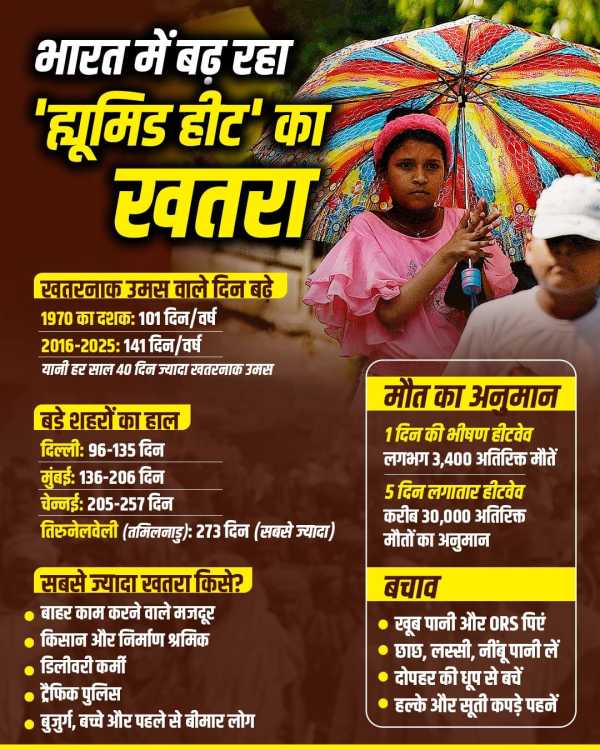
India is among the most heat-affected countries in the world. In this country with a population of hundreds of crores, a large number of people work in the open. These include farmers, construction workers, delivery workers, traffic police, street vendors and factory workers. Apart from these, elderly, children, pregnant women and already sick people are considered to be the most sensitive.
A recently published research titled Estimating heatwave-induced excess mortality in India's districts has estimated that if a severe heatwave of just one day occurs in India, it could cause about 3,400 additional deaths. If the heatwave continues for five consecutive days, this number could reach around 30,000 additional deaths. Researchers say that these estimates are also minimal, because they do not fully include the real risk of many coastal and more humid areas. An earlier published multi-city study also estimated that an average of more than 1,100 deaths could be linked to heatwaves in India each year, with the risk of death further increasing during more intense and prolonged summers.
The Indian Meteorological Department has predicted a heat wave in parts of eastern Uttar Pradesh and Jammu between July 13 and 15. A warning of hot and humid weather has been issued in Odisha, Tamil Nadu, Rayalaseema, Puducherry and Karaikal. IMD has also issued a warning for marine areas. There is a possibility of strong winds and bad weather in many parts of the Arabian Sea, Bay of Bengal and Andaman Sea between July 13 and 18.
According to IMD, those people who work in the sun for long periods or do heavy physical exertion are most at risk. Apart from this, the elderly, infants, small children and people already suffering from any disease have been advised to take special precautions. The weather department has appealed to people to drink enough water, take fluids regularly even if they do not feel thirsty, take ORS or home-made drinks like buttermilk, lemonade, lassi and rice bran and avoid the scorching afternoon sun.
Experts believe that this combination of heat and moisture is increasing rapidly due to increasing climate change due to human activities. Therefore, in the coming years, the definition of heatwave in India will not be limited to temperature alone, but “feel like” temperature and humidity will also play a big role in determining health risks. This is why now the meteorological department and health agencies are advising people to be cautious not only during strong sunlight but also during hot and humid weather.