The FIFA World Cup stands as the ultimate global celebration of football. On the field, it represents the pinnacle of countless careers every four years, offering a stage where the purest form of international football unfolds—unmatched in passion and prestige.
Yet, beyond the pitch, it is also a commercial powerhouse—an enormous enterprise at the summit of sport and sponsorship. Official partners invest heavily during the tournament’s golden period, while numerous other brands, both major and minor, attempt to capitalise on the moment, often missing the true essence of the game.
Switch on any television during a World Cup match, and the commercial breaks are filled with exaggerated portrayals of the sport—actors pretending to be overzealous fans, scenes of pubs packed with face-painted supporters (something rarely seen in reality), and stylised football sequences that bear little resemblance to the actual game.
In these flashy advertisements, viewers often encounter highly unrealistic football manoeuvres. Counter-attacks inexplicably end with bicycle kicks, while players execute improbable slide tackles and extravagant toe drags that seem more choreographed than competitive.
Occasionally, these ads even feature the famous scorpion kick—portrayed as a routine skill to make players appear extraordinary. In truth, it’s anything but common. Most football fans will live their entire lives without witnessing one live in a real match.
Despite its rarity, the scorpion kick is a genuine footballing move. It has been executed in professional matches, combining both improvisation and breathtaking athleticism to create a moment of pure spectacle.
There are actually two distinct versions of the scorpion kick.
The first, often dramatised in football commercials, is sometimes employed by outfield players attempting an unlikely shot on goal. When the ball hovers mid-air, slightly behind a forward-facing player, the attacker may dive forward and flick their leg upward and backward in an acrobatic motion.
The foot makes contact with the ball from behind the back and above head height, sending it goalward. The technique takes its name from the shape of a scorpion’s arched tail, as the player’s motion mirrors the creature’s striking posture.
Notable instances of this attacking version include goals scored by Dominic Solanke, Olivier Giroud, and Henrikh Mkhitaryan in the Premier League, with Zlatan Ibrahimovic famously making it look effortless during his time at Paris Saint-Germain.
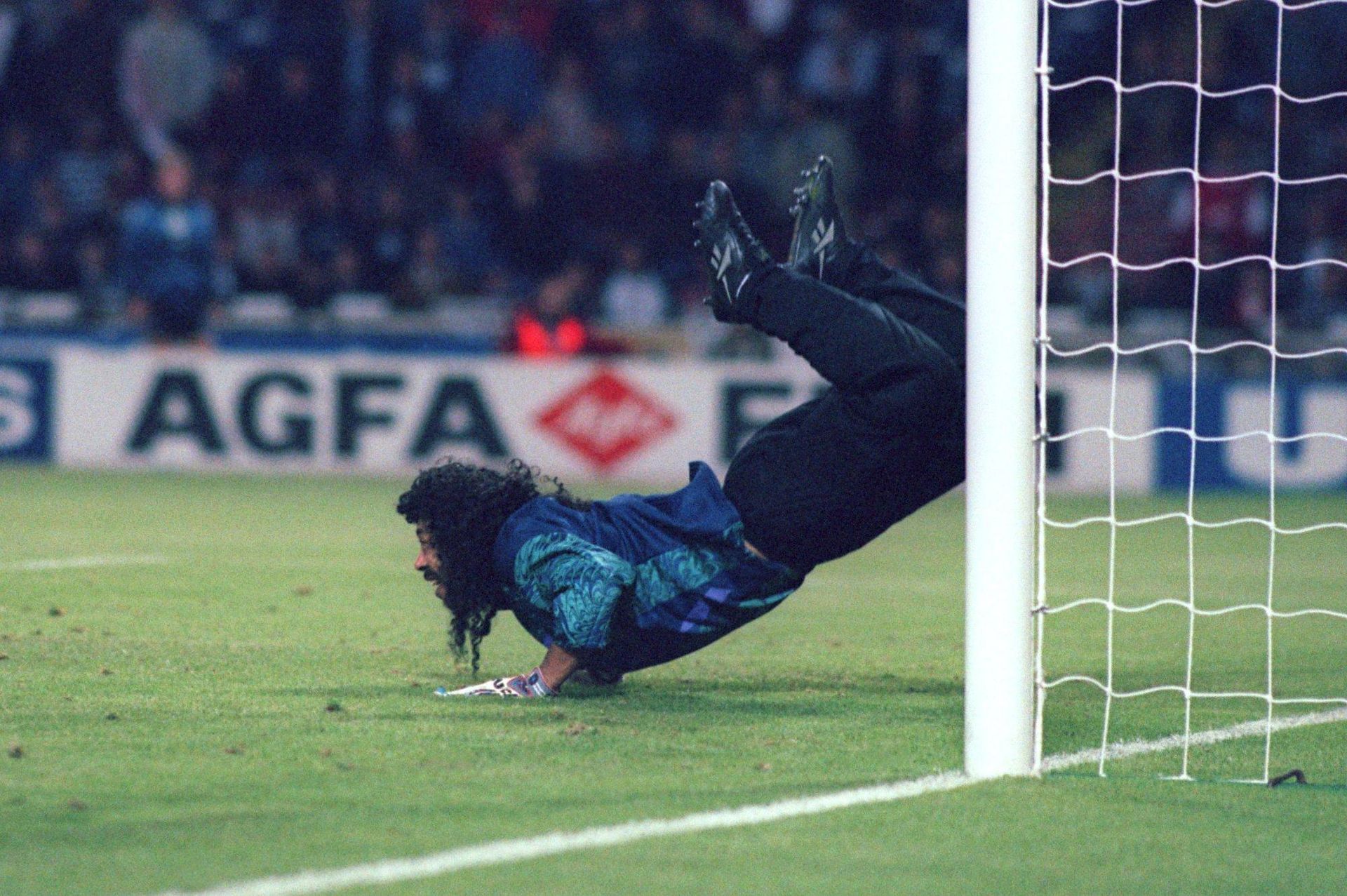
The second and more iconic form of the scorpion kick belongs to the legendary Colombian goalkeeper Rene Higuita. He immortalised the move during an international friendly against England at Wembley Stadium in 1995—a moment that remains one of football’s most audacious acts.
In that match, Higuita, wearing his trademark tracksuit bottoms, launched himself forward as a mishit cross from Jamie Redknapp drifted over his head. In mid-air, he swung both legs upward behind him, connecting cleanly with the ball and clearing it from danger with extraordinary flair.
Though some critics dismissed the act as unnecessary showboating, it was undeniably a stunning display of daring skill. Many believed at the time that the effort was meaningless, as Redknapp’s intended target was thought to be offside.
However, it was later confirmed that if the cross had gone directly into the goal, it would have stood—the referee had not blown the whistle, contrary to reports. That revelation only deepened appreciation for Higuita’s moment of pure football artistry, which has since become etched in the sport’s folklore.