India-UK trade agreement
Today is a very historic day in the economic and strategic relations between India and the United Kingdom (UK). After years of long negotiations between the two countries, the Free Trade Agreement (FTA) has finally become fully effective from today. With the implementation of this agreement, the way has been cleared for Indian exporters to get duty-free access to the British markets. This is not only a big booster dose for the Indian economy, but also reflects India's growing dominance in global trade. Let us understand in simple language who is going to get what from this historic deal, which sectors' fortunes will shine and what effect it will have on your pocket.
Under the Comprehensive Economic and Trade Agreement (CETA), India has been promised duty-free access to the UK on 99 per cent of tariff lines. This will benefit sectors ranging from textile, leather and footwear to marine products, engineering goods, chemicals and processed food. This is one of Britain's most important trade agreements after Brexit, which will give UK businesses greater access to the world's fastest growing consumer market. Still, trade experts say lower tariffs alone will not guarantee more exports. If Indian companies want to translate preferential market access into sustained export growth, they will now have to navigate stringent quality standards, certification requirements and non-tariff barriers.
According to TOI report, Ajay Srivastava, founder of Global Trade Research Initiative (GTRI) said that the agreement has opened the door, now India will have to convert this access into exports. Apart from the relaxation in tariffs, this 30-chapter agreement also includes issues like digital trade, government procurement, innovation, small business, sustainability and supply-chain strength, which shows India's growing ambition in trade negotiations. The biggest benefit for Indian exporters is the elimination of UK tariffs on labour-intensive sectors where India already has a manufacturing advantage. Garments, textiles, leather goods, footwear, seafood, processed food and certain agricultural products are expected to benefit the most from this.
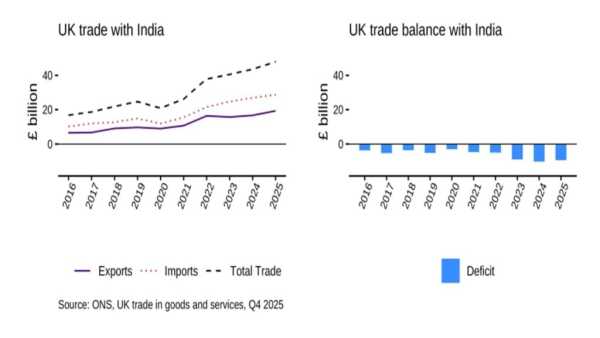
According to GTRI, Britain imported goods worth $928.9 billion in 2025, but India's share in this was only $15.2 billion or 1.6 percent. This shows that if Indian companies can improve their competitiveness, then there is a lot of scope for expansion. Processed food is one of the biggest opportunities that has not yet been fully exploited. The UK imported processed food worth $33.4 billion last year, while India's export was only $354 million, giving its market share only 1.1 percent.
This agreement is also expected to provide regulatory certainty to Indian service providers in sectors like information technology, financial services, healthcare and education. Business visitors and employees transferring within the same company are expected to benefit from more predictable mobility rules, while professionals such as Indian chefs, yoga instructors and classical musicians are also expected to get better access. Additionally, the accompanying 'Double Contribution Convention' increases the social security exemption period from three years to five years for Indian professionals on temporary work in the UK. This eliminates the need for double Social Security payments and reduces costs for both employees and employers.
Sector | Highest duty at present (%) |
marine | 20 |
transport/auto | 18 |
leather/footwear | 16 |
electrical machinery | 14 |
textile/Clothes | 12 |
headgear/glass/ceramic | 12 |
Wood/paper | 10 |
base metals | 10 |
Minerals | 8 |
chemicals | 8 |
plastic/Rubber | 8 |
mechanical machinery | 6 |
gems and jewelery | 4 |
Furniture/sporting goods | 4 |
Weapon/Circle–gunpowder | 2 |
Note: : dairy products, Apple, Edible oil and oats have been kept out of tariff concessions.. | |
For British exporters, one of the most noteworthy changes is India's phase-wise cut in import duty on UK-made vehicles. Tariffs, which are currently up to 110 per cent, will gradually reduce to 10 per cent over five years under a quota-based system, although electric, hybrid and hydrogen-powered vehicles are kept out of the concessional regime for the initial five-year period. Alternative-fuel vehicles costing more than £40,000 will only be eligible for phased tariff reductions from the sixth year onwards, subject to quota limits.
Despite optimism, analysts say several structural challenges may limit the immediate impact of the agreement. GTRI said exporters from different sectors will have to adhere to the UK's strict quality, food safety, traceability and technical certification requirements, especially in the case of food products, engineering goods and vehicles. Srivastava said that without parallel work on standards, certification, logistics, regulatory approvals and buyer networks, most of the opportunities will remain only on paper.
The think tank also warned that sectors such as chemicals and pharmaceuticals may see limited gains as regulatory approvals and procurement systems remain more important than tariff concessions. Steel export remains another matter of concern. Britain's safeguard reforms – including lower tariff-free quotas and 50 per cent duty on imports above those quotas – are hurting export prospects, even though about 85 per cent of Indian steel exports are outside the safeguard mechanism due to concessions.
Industry watchers also say there has been limited progress in talks on relaxing visa rules, as domestic political reasons in the UK have put a halt to the broader mobility commitments sought by India. For many micro, small and medium enterprises, complying with UK sanitary, phytosanitary and technical standards may prove to be a bigger hurdle than tariffs, suggesting that the real test of the agreement will only begin after its implementation. Although the FTA significantly reduces trade barriers, experts say its long-term success will depend less on tariff concessions and more on India's ability to improve product quality, strengthen supply chains, expand certification capacity and build strong commercial networks in the British market.