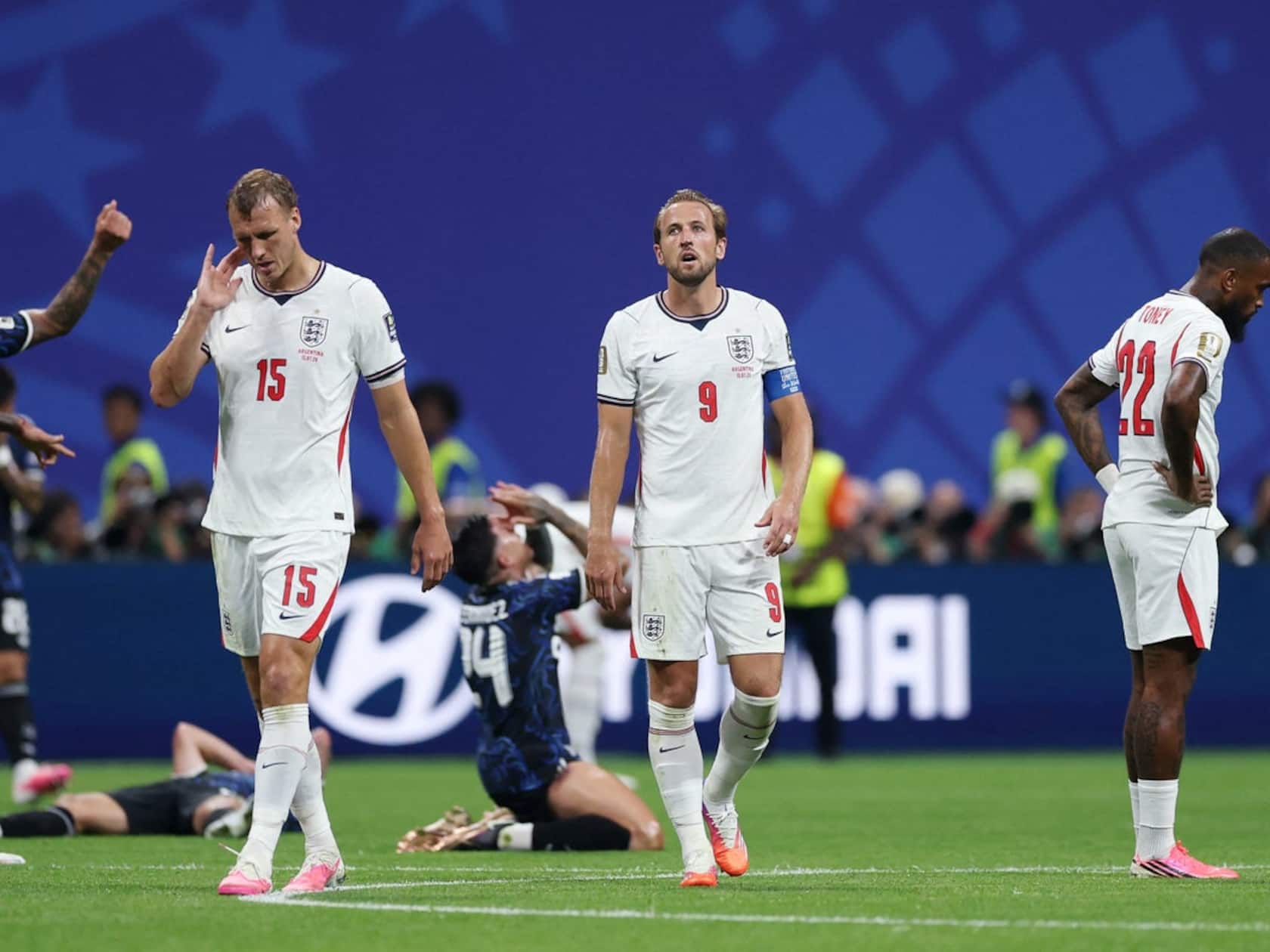
Some fans had already begun to celebrate on the pitch. They thought it was all over. Then came the moment — Lionel Messi’s cross, Lautaro Martinez’s header, and the Argentina substitutes sprinting towards the corner flag in jubilation. England’s dream of lifting the World Cup had ended. Sixty years of longing, sixty years since Geoff Hurst’s heroics, and England are still left recalling Bobby Moore’s famous tackle and Nobby Stiles’ dance.
The fact remains that the only time England’s men have won a World Cup semi-final was when Bobby Charlton struck that decisive goal; they have not reached a final since. For a fleeting thirty minutes, it appeared that Anthony Gordon might join Charlton in that exclusive group of Englishmen to score a semi-final winner. For fifteen minutes more, it seemed as if Djed Spence’s thunderous challenge on Giuliano Simeone would be spoken of in the same breath as Moore’s iconic stop on Pele.
Jordan Pickford, too, had his Gordon Banks moment with a stunning save to deny Nico Gonzalez. Yet, in the end, all these heroic efforts came in vain. In years ahead, they will be remembered as footnotes rather than enduring chapters in England’s football history.
For Thomas Tuchel, the comparison is not with Sir Alf Ramsey — England’s most legendary manager — but with his immediate predecessor and arguably the nation’s second-best coach, Gareth Southgate. England have just concluded what may be considered their second strongest decade in football, but the inability to hold onto leads in major tournaments continues to haunt them. This defeat completed an unwelcome hat-trick: after Croatia in the 2018 semi-final and Italy in the Euro 2020 final, now Argentina in 2026.
On previous occasions, Southgate’s teams struggled to retain possession at crucial moments. Tuchel’s side, however, didn’t even try. They chose to concede territory to Argentina, attempting to recreate the heroic defensive stand from Mexico City — only this time with eleven men, and far too early in the game.
England effectively invited pressure. Tuchel’s shift to a back five backfired badly. In reality, it often looked like a back six, as Nico O’Reilly slotted deep into a midfield that lacked balance. That tactical setup gave Alexis Mac Allister space to strike the woodwork twice and allowed Enzo Fernandez the freedom to blast home the equaliser. It also liberated Messi. Just when it appeared his World Cup journey was nearing its end, he produced two moments of magic — two assists that turned the game.
Removing Gordon, a tireless forward who often exhausts himself through effort, had some logic. Yet by replacing him with Ezri Konsa, Tuchel removed England’s attacking threat — and with 27 minutes plus injury time still to play. He then introduced Dan Burn, perhaps imagining that Messi’s nemesis might be a man twice his height who could head the ball halfway up the pitch. It was not to be.
With each substitution, England surrendered more control to Argentina — and the South Americans needed no second invitation. This was a team with a deep-rooted rivalry against England and an unyielding will to fight. Argentina’s habit of scoring late goals resurfaced once again. Ask Cape Verde, Egypt, or Switzerland. Against a stronger English side, the story remained unchanged.
Tuchel’s approach also highlighted a familiar irony: foreign managers of England often end up adopting a more conservative English style. Sven-Goran Eriksson clung to 4-4-2, Fabio Capello did the same, and now Tuchel, though tactically flexible, chose not to trust his players’ ability to keep possession. He set them up merely to defend.
It’s possible that different choices may not have altered the result, but alternatives were available. Kobbie Mainoo, a composed passer, remained unused throughout the tournament. Adam Wharton, another technically gifted midfielder, wasn’t even in the squad. Winger Bukayo Saka never left the bench, and Marcus Rashford appeared only in the 95th minute.
Tuchel might have taken cues from earlier matches. Lionel Scaloni had admitted that Switzerland’s physical approach unsettled Argentina. Lisandro Martinez and Cristian Romero both received bookings for pulling back English players like Morgan Rogers and Jude Bellingham when they ran at them — yet England stopped pressing. They retreated, seeking refuge inside their own penalty area.
Argentina, true to form, tried to provoke England, reviving echoes of old rivalries by fielding a Simeone — Giuliano — whose feisty style showed that mischief runs in the family. But Argentina triumphed not through gamesmanship, but through attacking intent. Their response was that of champions.
England, meanwhile, will look back with regret, having let Argentina off the hook. Their reaction followed Tuchel’s familiar blueprint for defending a lead — more defensive changes. Argentina could have predicted it; the same had occurred against Mexico and Norway. And when the analysis begins, Tuchel will have to reflect on how Southgate, once criticised for cautious tactics, had improved his in-game management during Euro 2024 with bold attacking substitutions — often involving Cole Palmer, another player omitted this time.
Perhaps this is an old debate revisited, but England ended the night as a limited team showing their limitations. Leading Argentina in Atlanta was a golden opportunity. For years to come, they will have Georgia on their minds — perhaps for another sixty years.