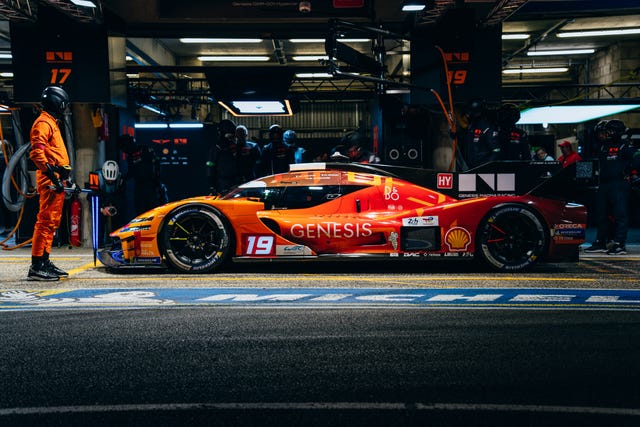
When the Genesis GMR-001 finally crossed the finish line at the 2026 edition of the 24 Hours of Le Mans, it hardly felt like a surprise. The car had already earned points in an FIA World Endurance Championship (WEC) round, qualified in the top ten at Le Mans, and completed 24 hours of continuous racing with just one major issue across two cars. By that stage, bringing the car home seemed to be the logical outcome rather than an extraordinary achievement.
However, looking back reveals the magnitude of what the South Korean automaker managed to accomplish. Less than 600 days earlier, Genesis did not have any motorsport programme in place. In fact, no Korean manufacturer had ever competed at such a high level of international endurance racing. When Genesis received the go-ahead in September 2024, it faced an incredibly tight schedule to transform its vision into reality. Yet by December of the same year, the company had already produced a scale design model, secured a chassis partnership with Oreca, and announced plans for a new V-8 engine—derived from a four-cylinder rallying powerplant, no less.
Just 499 days after that announcement, Genesis debuted its first race car at Imola. During that period, the company built a full-fledged factory team, making Genesis Magma Racing far more than just a nameplate attached to an existing operation. A collaboration with LMP2 outfit IDEC Sport gave Genesis its initial experience at Le Mans in June 2025, while the GMR programme concentrated on constructing, testing, and refining the LMDh-spec GMR-001 prototype. Over the course of 2025, the team progressed from assembling its first engine to putting its car on the track for the first time.
When the delayed 2026 FIA World Endurance Championship began at Imola, South Korea’s only luxury car brand had homologated its first-ever race car. It was immediately thrust into competition with iconic names like Ferrari, Toyota, Cadillac, BMW, Alpine, Peugeot, and Aston Martin—manufacturers with decades of racing heritage. Genesis stood alone as the newcomer among seven brands that had already claimed overall victories at Le Mans, along with a corporate cousin of the Corvette team that boasts three decades of GT-class success at the event.
The GMR-001 didn’t arrive as an instant race winner, but its solid early performances culminated in Genesis scoring its first-ever world championship points after an eventful race at Spa allowed slower cars to secure top-ten finishes. In the lead-up to Le Mans, the team appeared capable of repeating that success purely on pace. Both GMR-001 entries reached the final qualifying round, earning two top-ten grid positions within the 18-car Hypercar category.
Once the race began, however, the underdog story took a different turn. The two Genesis cars slipped out of the top ten early as seasoned competitors from Ferrari and Toyota climbed through the field. Nonetheless, Genesis maintained competitive pace against the Peugeots and Aston Martins—two hypercars developed by long-established manufacturers with a history of top-level prototype racing. With steady reliability and typical Le Mans attrition, Genesis had a realistic shot at repeating its points finish from Spa.
That reliability, though, became the team’s biggest challenge. The No. 19 car encountered an issue overnight, falling several laps behind the leaders. Early on Sunday morning, the No. 17 GMR-001 suffered a major suspension failure and came to a halt on track. After it was towed back to the garage, the team decided to retire the car. The No. 19 soldiered on, eventually finishing nine laps down in 13th place.
While the result may seem modest at first glance, it far exceeded expectations within endurance racing circles. Competing at this level is immensely difficult, as both Peugeot and Aston Martin discovered while battling through their own challenges during this year’s 24-hour race. For Genesis, simply staying competitive with experienced rivals was a remarkable accomplishment—and unlike Lamborghini’s short-lived SC 63 programme, Genesis leadership has made it clear that they intend to keep investing in the GMR-001 project well beyond its promising debut.
Beyond the immediate results, the team’s participation itself represents a significant achievement. Genesis leaves Le Mans not with championship points, but with the distinction of being the first South Korean manufacturer ever to finish the legendary race. Indeed, it is also the only Korean company to qualify, start, and have a car still running at the halfway mark. For a brand attempting something unprecedented, even reaching the finish line stands as a historic milestone.
This marks only the beginning of Genesis’s and the Hyundai Motor Group’s broader ambitions in motorsport. The company has already hinted through concept vehicles that a road-going supercar and a GT racing machine could follow. Combined with the leadership’s expansive vision for future vehicle development and product strategy, Genesis’s motorsport journey appears poised for rapid and ambitious growth in multiple directions.