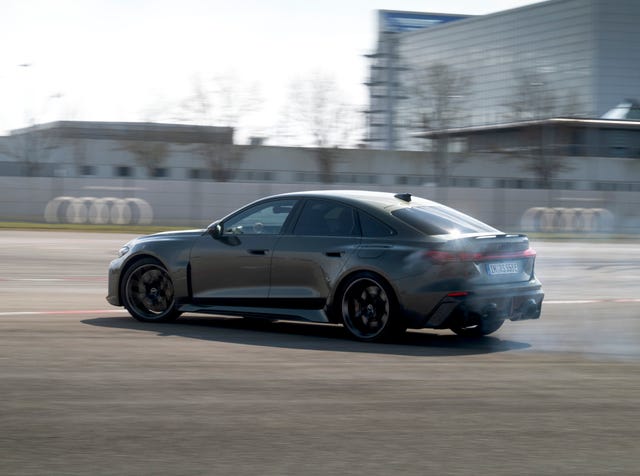
Audi has long taken pride in its Quattro all-wheel-drive legacy, frequently highlighting its history of producing outstanding AWD performance cars. With the introduction of the new plug-in hybrid RS5, Audi brings a completely redefined Quattro experience, powered by an innovative electro-mechanical torque vectoring differential. The technology is referred to as Quattro with Dynamic Torque Control.
Control has always been a core element of Audi’s Quattro systems, and this new torque vectoring setup takes that concept to a dramatic new level. One of its key attractions is its ability to let drivers experience controlled oversteer while maintaining perfect stability. The ease with which the RS5 allows for such driving antics cannot be overstated. What truly sets this system apart is its precision in generating and managing yaw moments during braking and corner entry, responding with remarkable quickness and accuracy. It effectively combines the properties of a conventional limited-slip differential with rear mechanical torque vectoring, outperforming both systems individually.
This 187-pound electro-mechanical assembly, developed jointly by Audi and Borg Warner, is situated on the rear axle. At its heart lies a 400-volt, 11-horsepower, 30-pound-foot permanent magnet electric motor that acts as the actuator for the system. This motor works in tandem with a superimposed gearset and an open differential. Thanks to torque multiplication, the motor can generate torque differences of up to 1475 lb-ft to either wheel in both directions, reacting in as little as 15 milliseconds. It’s an astonishing display of torque control capability.
Traditionally, mechanical torque vectoring has been understood as a system that redistributes torque between drive wheels to help the car accelerate through corners. The Honda Prelude SH was the first production vehicle to employ active torque vectoring, and many manufacturers have since adopted similar systems. The basic principle remains consistent—overdriving the outer wheel during corner exit to improve stability and reduce understeer. However, torque vectoring on rear- or all-wheel-drive cars can also promote controlled slides. Audi already implements such behavior in the RS3, known for its lively rear end.
Dynamic Torque Control takes things much further, with significantly higher torque capacity (1475 lb-ft compared to the RS3’s clutch-based system at 885 lb-ft), extreme precision, and the ability to reverse torque flow for superior turn-in stability compared to traditional limited-slip units.
While Audi’s animations demonstrate the system’s operation effectively, chassis engineer Andreas Sticht offers a detailed explanation.
“When we are slightly on the brakes and simultaneously steering into a corner,” explains Sticht, “the car tends to rotate more than desired. To stabilize it, we manage drag torque distribution—applying higher drag torque at the rear right wheel during a left-hand corner, which slows down the vehicle’s yaw motion.”
Although a limited-slip differential performs a similar stabilizing role, it’s constrained by available drag torque until wheel speeds equalize. In contrast, Audi’s Dynamic Torque Control imposes no such limitation. It can deliver any desired stabilizing torque instantly and precisely. For instance, if 220 lb-ft of drag torque is needed to guide the RS5 into a corner under trail braking, that’s exactly what the system applies. The level of control is near uncanny.
As expected, the system performs the traditional torque vectoring function on corner exit by directing additional torque to the outer rear wheel. What’s unusual, though, is that it doesn’t merely shift a percentage of total rear torque. Instead, it can supply up to 1475 lb-ft to either side independently. This could mean all 1475 lb-ft to one wheel, or an equal split of 737 lb-ft of positive torque and 737 lb-ft of drag torque across both sides. It’s an unconventional but highly effective approach.
For drivers, the result is versatility—the RS5 can transform from a drift-friendly machine to a perfectly stable cornering tool, depending on the selected drive mode. The RS Torque Rear mode, for example, behaves quite differently from Comfort mode. Sticht points out that sustaining a drift is now easier than ever, and recovering from it requires no advanced driving skill.
“Once the car begins rotating, we have full control to dial back the agility and redirect torque inward,” Sticht adds. “We can slow the rotation rate seamlessly if we choose to.”
Even rapid maneuvers that would typically unsettle a car are now handled by the differential itself.
“If you’re traveling at 150 km/h and perform a quick lane change, the system injects torque to initiate the motion and immediately applies stabilizing torque afterward,” Sticht explains. “This prevents oscillation and allows the car to settle almost instantly.”
According to Audi, this level of precision is possible thanks to the high-speed electromechanical actuation and the integration of multiple dynamic systems through a central control unit. This computer processes data from across the vehicle, enabling seamless coordination between subsystems. Sticht particularly emphasizes the synergy between adaptive dampers and the rear differential.
“We need close coordination between damping and torque vectoring,” he says. “When torque is applied to rotate the car, the dampers must simultaneously manage chassis roll. That’s why central integration is essential—it ensures both systems work in harmony.”
While the system’s complexity might suggest high energy consumption and heat generation, Audi assures that the RS5’s 400-volt plug-in hybrid platform makes it feasible. Sticht notes that although such a system could theoretically function on a 48-volt setup, it would require a larger motor, creating packaging and weight issues. The only significant thermal management concern is cooling the electric motor and power electronics. Sticht confirms that both are well managed, even under track conditions.
“The power electronics and the motor stator are water-cooled,” Sticht explains. “The system is designed so that the cooling period between corners is sufficient to maintain thermal stability. Even during aggressive driving, the heat generated by the electronics dissipates quickly enough to prevent thermal degradation.”
Audi rigorously tested the system at its proving grounds and on racetracks, including the Nürburgring, to ensure thermal reliability. Sticht confirms that the full 1475 lb-ft torque capacity remains consistently available.
“It doesn’t de-rate,” he asserts. “The system is engineered to maintain full torque output through long corner exits in second or third gear, and it cools down adequately before the next corner.”
While Audi has not detailed specific future applications for the Dynamic Torque Control differential, it strongly hints that the RS5 will not be the only model to feature it.
“For us, this is a game changer and the gateway to a new level of vehicle dynamics,” says Sticht. “Full stop.”
It’s reasonable to expect that more Audi Sport models will adopt this breakthrough technology, promising a significant leap forward in handling performance across the brand—a preview of which we’ve already seen in the RS5’s first drive impressions.