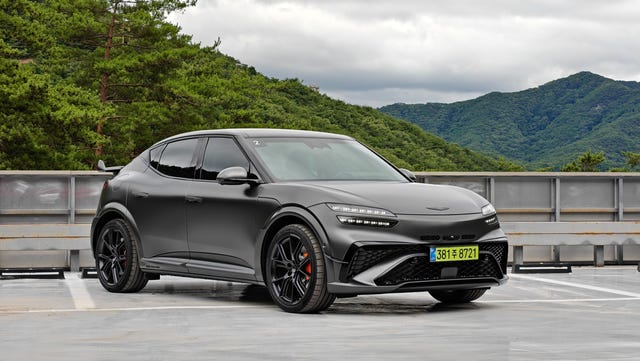
The introduction of the Magma division marks a major milestone for Genesis. In just over a decade since its inception, the Korean luxury automaker now boasts its own performance arm. The brand made its debut with an ambitious entry at the 24 Hours of Le Mans, followed soon after by the launch of its first production model under this new banner. That very car brought me on a 14-hour flight to South Korea for an exclusive first drive.
This sleek, compact, coupe-styled, all-electric SUV is the 2027 Genesis GV60 Magma. While the standard GV60 already carries a sporty flair, it doesn’t quite deliver the full performance car experience from behind the wheel. Much like the transformation between the Hyundai Ioniq 5 and the Ioniq 5 N, the GV60 Magma offers a completely different driving character from its base model. Sharing the same E-GMP EV platform, it benefits from the engineering expertise and components developed for the acclaimed Ioniq 5 N.
When it comes to performance EVs, power is a given—and the GV60 Magma lives up to that expectation with 641 hp and up to 583 lb-ft of torque in Boost Mode. These figures are available for 15-second bursts, while the continuous output stands at 600 hp and 546 lb-ft. With dual electric motors providing all-wheel drive—where the rear motor is the more powerful of the two—the SUV sprints from 0 to 62 mph in a claimed 3.4 seconds, reaching a top speed of 164 mph.
Although the GV60 Magma’s numbers don’t rewrite the EV performance rulebook, what truly differentiates it is its driving sensation—thanks to the same innovations Hyundai introduced in the Ioniq 5 N. The Magma features two key systems: VGS (Virtual Gear Shift) and e-ASD+ (e-Active Sound Design Plus). Together, they simulate gear shifts and engine noises, creating a surprisingly authentic impression of an internal combustion engine-powered vehicle.
In Genesis style, the brand has added its own twist to this technology. Rather than mimicking the turbocharged four-cylinder sound found in the Hyundai, the GV60 Magma emulates the tone of a high-revving, naturally aspirated V6. The digital tachometer even revs up to 9000 rpm. When asked whether a specific engine inspired this sound, Genesis representatives didn’t specify. To my ear, the sound seems to fall somewhere between a Porsche 911 GT3 and a McLaren Artura—a sharp, exotic wail that feels delightfully out of place in a compact performance SUV.
Genesis has even gone as far as replicating the torque curve of a free-revving V6. Acceleration feels subdued below 3000 rpm, then builds progressively as the “revs” climb to 9000. The simulated shifting behavior is remarkably convincing, mimicking the nuances of an eight-speed dual-clutch gearbox. The effect includes subtle torque interruptions during shifts and a natural sense of engine braking when easing off the throttle.
While this system may not convert die-hard petrolheads to electric propulsion, it certainly makes the EV experience more immersive and approachable. Drivers can instinctively gauge speed by sound and simulated gear, allowing for a more natural rhythm on twisty roads. The GV60 Magma’s sound profile is distinct from the Ioniq 5 N, though arguably a bit bold and theatrical for a four-door SUV. For those who prefer a more futuristic electric tone—or complete silence—Genesis offers customization through the vehicle settings.
My time behind the wheel in South Korea was limited, making it difficult to fully assess the GV60 Magma’s chassis. Despite the country’s mountainous terrain, my roughly 30-minute test route was dominated by highways, heavy traffic, and strict 30 km/h (18.6 mph) limits on the few suitable twisty roads—complete with speed bumps designed to enforce them.
Even so, the brief moments of open road revealed that this is a far more capable machine than the standard GV60. The Magma features its own lower control arms, hub carriers, and link structures, creating unique suspension geometry and lowering the roll center. Engineers have reinforced the chassis with structural adhesive and 20 additional weld points for improved rigidity. Combine that with Magma-exclusive bushings, adaptive dampers, an electronically controlled limited-slip differential at the rear, forged 21-inch wheels, and staggered Pirelli P-Zero summer tires, and the result is a serious performance package.
The GV60 Magma’s handling limits are clearly high—so high that a proper racetrack would be needed to fully explore them. Steering feel is substantial, though not razor-sharp, and the car communicates more vividly through the wheel and its supportive bucket seats, thanks to the stiffer structure. Like most well-engineered EVs, the Magma hides its weight well, but a fast downhill stretch still made its 4938-pound curb weight apparent. The braking system, borrowed from the track-prepped Ioniq 5 N, should have no trouble managing that mass.
Despite its performance focus, the GV60 Magma still delivers comfort when needed. Switching to Comfort mode softens its firm character from Sprint and Sport modes, offering a surprisingly compliant ride on highways. With the synthetic shifting and sound effects turned off, it behaves like any refined EV—quiet except for tire and wind noise. Genesis also fitted thicker acoustic glass and added more sound insulation to counteract the wider performance tires.
The GV60 Magma’s battery technology mirrors that of the Ioniq 5 N. In Race Mode, the system actively manages temperature to maintain consistent power. Drivers can choose between endurance or qualifying modes depending on driving conditions. The 84-kilowatt-hour battery pack is expected to deliver around 230 miles of range, according to Genesis—22 miles less than the GV60 Performance, which is understandable given the Magma’s increased output and grippier setup.
Visually, the GV60 Magma stands out from its standard counterpart, even without any “Magma” badging. The exterior enhancements include front bumper canards, a triple-opening front grille, and a large rear spoiler with winglets. These additions are subtle yet functional, designed to reduce lift and generate meaningful downforce at speed.
Buyers will have a choice of exterior finishes including orange, matte grey, black, and white. The cabin, however, will only be available in a striking black-and-orange stitching combination, while white stitching will be offered in select markets. Genesis has developed new bucket seats for the Magma that balance sportiness with luxury—heated, ventilated, and power-adjustable, they provide both comfort and excellent lateral support.
The digital interface is equally engaging. Activating one of the Magma-exclusive drive modes with VGS brings up an orange-themed instrument cluster centered around a large tachometer. In manual mode, the system even lets drivers hit the rev limiter at 9000 rpm, simulating a bounce off the limiter for realism. The only real letdown inside is the paddle shifters, which feel somewhat plasticky despite their size and importance to the driving experience.
Overall, this first encounter with the GV60 Magma leaves a strong impression, though it’s too early for a definitive verdict. A Genesis spokesperson confirmed that the Korean-spec cars tested may differ from the U.S. versions in terms of suspension and steering calibration, and other regional tweaks—possibly in powertrain or sound—are expected. Pricing details are still under wraps, but Genesis has announced that the GV60 Magma will arrive in the U.S. in July. When it does, it promises to be one of the most engaging performance EVs available and a highly encouraging start for the Magma performance sub-brand.