
A few days earlier, she had left for the United Kingdom to study. Only after the vehicle disappeared from sight did he turn and head home. “From now on, I’m truly unemployed,” the 55-year-old living in Tu Liem Ward, told his wife.
At an apartment in Thanh Xuan Ward, Phuong Hao, 50, came home from work and out of habit called out: “Nhi, come help mum carry the bags.” No one replied. She froze for a moment before remembering that her daughter was 10,000 kilometers away.
As students prepare to start university or head abroad to study, many families enter a period of transition. Children begin building their own lives far from home while parents must learn to adapt to a “new normal.” Routines repeated for decades, school runs, preparing dinner, helping with homework, suddenly vanish from daily life.
The resulting sense of loss gives rise to the empty nest syndrome.
According to a report by UNESCO and the Ministry of Education and Training, as of the 2025-2026 academic year Vietnam has more than 250,000 students studying abroad.
“The phase is a necessary transitional milestone for children to achieve independence and for parents to redefine their own lives,” Dr. Hoang Phuong of the British University Vietnam says.
As director of a study abroad consultancy, Phuong Hao had helped hundreds of students prepare for the journey, but it was only when she went through it herself that she truly felt the disruption. When her son left for the U.K. 10 years ago, life changed little because her daughter was still at home. Even so, she kept everything in his room exactly as he had left it.
Every so often, she would open social media to rewatch videos of him playing football. Once, spotting a teenage boy on the street wearing the same shirt as her son, she stood still for a long time. The real psychological crisis hit when her second child, her daughter, also left for the U.K. last year.
“Every day I open the door and walk in, I have to face the silence,” she says.
To ward off the emptiness, the first thing she does when she gets home is turn on every light and open all the bedroom doors. She moved her work desk into her daughter’s room to feel a little closer to her.
“There are mornings when I rush over in a panic to knock on her door and call her to get up for school, only to remember she is far away,” she says.
|
A parent hugs their child before the 2023 university entrance exam in Hanoi. Photo by Giang Huy |
Missing them often comes with anxiety.
Because of the time difference, many parents stay awake until two or three in the morning just to see a green dot confirming their child is online. One of Hao’s clients once panicked after seeing that her child had been offline for eleven hours straight.
Quang Khai and his wife also went through an anxious stretch when they learned their daughter had been robbed of her phone, and again when the dormitory cut off internet access after 10 p.m.
According to Phuong, what parents feel in these moments is an “identity crisis.” For two decades, the role of caregiver has been the central purpose of their lives. But when a child leaves home, the empty house is only the surface; the deeper cause is that parents have suddenly lost their emotional anchor, she says.
Years of close involvement can also inadvertently create a “role addiction”, a form of emotional dependence on being the protector, which makes parents feel adrift when children no longer need them in that way, she says.
In many Asian cultures, where parents tend to build much of their lives around their children, this feeling is especially pronounced, she explains. “Letting go is not just a behavioral change, it is an ideological revolution.”
 |
|
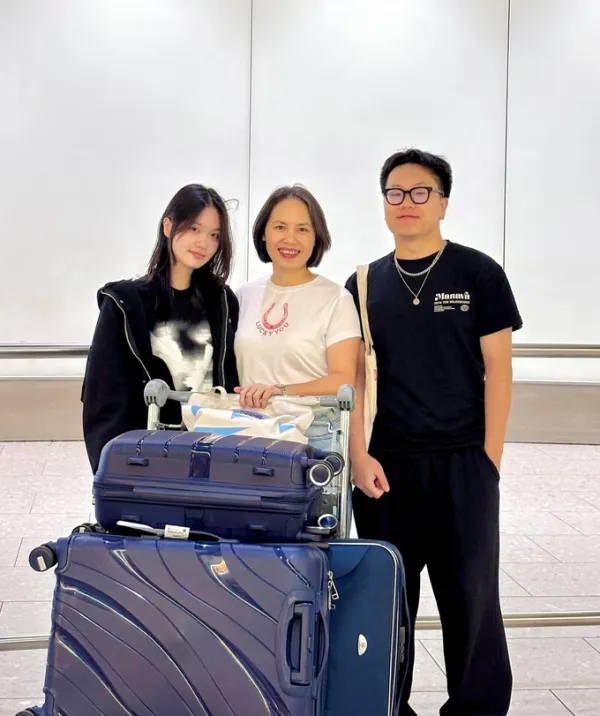
Phuong Hao sees her two children off at the airport in 2025. Photo courtesy of Hao |
A transitional phase for the whole family
The process of letting go also calls for help from the children themselves. Having been closely monitored by his mother throughout secondary school, Minh Thanh, 19, a university student in Hanoi, found himself under equally strict supervision when he moved to the city.
From their hometown, his mother tracked his eating and sleeping schedule over phone and sent care packages every week without fail. “If I was a little slow to reply to a message, the two of us would end up tense,” he says.
Feeling stifled, he turned to his father for help, asking him to take his mother out more. The turning point came when she signed up for a yoga class and began building new friendships. A busier life helped her fill the psychological void. “Now whether I come home late or go out early or want to eat whatever I like, she doesn’t have the time to worry about it anymore,” he says.
According to Phuong, to move through the empty nest phase, parents need the courage to “break their addiction to control.”
From the time children are in school, parents should shift from a surveillance mindset to a “scaffolding” approach, supporting children in completing tasks and then gradually stepping back, she says.
Allowing children to stumble is precisely how their psychological resilience is built, she points out.
This understanding of parenting has borne fruit. Hao’s son completed his master’s degree in the U.K. and is preparing to take up citizenship there. Her daughter achieved straight A’s in her first year of secondary school.
Khai’s daughter has also managed to organize her own studies and daily life abroad.
Hao herself has found a new equilibrium. In the early days after her children left, she treated it as a time to “decompress”, a break from the kitchen. But she eventually realized she needed to maintain regular routines, keep cooking, and look after her health.
“I tell my children they must live tidily and know how to take care of themselves. If I can’t do that myself, it’s hard to set an example,” she says.
Looking back on her journey through empty nest syndrome, Hao has come to a quiet realization. “People assume that once you’re free from the caregiver role you’ll have freedom and peace, but the truth is that when your children go away to study, it’s actually the parents who have to learn how to be independent.”