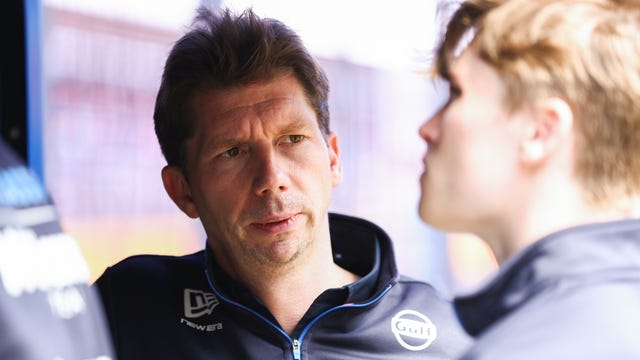
When James Vowles took charge as the Team Principal of Williams F1 in January 2023, the once-dominant team was struggling, having finished 10th in the Constructors’ Championship for the fourth time in five years. The former Mercedes strategist faced a monumental challenge—reviving a team that had lost its way, a task he likened to steering a massive ship that takes time to change direction.
Vowles began reconstructing the foundation of the team, introducing new systems and bringing in key personnel. His most notable move came in the summer of 2024, when he convinced Carlos Sainz to join Williams after presenting his long-term vision. The decision paid off handsomely when the team secured fifth place in the 2025 Constructors’ standings, with Sainz exceeding expectations by scoring a couple of podium finishes.
The 2026 season, however, has proven more challenging. The FW48 made its debut later than planned, missing the first pre-season test in Barcelona, and arrived overweight. Even so, those factors alone didn’t fully explain its lackluster performance in the early rounds. Although the car gradually improved, allowing Sainz and teammate Alex Albon to occasionally score points in high-attrition races, it still suffers from some core issues.
In response, Williams has decided to undertake a major redevelopment—similar to the approach adopted by Aston Martin—by introducing a heavily revised “B-spec” version of the FW48 for the Azerbaijan Grand Prix in September. Assuming the current calendar retains its two Middle Eastern rounds, Sainz and Albon will have eight races to improve results and lift the team from its current eighth place in the standings. Implementing such a mid-season transformation is a massive undertaking and effectively admits that the original car concept missed the mark.
Vowles regards this as a vital test for the team. “In terms of our direction, we must, as an organisation, demonstrate that we can deliver engineering quality and build a car of high standards within the season,” he said. “It’s essentially like flying a plane while rebuilding it mid-air. But we need to prove, both to ourselves and others, that we’ve evolved from where we were three years ago, and that we now have that capability. At the moment, we’re on course to achieve it.”
He drew parallels with Aston Martin’s current efforts, where Adrian Newey is also leading a transformation and developing a significantly reworked car during the season. “We lacked proper process systems and the structural foundation behind them. I know what efficient organisations look like, and even today, we’re still struggling to match what others can do at this point. It’s our responsibility to fix that,” Vowles explained. “The challenge is doing all this while continuing to move forward on-track.”
The case of Williams highlights just how demanding Formula 1 can be, particularly for midfield teams trying to challenge the top-four powerhouses—Mercedes, Ferrari, Red Bull, and McLaren. Although Williams had made steady progress in recent years, overhauling deep-rooted work processes takes time. Doing so while developing a new car to meet fresh regulations only adds to the complexity.
It’s no surprise that in 2026 the leading four teams have pulled ahead again after the field had gradually tightened under the previous rules. Entering this season, top teams were already equipped to focus purely on performance, while outfits like Williams were still refining their internal processes. Vowles anticipated that 2026 would be challenging—but it turned out to be even tougher. “I expected we’d build a car that was slightly overweight but generally delivered on time,” he said. “We never claimed to be the benchmark this year. The car should at least have worked as intended, but we fell short of that expectation.”
Williams’s main struggle over the winter was keeping up with its development timeline. Designing an F1 car involves thousands of new components being designed, manufactured, and assembled at precise intervals. Managing that while simultaneously developing the underlying operational systems is like playing three-dimensional chess—if one element falters, the entire schedule collapses.
“The first time the data highlighted issues, it was far too late in the process to make corrections,” Vowles explained. “And the strange thing is, when you fall three weeks behind—like we did—it becomes unrecoverable. You can’t catch up because every other part of the system is already scheduled. Once one component is delayed, the entire chain falls apart. The effort needed to recover from that is enormous, and the only way forward is compromise, which is what we’re seeing now.”
Despite the setbacks, Vowles remains optimistic and views the tough 2026 season as a valuable learning experience in closing the gap to the top teams, including his former employer. “Understanding the capacity your operations facility can handle is data that Mercedes built up over at least a decade—from around 2010 to 2026,” he noted. “We’ve gathered similar data in just one year, during this winter. It’s not only about process systems but also about the working methods and expertise that come with them.”
Vowles chooses to see the positives. “Never let a good crisis go to waste. The changes we’ve made have positioned us well for the future, and I doubt we would have made them if this winter had gone even moderately well,” he said. “So, as painful as this period has been, I believe it was a necessary step for our long-term progress.”