
Shopping for an Indian wedding is one of life’s biggest emotional and financial milestones. Months of planning eventually lead to a handful of purchases that define the celebration. But no expense is greater than the cost of buying bridal jewellery. It is one of the few wedding expenses that preserve family wealth and become heirlooms for future generations.
That is why families walk into jewellery showrooms with expectations that go far beyond beauty. They want pieces that reflect rich craftsmanship, feel grand enough for one of life’s biggest occasions, and, above all, never lose their value. And almost every wedding jewellery has a special place for diamonds.
Sanjana Tripuramallu, now the founder of Cosmos Diamonds, had to navigate this high-stakes process during the peak of the pandemic. A graduate of the National Institute of Design with an entrepreneurial itch, she began hunting for her perfect engagement ring in June 2020, ahead of her wedding on May 13, 2021.
Looking at the jewellery industry through the lens of a bride-to-be changed everything for her. While shopping for her jewellery, she found that the diamonds were too expensive and didn’t offer good resale value, a realisation that made her notice how out of reach they were for the average buyer. The experience stayed with her longer than expected.
“I remember walking out of those stores thinking, ‘Why should owning diamond jewellery feel so out of reach for so many people?’ That thought stayed with me. I knew I wanted to change it, but I had no idea how…” Tripuramallu said.
A Diamond In The Rough
During this time, India was witnessing a surge in demand for lab-grown diamonds. While the trend caught Tripuramallu’s attention, she also noticed a deeper gap — the heavy heritage jewellery Indian brides loved and the assurance that the jewellery would retain its value were missing from the market.
Combining her design background with her family’s entrepreneurial mindset, she founded Cosmos Diamonds in 2021 to bridge the gap.
Tripuramallu believed that simply offering a cheaper alternative wasn’t enough. To win over Indian wedding buyers and compete with established brands like Tanishq and Kalyan, she had to solve the two biggest concerns holding people back.
“If we wanted families to choose lab-grown diamonds, we couldn’t just make them affordable. We had to give them the same trust and sense of tradition as conventional jewellery,” the founder said.
Tripuramallu’s first challenge was to understand the consumer mindset — what buyers truly wanted and what would persuade them to choose a new brand over traditional ones. For this, she interacted with more than 1,000 women.
Her takeaways? Indian buyers needed lab-grown jewellery that didn’t feel like a compromise; they needed culturally significant designs and an absolute guarantee that they could safely get their money back if they ever chose to return or exchange it.
Today, the brand’s business model is anchored around the same grand, heritage-inspired design architecture and a contractual 100% buyback programme. This has helped the brand bring the traditional financial security of gold retail into the modern lab-grown diamond ecosystem.
Translating this trust-first model into a premium retail experience paid off.
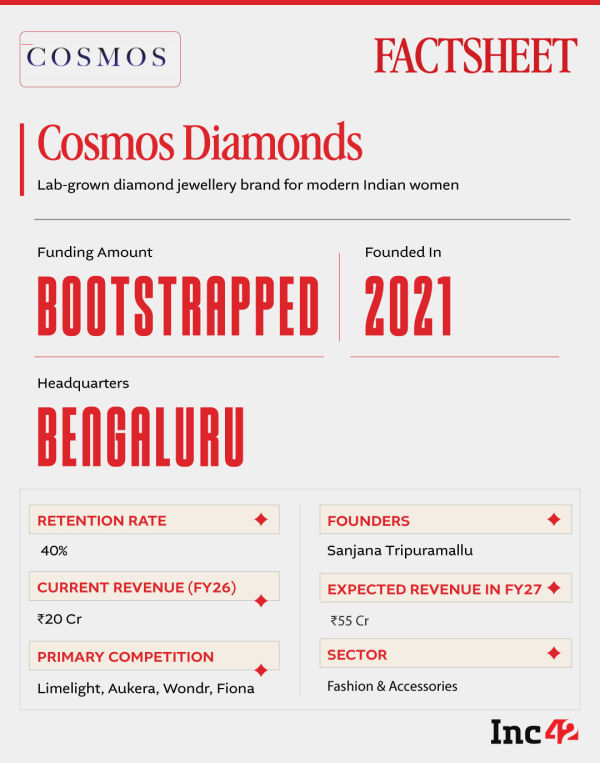
Today, Cosmos Diamonds operates physical flagship stores in Bengaluru and Vijayawada in Andhra Pradesh. The company reported revenue of ₹20 Cr in FY26, doubling its FY25 performance of ₹9.77 Cr.
Currently running at a steady annual run rate (ARR) of approximately ₹30 Cr, the brand boasts an impressive 55% in-store conversion rate and a 40% repeat customer rate.
To support its overall revenue target of ₹55 Cr for FY27, Cosmos Diamonds plans to expand its physical footprint from its current two stores to five strategic locations by the end of this year.
One of the biggest challenges facing the lab-grown diamond category is consumer hesitation around long-term value. For decades, Indian consumers have viewed jewellery not just as an accessory but as a financial asset. While younger consumers increasingly buy jewellery for self-expression, long-term value continues to influence purchase decisions.
Most brands address this concern through exchange and buyback programmes that return a percentage of the original value. On the contrary, Cosmos Diamonds has disrupted the market with its 100% buyback policy. Customers can choose between a cash refund and store credit, giving them greater flexibility after purchase.
While the policy exposes the company to greater financial risk, Tripuramallu believes it is the strongest way to earn customer trust.
“Trust is easy to talk about and difficult to demonstrate. If we genuinely believe in the long-term value of our products and our business, then we should be willing to share that confidence with our customers,” the founder said.
According to her, the policy shapes the company’s approach to quality standards, pricing discipline and customer relationships. Rather than relying solely on education or marketing, the enterprise uses a financial commitment to reinforce its value proposition.
This operational focus on absolute transparency directly fuels the brand’s long-term customer loyalty. By absorbing the transaction risk, the brand drives high in-store retention and protects its baseline sales.
Crafting The New Language Of Bridal JewelleryWhile trust drives the business model, design remains central to the product strategy. Many lab-grown diamond brands have scaled around minimalist solitaire collections designed for broad consumer appeal. Cosmos Diamonds, however, has built its identity around reimagining India’s rich jewellery traditions for the modern bride.
According to the founder, Indian jewellery has always been maximalist, deeply emotional, symbolic and expressive. What we’re witnessing today is a generation that wants contemporary aesthetics without losing cultural identity.
Drawing inspiration from Indian architecture, traditional motifs and heritage craftsmanship, the brand develops collections that reinterpret familiar design elements for modern lifestyles.
The D2C brand’s design philosophy is also shaped by its women-led leadership team. The founder says nearly 90% of the company’s customers are women, giving the team first-hand insight into what women want.
This has influenced the brand’s approach to design, customer experience and product development. Besides, the team spends significant time understanding how jewellery fits into everyday lifestyles, occasions and personal milestones.
The brand works closely with a community of more than 2,000 members. According to Tripuramallu, the community helps the brand identify recurring themes, unmet needs and emerging preferences while maintaining a distinct design point of view.
Polished By Profits, Not FundingAccording to Vantage Market Research, India’s lab-grown diamond jewellery market is projected to grow from $2.8 Bn in 2025 to $11.6 Bn by 2035. As the category expands, it has attracted significant investor interest, with several brands raising capital to accelerate marketing and retail expansion.
Cosmos Diamonds is intentionally bucking the trend. As a bootstrapped brand, it expects every new store to be sustainable and profitable before expanding further.
“Being bootstrapped forces discipline. Every decision must make economic sense,” Tripuramallu said.
According to the founder, every store is expected to justify itself through customer demand, operational efficiency and sustainable economics rather than serving as a branding exercise.
The company’s measured approach also shapes how it invests in technology. Instead of relying on off-the-shelf software, Cosmos Diamonds has built internal systems that connect customer feedback, inventory planning and sales performance across online and offline channels. These tools help improve inventory efficiency, reduce deadstock and support faster decision-making.
Cosmos Diamonds plans to open new stores in Hyderabad, Visakhapatnam and Chennai by the end of 2027. Backed by this expanded retail footprint, the company is targeting total revenue of ₹55 Cr for FY27 and aims to achieve ₹100 Cr ARR by the end of 2027.
Unlike many competitors pursuing growth through external funding, the brand intends to fund this expansion through its own operating performance.
For Tripuramallu, however, the ambition extends beyond revenue targets and store count. She believes India has an opportunity to create jewellery brands with a distinct and recognisable design language, much like how global luxury houses are identified by their signature motifs and aesthetics.
As the brand grows, it plans to continue exploring Indian motifs while deepening its investments in design, technology and customer experience. Whether that approach can compete with larger, better-funded rivals remains to be seen.
The post Inside Cosmos Diamonds’ Bootstrapped Push Into India’s Lab-Grown Jewellery Market appeared first on Inc42 Media.