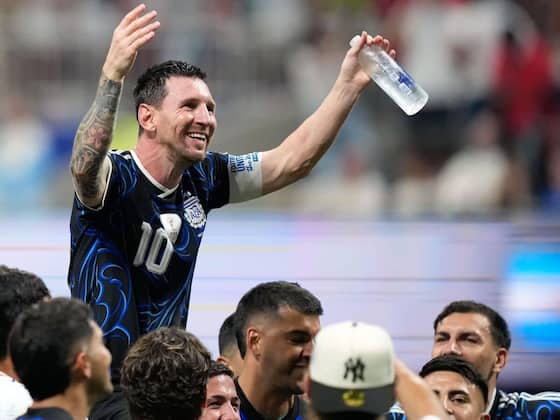
If this truly turns out to be Lionel Messi’s final World Cup, the Argentina captain is ensuring he makes it a memorable farewell.
Over the years, we have grown accustomed to witnessing greatness from the Argentine icon, yet even at 39, he continues to surprise with his brilliance on the world stage. This summer, Messi has delivered one of his most exceptional World Cup campaigns.
Should Argentina overcome Spain in the final and secure back-to-back titles, Messi’s 2026 performance will undoubtedly become part of footballing folklore.
As the veteran forward prepares for yet another World Cup final on Sunday, we take a closer look at the remarkable records he stands on the verge of breaking.
It almost feels inevitable that Messi will take the field in the final against Spain. Only an unforeseen setback could keep him out of this historic clash.
Sunday’s final at the MetLife Stadium comes just 25 days after Messi celebrated his 39th birthday.
Although he won’t become the oldest player ever to feature in a World Cup final—that distinction belongs to Italy’s legendary goalkeeper Dino Zoff, who was 40 years and 133 days old when he played the 1982 final—Messi will be the oldest outfield player to appear in one if he starts against Spain.
Should he find the back of the net, he will also set a new mark as the oldest goalscorer in a World Cup final, surpassing Sweden’s Nils Liedholm, who scored at 35 years and 264 days in 1958.
Despite failing to score in the semi-final against England, few would confidently bet against Messi finding a goal in this form, would they?
Most of Argentina’s starting lineup for the final will be familiar faces from their triumph over France in the 2022 final. However, Messi remains the only player from the current squad who also featured in the 2014 final defeat to Germany.
Regardless of the outcome this time, he is set to equal Brazilian legend Cafu’s record as the only player to appear in three World Cup finals.
Messi’s showing at this tournament has been nothing short of extraordinary. With eight goals and four assists so far, he is just one contribution away from equalling the record for the most goal involvements in a single World Cup since 1966.
That record was set by Gerd Muller, who had 13 combined goals and assists for West Germany in 1970. Messi needs one more to match Muller and two to surpass him.
While historical data on assists is incomplete—Just Fontaine, for instance, netted 13 goals in 1958—it’s possible the overall record could be slightly higher. Still, given Messi already holds the all-time World Cup records for both goals and assists, setting a new single-tournament benchmark would be a fitting addition.
If Messi scores in Sunday’s final, he will become only the sixth player ever to score in two different World Cup finals, joining Vava and Pele (Brazil), Paul Breitner (West Germany), Zinedine Zidane and Kylian Mbappe (France).
Messi’s brace in the 2022 final means another double this weekend would see him equal Mbappe’s record of four goals scored in World Cup finals—achieved through the Frenchman’s hat trick in the same match.
Currently, Messi is one of seven players tied for the record of two free-kick goals at World Cups, following his superb strike against Jordan in the group stage. Another successful free-kick in the final would hand him sole ownership of that record.
Argentina are also chasing their own piece of history, aiming to become only the third nation to win consecutive World Cups, after Italy (1934 and 1938) and Brazil (1958 and 1962).
If they succeed, Messi would become the oldest player to retain the World Cup title, overtaking Brazil’s Nilton Santos, who was 37 when he achieved the feat in 1962.
It’s virtually impossible for Messi to topple Just Fontaine’s record of 13 goals in a single World Cup—he would need an astonishing five goals in the final to do so. However, he could still achieve another notable milestone: becoming the top scorer from a World Cup-winning team.
That record currently belongs to Brazil’s Ronaldo, who scored eight goals during their victorious 2002 campaign. With Messi already on eight goals in 2026, he needs just a goal and a victory to break that record outright.
It almost feels like a challenge tailor-made for him.
Argentina’s loss in the 2014 final preserved Pele’s unique record as the only player to win three World Cups. But Messi now has a third—and possibly final—chance to join that elite company.
Several players have lifted the trophy twice—most notably from Italy’s 1930s squads and Brazil’s 1958–62 teams—but Messi could become the first ever to captain his nation to both triumphs.
Giuseppe Meazza, Bellini, Mauro, Cafu, and Daniel Passarella all lifted the World Cup twice, but only once as captain. Messi now stands on the brink of rewriting that chapter of football history.