A former Japanese minister has blamed India for delays in the Mumbai-Ahmedabad bullet train project, accusing New Delhi of repeatedly failing to honour commitments and expressing concern over Japan's alleged exclusion from the project's signalling system.
Hideki Makihara, a member of Japan's ruling Liberal Democratic Party, said the responsibility for the delayed implementation of the high-speed rail project lay "entirely on the Indian side", despite Japan's financial and technological support.
In a social media post, Makihara, who said he had been involved with the project, criticised India's handling of the negotiations. "But what stood out in meetings and negotiations was the sheer recklessness of the Indian side, repeated over and over. They just don't keep promises, no matter what," he wrote in Japanese.
"Even if they make a promise, they flip it right away. They keep pushing their own self-interest. For the honour of all the Japanese folks who poured their hearts into this, I have to say it: I feel 100 per cent that the reason this hasn't moved forward is entirely on the Indian side."
Referring to the recent meeting between Prime Minister Narendra Modi and Japanese Prime Minister Sanae Takaichi, Makihara said there had been no clear outcome on the Shinkansen project and alleged that Japan had been "excluded from the signal system, the key to safety".
The remarks sparked a political row, with India on Friday dismissing them as inaccurate. "It is an individual opinion and at considerable variance with facts. India-Japan discussions on the Mumbai-Ahmedabad high-speed train project are progressing well. Japan will provide E10 series trains, but only in early 2030s," external affairs ministry spokesperson Randhir Jaiswal said.
"The train in question is still under development. Meanwhile, construction work has rapidly progressed. First section will be opened in 2027 itself. Therefore, both sides agreed to start the operations with Indian high speed train," he said.
Responding to Makihara's concerns over the signalling system, Jaiswal said the equipment had been procured in accordance with international standards.
"The signalling equipment has been ordered accordingly and is in line with international specifications. No Japanese offer was received in this context. The project execution is in line with the common goal of starting the high speed train project at the earliest," he said.
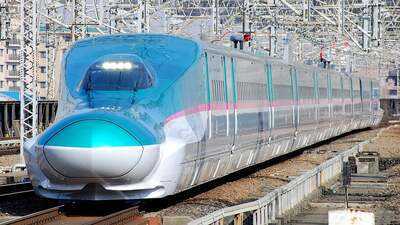
Japan has been a key partner in the Mumbai-Ahmedabad high-speed rail project, providing soft loans, technology and engineering expertise under the bilateral Shinkansen cooperation programme.
Under the current plan, India will initially deploy indigenously developed high-speed trains when the first stretch of the corridor becomes operational. Japan is expected to supply its next-generation E10 series Shinkansen trains in the early 2030s, once they are ready for commercial deployment.
With PTI inputs