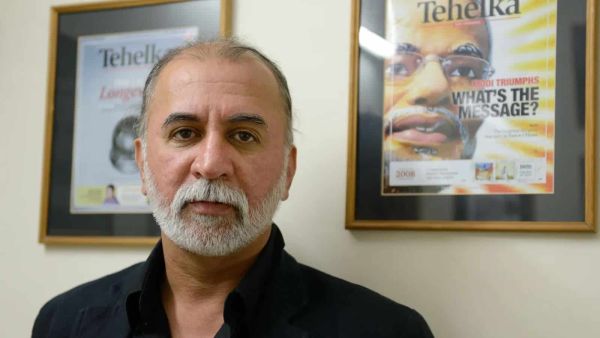
Panaji: Former Tehelka editor-in-chief Tarun Tejpal’s counsel on Saturday, July 18, concluded final arguments before the Bombay High Court in the Goa government’s appeal against his acquittal in a 2013 sexual assault case, contending that the complainant’s testimony was unreliable and that the trial court’s verdict be upheld.
Tejpal was personally present in the court when senior advocate Aabad Ponda argued on his behalf.
The case stems from allegations made by a former colleague of Tejpal, who accused him of sexually assaulting her inside a hotel elevator on November 7 and 8, 2013, during a ThinkFest event organised by Tehelka magazine in Goa.

While a court in Mapusa, Goa, had acquitted Tejpal of all charges in May 2021, the state government had challenged the acquittal in HC.
Ponda, appearing for Tejpal before HC’s Goa bench comprising Justices Dr Neela Gokhale and Amit Jamsandekar on Saturday, argued that the complainant’s conduct before and after the incident, along with contemporaneous emails, WhatsApp messages and documentary records, contradicted the prosecution’s case.
Questioning the complainant’s explanation that she did not leave the ThinkFest venue immediately after the alleged assault because she feared losing her job, Ponda submitted that digital records indicated she had already been exploring alternative employment opportunities before the incident.
According to the defence, these included correspondence with the editor of another publication stating that her “time is running out” at Tehelka, a higher-paying job opportunity connected with another television programme, and an application for a fellowship to write a book on violence against women carrying a monthly grant of around Rs 1 lakh, which she allegedly secured soon after the incident.
The defence also argued that instead of immediately initiating criminal proceedings, the complainant was engaged in discussions regarding a “closure”.
Referring to emails and WhatsApp messages, Ponda said these included discussions on a “severance package” from Tehelka, advice from her family member to negotiate a better settlement instead of accepting an apology immediately, consultations with a senior advocate on legal options and exchanges discussing the possibility of seeking Rs 100 crore as compensation.
Ponda also placed before the court WhatsApp conversations between the complainant and her friends, referring to one message in which she allegedly wrote that she intended to “unleash a reign of sexual terror on unsuspecting thinkers” attending ThinkFest.
The defence said that although the complainant later described the message as a joke, it formed part of the contemporaneous record and should be considered while assessing her credibility.
Revisiting the apology email exchanged after the alleged incident, Ponda submitted that the complainant had initially sought an apology through Tehelka’s internal mechanism as a means of achieving “closure” rather than filing a criminal complaint.
He argued that the complainant herself had laid down the terms of the apology and that the email was drafted by then managing editor Shoma Chaudhury at her instance and not by Tejpal.
The defence further argued that even if the complainant’s version was accepted in its entirety, the allegations would not sustain charges of rape and wrongful confinement against Tejpal.
Ponda also submitted that during cross-examination the complainant repeatedly stated that she did not recollect events when confronted with documentary material.
He cited her claim that the investigating officer had never asked her to undergo a medical examination, adding that when shown a written endorsement recording her refusal for such an examination, she again said she could not recollect.
Over the previous two days, the defence had challenged the prosecution’s case by arguing that the complainant’s account of being confined inside a moving lift was inconsistent with expert evidence and CCTV footage.
The defence also contended that she changed her version of how the lift operated after technical evidence emerged.
Her conduct after the alleged incident, including CCTV footage, photographs, emails and WhatsApp messages, was inconsistent with the prosecution’s allegation that she was fearful of Tejpal, the defence added.
The defence had also argued that CCTV footage from the first floor, which it described as crucial evidence, was never produced before the court.
Concluding his submission, Ponda argued that repeated contradictions between the complainant’s oral testimony and contemporaneous documentary evidence meant that her evidence did not inspire confidence, and urged the High Court to uphold Tejpal’s acquittal.
With the defence concluding its arguments, the Goa government is scheduled to present its rejoinder before the High Court on July 30.