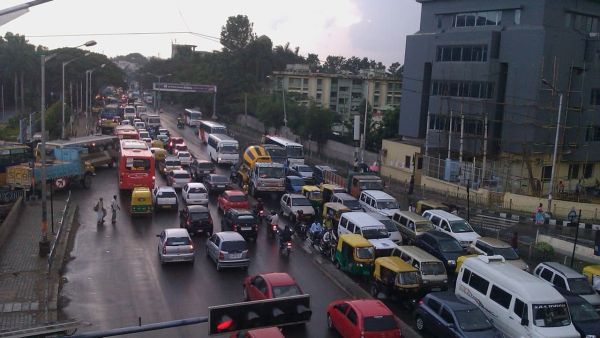
In a major move to tackle Bengaluru's worsening traffic congestion, the city traffic police have prepared a comprehensive five-point action plan and submitted it to the Karnataka Government. The proposal aims to improve traffic flow, reduce road accidents and ease daily commuting in one of India's busiest metropolitan cities. The recommendations include stricter restrictions on heavy vehicles, legalising carpooling, restoring higher traffic fines, restricting two-wheelers on selected flyovers and regulating the movement of private buses.
The proposal was prepared under the leadership of Joint Commissioner of Police (Traffic) Karthik Reddy following an extensive study of Bengaluru's traffic patterns, accident data and congestion hotspots. According to sources, a high-level meeting to discuss the proposal's technical aspects has already been held. The meeting was chaired by Home Minister Dr G Parameshwara and attended by Director General and Inspector General of Police (DG&IGP) Dr MA Saleem, Bengaluru City Police Commissioner Seemant Kumar Singh and other senior officials.
The traffic police have recommended imposing a permanent ban on the entry of heavy goods vehicles into Bengaluru city limits.
Currently, heavy trucks are permitted to enter the city only between 10 pm and 7 am, a restriction that has been in place since 2014. Under the new proposal, such vehicles would be stopped at the city's outskirts, with smaller goods vehicles transporting cargo within the city.
The proposal also recommends prohibiting all goods vehicles from operating during peak traffic hours between 8 am and 10 am and 5 pm and 7 pm.
The traffic police have also urged the government to legalise app-based carpooling services to reduce the number of private vehicles on Bengaluru's roads.
Before the COVID-19 pandemic, app-based carpooling services were widely used by employees in the IT and BT sectors, with nearly 60,000 commuters using the service daily. According to the proposal, this helped keep around one lakh vehicles off the roads.
However, usage declined significantly after the pandemic, while legal and regulatory issues raised by the Transport Department further affected such services, resulting in an increase in the number of private vehicles on the roads.
The traffic police have proposed restoring the higher penalties for traffic violations that were introduced by the Central Government in 2019 but were later reduced by the Karnataka Government following public protests.
The proposal focuses on stricter enforcement against offences such as jumping traffic signals, driving on the wrong side of one-way roads and using mobile phones while driving.
If approved, penalties for certain violations could increase from ₹500 to ₹1,000. Officials believe stricter penalties would improve compliance with traffic rules and encourage safer driving practices.
Based on accident analysis, the proposal recommends restricting two-wheelers from using selected flyovers where motorcycle accidents have been found to be more frequent.
Traffic police believe such restrictions could reduce accidents and minimise traffic disruptions caused by crashes.
The proposal also recommends prohibiting small commercial vehicles, including Tata Ace goods carriers and mini tankers, from using flyovers across the city.
Another key recommendation is to prevent private buses, particularly those operating with All India Permits, from entering Bengaluru city.
Instead, these buses would operate from designated terminals on the city's outskirts, with passengers using connecting transport to reach their destinations.
According to the proposal, many private buses currently stop at unauthorised locations, contributing to traffic congestion. The police have recommended introducing designated boarding and drop-off points to streamline their operations.
According to sources, the five-point proposal was prepared after an extensive study conducted by the Bengaluru Traffic Police under the supervision of Joint Commissioner Karthik Reddy.
Officials analysed traffic volume, accident records and congestion patterns across major corridors. Artificial Intelligence (AI) was also used to study traffic movement on flyovers, the Outer Ring Road (ORR), IT corridors and Central Business District (CBD) areas.
Senior traffic officials also carried out multiple field visits to identify the city's most congested locations and assess possible solutions.
The traffic police also conducted a month-wise analysis based on the academic calendar and traffic trends.
The study found that traffic congestion is generally highest between June and November, with September emerging as the busiest month due to heavy rainfall, school and college activity, and festival-related traffic.
Officials noted that traffic conditions are comparatively smoother between November and March, when academic activity is lower and weather conditions are more favourable.