
NVIDIA just dropped Cosmos 3 Edge. It’s a lean 4-billion-parameter world model built to slap raw intelligence straight onto local hardware. No cloud and no latency.
We saw Cosmos 3 Nano (16B) and Super (64B) earlier, but this Edge model targets memory-starved gear that needs instant spatial awareness without a digital leash.
Jensen Huang keeps calling Physical AI “the next ChatGPT moment.” And, he’s right, for with Cosmos 3 Edge, NVIDIA wants to yank generative models out of distant server farms and bolt them directly onto factory floors, self-driving cars, and city grids.
World models flip that entire dynamic. They learn raw physics and time directly from messy, real-world data streams. Cosmos 3 Edge essentially fuses perception, reasoning, and execution into a single, lightning-fast loop.
Here is how that actually plays out on the ground:
The model compresses wildly different form factors, from 9D camera setups to 29D humanoid mechanics, into uniform geometric vectors.
An industrial robot or AMR feeds on visual inputs at $640 \times 360$ resolution. Fast. Direct.
It predicts physical futures on the fly, spitting out 32 candidate actions per pass without choking.
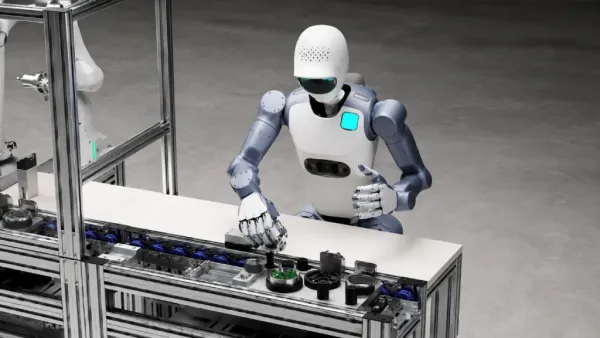
Putting heavy AI directly on local chips alters how plants run. What we’re seeing is a “silicon workforce” step up alongside human crews as collaborative partners.
The factory floor is shifting quickly:
Companies are retraining line staff to manage, direct, and fine-tune these self-correcting machines.
Labor groups are watching closely, demanding strict limits on automation speed and firm job guarantees.
Early setups show humans stepping back to make high-level calls while cobots take on hazardous, back-breaking repetition.
Governments no longer view physical robotics as critical national infrastructure.
NVIDIA timed this release alongside major geopolitical moves. Look at Japan, where the industrial giants like FANUC, Yaskawa Electric, Kawasaki Heavy, and SoftBank are already building directly on the Cosmos stack.
Sovereign state initiatives want local manufacturing empires to stay fast. Crucially, they want that speed without handing trade secrets to foreign cloud providers.
Running giant AI models inside actual factories usually hits a hard brick wall of bad latency, insane bandwidth bills, and massive power draws. Cosmos 3 Edge dodges those financial traps by severing the cloud connection entirely.
Runs natively on consumer GeForce RTX workstations all the way down to tiny NVIDIA Jetson Thor modules.
Zero network dependency means lower latency and vastly cheaper power bills.
Teams can retrain Cosmos 3 Edge for specific hardware setups in about 24 hours using local DGX stations or modest H100 clusters, which completely collapses the old iteration cycle.
Local processing gives you an immediate privacy win. Video feeds from high-security plants, operating rooms, or private roads stay on the local board. Nothing streams out to public servers.
Still, physical AI carries serious risk. Hallucinating inside software makes you get bad text. Hallucinating inside a 500-pound steel arm does cause stuff to break.

NVIDIA released the model weights open under the OpenMDW-1.1 license so researchers can stress-test safety limits. Meanwhile, developers are running tight closed-loop simulations to burn out weird edge-case bugs long before letting these machines near actual humans.
Releasing Cosmos 3 Edge gives NVIDIA a real shot at making Physical AI practical, not just a flashy demo, and as open physical models gain traction, this mix of on-device compute and localized policy will completely rewrite how physical work gets done.
Ready to deploy real-time physical AI on your local hardware? Download the Cosmos 3 Edge open weights on Hugging Face today and build the next generation of autonomous robotics!