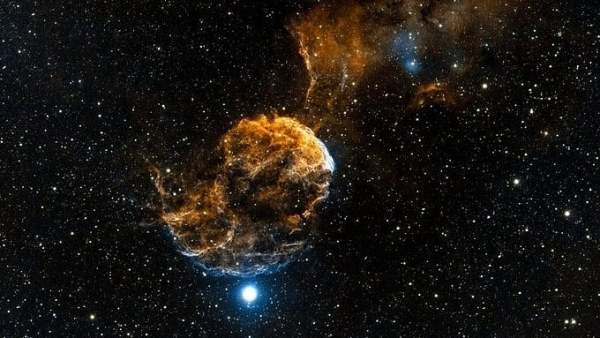
Scientists have found the first evidence of a binary star system where both massive stars exploded as supernovae, leaving behind visible nebulae. Using over 16 years of NASA Fermi telescope data, researchers linked the Jellyfish Nebula and G189.6+3.3 remnants, offering new insights into massive star evolution.
Scientists have, for the first time, found evidence that two massive stars born together in a binary system both exploded as supernovae within a relatively short period, each leaving behind a glowing cloud of gas known as a nebula.
Unlike the Sun, many of the universe's largest stars are born in binary systems, where two stars remain gravitationally bound throughout their lives. The discovery provides the first observational evidence of a binary pair in which both stars exploded and left behind visible remnants, Reuters reports.
One of the two nebulae is the well-known Jellyfish Nebula in the Milky Way, formally known as IC 443. Using more than 16 years of data from NASA's Fermi Gamma-ray Space Telescope, researchers identified a second nearby nebula, G189.6+3.3, linking the two as the remains of companion stars.
Researchers believe the Jellyfish Nebula was created by the explosion of a star about 15 to 25 times the Sun's mass, while the second nebula was formed by the explosion of its companion star, which was at least 20 times more massive than the Sun.