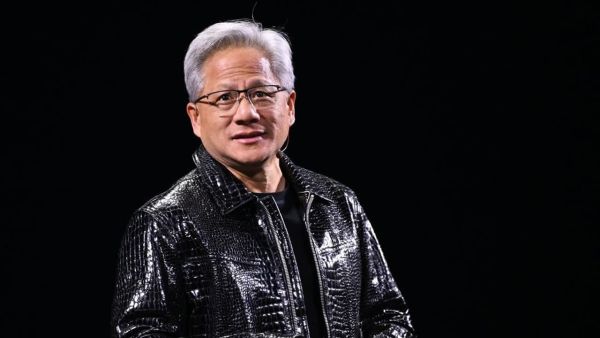
Nvidia (NVDA) CEO Jensen Huang posted on X for the first time ever on Friday, sharing a multi-company letter defending open-weight AI models and why they are critical to maintaining U.S. leadership in artificial intelligence.
"For my first post, I'm sharing a letter Nvidia signed on why open models matter," Huang wrote. "AI will transform every industry, power every company, and be built by every country. Open models strengthen safety and cybersecurity, accelerate innovation and diffusion, and enable sovereignty. The world needs both frontier closed models and frontier open models."
The post follows Huang's comments to Axios earlier this week, where he said American companies should be "absolutely" free to use Chinese AI models. Nvidia and about 20 other organizations expanded on that argument in a joint paper titled "Open Weights and American AI Leadership."
NVDA’s stock dropped over 1% in morning trade on Friday. On Stockwits, retail sentiment around the company trended in ‘neutral’ territory over the past day.
The letter stated that restricting open-weight AI models would weaken, rather than strengthen, America's position in the global AI race. Signatories included Meta (META), Microsoft (MSFT), Andreessen Horowitz, Hugging Face, IBM (IBM), the Linux Foundation, Palantir (PLTR), and Perplexity.
Meanwhile, OpenAI and Anthropic, the two labs that have been most vocal in Washington about the risks of Chinese open-source models, were absent from the list.
The group presented that open-weight models improve security because their underlying model weights can be inspected by researchers worldwide, allowing vulnerabilities to be identified and addressed more quickly. The paper noted that closed models create "single points of failure" by concentrating development and oversight within a small number of companies.
The paper drew parallels with the open-source software movement of the 1980s, which it says laid the foundation for much of today's internet infrastructure and many of the systems used by the U.S. military. It stated that AI has reached a similar inflection point in 2026, where broader collaboration could accelerate innovation while strengthening resilience.
The letter comes after Beijing-based Moonshot AI released Kimi K3 last week, an open-weight model the company claims delivers frontier-level performance at a fraction of the cost.
In an interview with Axios, Huang stated that many fears about hidden backdoors in Chinese models are "a misconception" and that broader adoption of capable AI models, whether open or closed, ultimately increases demand for Nvidia's AI chips.
His comments came shortly after Treasury Secretary Scott Bessent said the administration was reviewing whether Chinese AI models had been trained using stolen U.S. intellectual property.
The paper also addressed the increasingly contentious issue of AI distillation, which is the practice of training one model using the outputs of another.
OpenAI has alleged that some Chinese AI developers improperly used distillation techniques to build competing models. The letter's signatories take a different view, describing distillation as a widely used and legitimate technique for improving AI systems.
Rather than imposing broad restrictions on open-weight models, the group stated policymakers should focus on addressing genuine intellectual property violations through targeted legal and commercial measures.
Read also: Meta’s Latest AI Data Center Debt Raise Could Reportedly Cost More Than Its 2025 Record Deal
For updates and corrections, email newsroom[at]stocktwits[dot]com<