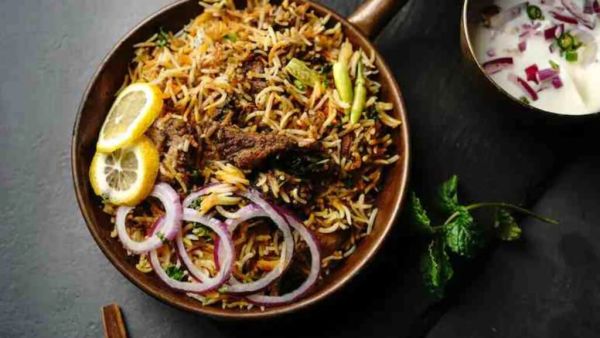
Ask most people where biryani comes from, and the answer will almost always be India. Yet the name itself tells a different story. “Biryani” stems from the Persian ‘birinj biryan’, roughly translating to “fried rice” – a clue that hints at a far more layered, well-travelled history of the dish than it is usually known.
Many food historians trace biryani’s roots back to Persia, long before it ever touched Indian soil. In the royal kitchens of the Safavid and Timurid empires, rice was fried in ghee or fat and layered with meat, dried fruit, nuts and saffron, then cooked slowly under a tightly sealed lid – a technique now recognized across South Asia as “dum” cooking, explains Shabnam Nasimi in an Instagram video. This slow-fire method is widely considered the foundation of what would eventually become biryani.
From Persia, the dish is thought to have made its way eastward along ancient trade routes, passing through cities such as Isfahan, Naishapur and Khurasan, carried onwards by merchants, soldiers and wandering poets, before eventually arriving in Herat and Kabul.
According to legend, by the 15th century, Herat and Kabul had become dazzling centers of Timurid culture, celebrated for their art, poetry and food. It was here that court chefs are believed to have refined dishes such as Qabuli Palau – a regal combination of rice, lamb, carrots, raisins, almonds and cardamom, reserved for nobility and served at grand feasts.
When the Timurid prince Babur was forced out of Fergana and took refuge in Kabul in 1504, he brought these Central Asian and Persian culinary traditions along with him.
Later, in 1526, when he crossed into India and established the Mughal Empire, those same flavors traveled too – gradually evolving to incorporate Indian staples like Basmati rice and native spices.
A separate theory holds that biryani has Mughal roots of its own, evolved from pulao-style dishes introduced by Arab and Persian traders. It is believed that soldiers combined rice with whatever meat was on hand to make a filling, one-pot dish.
It wasn’t until the 18th century that the word “biryani” itself began appearing in Mughal records, by which point it had shed its humble origins and become a dish fit for royalty in Delhi, Lucknow and Hyderabad, with each city crafting its own signature style.
There’s also a fourth, older theory that pushes the timeline back even further – to around 2 AD in present-day Tamil Nadu, where accounts describe a rice-and-meat dish made with clarified butter, beef, bay leaves and black pepper, prepared as a hearty meal for warriors.
Wherever it began, biryani found its true calling in the courts of Awadh and Hyderabad, where regional chefs elevated it into an art form. Lucknow’s version is traditionally cooked in a copper vessel, prized for its delicate, refined flavours. Hyderabadi biryani leans on saffron as its defining note.
So, did biryani originate in Persia, take shape in Afghanistan, or come into its own in India? It can be hard to trace a single origin.