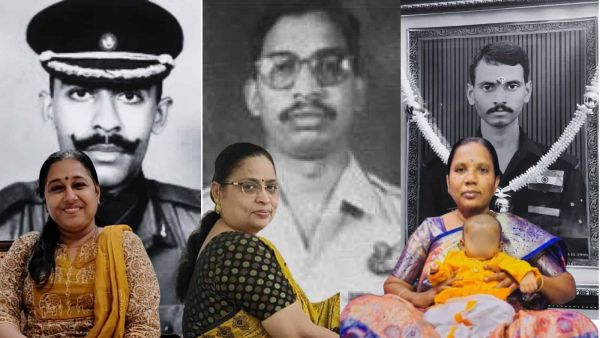
Hyderabad: The summer of 1999 is etched into every Indian’s memory. A war defined by the extraordinary courage and supreme sacrifice of men who fought the Pakistani Army and infiltrators on the icy heights of Kargil. For the first time, Indians were given a glimpse of an actual battleground, because until then, war had largely existed through history books and cinema.
The summer of 1999 – the Kargil war – changed that forever.
It has been over 25 years since, more than a quarter of a century. A lot has changed. A new millennium arrived. The attacks on the World Trade Center (WTC) reshaped global politics. Mobile phones, smartphones, social media brought the world closer. Consumerisation, influencers, a pandemic followed. And now artificial intelligence. A lot has changed.

But while the soldiers have remained frozen in time, the lives they left behind have not.
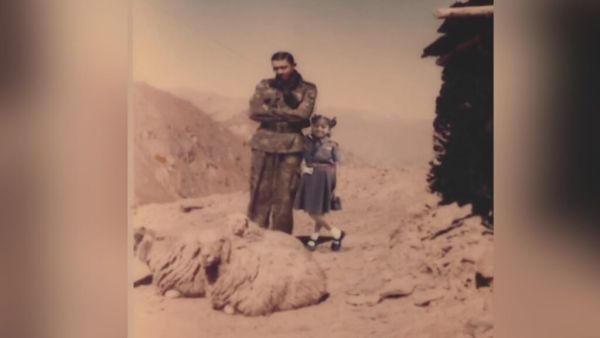
Five-year-old Aparajita woke up one day to tell her mother, Charulatha Acharya, about her dream. “Mummy, Daddy came in my dream. He walked through the mountains, showed me beautiful things, big, big sheep. He told me stories,” she said. Her twinkling eyes were not lying.
Charulatha, wife of Major Padmapani Acharya, was moved. Major Acharya of the 2nd Rajputana Rifles attained martyrdom on June 28, 1999. He was tasked with capturing the treacherous Lone Hill and Knoll, which stood at an altitude of 5,000 metres above sea level, with an almost 80-degree climb. Braving showering bullets and a land covered with mines, the young major and his men soldiered on. The capture of this enemy bunker was crucial for the Indian Army to progress in the Kargil war.
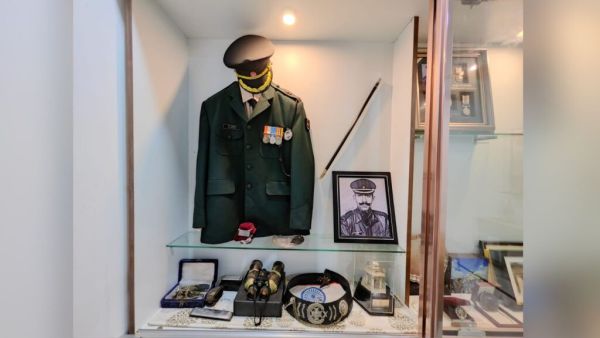
Major Acharya, who a few days ago had turned 30, crawled towards the enemy bunker and killed three enemies before laying down his life.
“We met in a train in August 1995. I was on my way back after meeting my athayya (paternal aunt) in Jabalpur (Madhya Pradesh) with my friend’s mother-in-law, an octogenarian. She wanted filter coffee and asked me to fetch milk from the pantry,” Charulatha recalled to Siasat.com.
Then a 22-year-old, Charulatha describes herself as an extremely introverted, shy person. “I went to the pantry and heard people speaking loudly in Hindi. I did not understand that language, and I hurried back to my seat without the milk.”
“Excuse me? Do you need any help?” Charulatha looked up. She saw a tall man with a moustache, speaking eloquent English. When she told him she needed milk for her paati (grandmother), he went inside and got her.
As a courtesy, she offered him idlis and chai. For the next few hours, neither Charulatha nor Acharya spoke. “Around lunchtime, we started conversing. He asked me about my family, what I studied… normal stuff,” she said.
“All of a sudden he asked me, ‘are you committed to someone?'”
The question shocked Charulatha. But she replied in the negative. At the end of the journey, he gave his landline number and asked her to call him once she reached home safely.
Charulatha reached home, but this young man had found a place in her heart. She wanted to call him back but feared her conservative parents. “My younger sister convinced them and I called him. His mother picked up the call and we spoke for almost 1.5 hours. My parents spoke to his parents, and in the blink of an eye, we were engaged in Hyderabad,” she reminisced fondly.
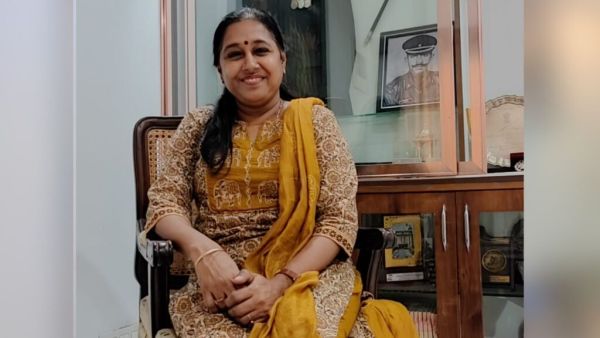
Charulatha and Babloo (Acharya’s house name) did not speak till both families accepted them. It was the 90s, and mobiles had not reached India. No exchange of letters or greeting cards or speaking on the landline. “It was just meant to be with the divine’s blessings,” she said. “And he was charming,” she blushed.
The couple were married in 1996 and were soon on their way to parenthood.
Almost a month before Acharya’s martyrdom, on May 28, 1999, Sergeant Pilla Venkata Narayan Ravi (PVNR) Prasad, serving as a flight gunner in the Indian Air Force, and his team were assigned to neutralise enemy positions at Point 5140 Tiger Hill, in the Dras sub-sector. It was highly risky and Sergeant Prasad and his team – Squadron Leader Rajiv Pundir as captain, Flight Lieutenant Subramaniam Muhilan as co-pilot and Sergeant Raj Kishore Sahu as flight engineer – knew it. They were aware that their presence would be fully exposed to the enemy eye, making them vulnerable.
They carried on, launching attack after attack, inflicting heavy damage. But their helicopter was struck by a Stinger missile, causing catastrophic damage and a fatal crash.
“Another soldier was supposed to go instead of him. But his wife was expecting. So Sergeant Prasad stepped in. We were in Saharanpur (Uttar Pradesh). He told me that he was going for a camp. I was not aware of what was transpiring on the borders. Plus, they do not reveal such sensitive details,” said Anuradha Prasad, his wife.
Sergeant Prasad was born on August 15, 1965, in Andhra Pradesh’s Eluru district. He was Anuradha’s maternal uncle, and at the time, marriages between maternal uncles and nieces were a socially accepted custom in many South Indian communities.
Prasad always knew he would marry Anuradha, but a teenage Anuradha was scared of her mamaya (maternal uncle). “I would run home as soon as I saw him. I was scared and very shy,” she chuckled.
“In fact, he told my parents that he would marry only me and could not bear the thought of me marrying off to someone else. He was sure from the beginning,” she said.
“We got married in 1993. I was 19 and he was nine years older than me,” she told Siasat.com. And soon, they welcomed their baby girl – Hyandavi.
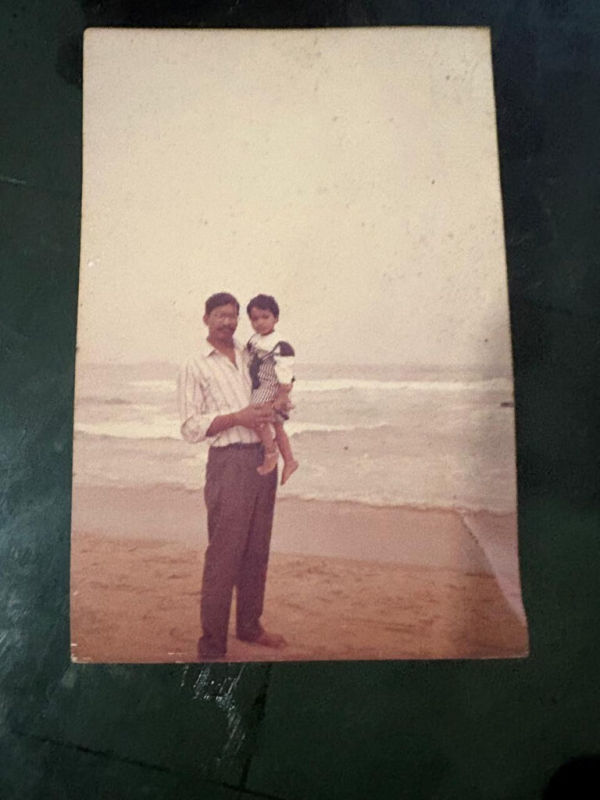
Hyandavi now works in the Financial District as an HR professional. She was just two-and-a-half years old when she lost her father. “In 2009, we observed 10 years of Operation Vijay Diwas. Mummy, other families and I were at Kargil. Looking at those mountains, my heart felt heavy. A profound grief engulfed all of us. None of us could hold back our tears,” she said.
Although Hyandavi has accepted the reality, Anuradha still holds on to hope that her mamaya will suddenly present himself at the door one day. “I never got to see his body. I still believe he jumped from the helicopter at the last minute and escaped. To this day, I believe he will come back,” she said.
On July 26, 1999, the Indian Army reclaimed high-altitude mountain posts in the Kargil, Dras and Batalik sectors, marking its decisive victory over Pakistan. To this day, July 26 is observed as Operation Vijay Diwas or the Kargil Diwas.
While television channels flashed news of India’s victory, the army remained on high alert. Indian troops were stationed in strategic positions along the Line of Control (LoC) to ensure there was no repeat. The heightened deployment and vigilance remained in place for years after the conflict ended.
Rifleman T Srinivasulu from Jammu and Kashmir Light Infantry (JAK LI) lost his life in November 1999 when his vehicle came under attack, falling into a gorge. His wife, Shivaneela, had just given birth to their first-born – a baby boy – a few days ago.
Both hailed from Vengalayapalem village in Guntur. Shivaneela was just 15 when she was married to an 18-year-old Srinivasulu. Both hailed from Vengalayapalem village in Guntur. At the time of their marriage, he worked on the farm. He joined the army in 1995, two years later.
Speaking to Siasat.com, Shivaneela said she barely got a chance to get to know her husband. “He would come once a year for 15 days. My mother-in-law was very strict and I was scared of her. We could not spend much time together,” she recalled.
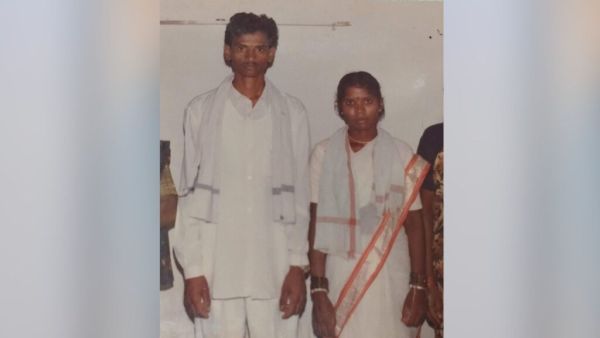
Before his death, Srinivasulu knew he was a father to a boy. He wrote back to her: “Take care of yourself and our son. I will return soon.”
As fauji wives, they embraced the defence life. They were introduced to new languages, food, cultures and responsibilities.
They had barely begun building a life, till fate played a cruel joke. This grief does not heal with time and perhaps never will, but it turns into something stronger.
Over the years, Charulatha, Anuradha and Shivaneela have transformed in ways they never imagined they could. Charulatha, who once described herself as a shy young woman who did not even know Hindi when she met Major Acharya, runs a gas agency in Attapur. Anuradha, who said she was too timid to even speak to her husband, now manages a gas agency in Nacharam named after him. Shivaneela, married at just 15 and once confined to the life of a village homemaker, now works at Sainik Ashram, supporting the welfare of ex-servicemen and their families.
Today, these women speak with confidence, run businesses, negotiate with officials and customers, raise families and stand on their own feet. More than wives of Kargil heroes, they are individuals who forged their own identities beyond their loss.
This strength, as Anuradha said, is something that cannot be comprehended. “My mamaya was everything to me. He gave me strength. He always told me to be brave, never give up in life. Even today, if I have an issue, I sit in front of his photo. And somehow, I have my answers,” she said.
“I have lived for my son. And now I am a grandmother. I have embraced life. It was difficult, but I did not give up. I work, I earn my own money and I am proud of myself. I am sure he would be proud of me too,” said Shivaneela.
“I am sure he is proud of both me and Aparajita. She is exactly like her father – strong-willed, determined,” Charulatha said
Major Padampani Acharya was awarded Maha Vir Chakra (MVC), Sergeant PVNR Prasad was decorated with Vayu Sena and Srinivasulu was declared a battle casualty.
When five-year-old Aparajita shared her dream with her mother, she knew exactly what to do. “My sister-in-law and I took a photo of her in the school uniform and photoshopped it with him standing on the mountains,” she said, smiling.
Twenty-five years on, the soldiers are still climbing those mountains, and the women they left behind have climbed higher.