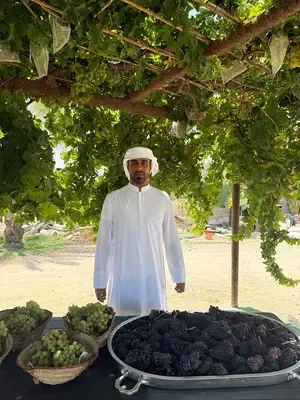
As grape harvest season gets under way in Ras Al Khaimah’s mountainous Asimah region, a local farmer says demand for Emirati grape seedlings has surged tenfold over the years, with his nursery now producing more than 10,000 local grape seedlings each season to meet growing interest in cultivating traditional varieties.
Marwan Saif Rashid Al Mazrouei, from Asimah, a scenic mountainous and agricultural area in the southern part of Ras Al Khaimah located about 90 kilometers from Ras Al Khaimah city, said this year’s grape harvest began in May and continued through June, with the season largely determined by temperatures.
“The hotter the weather, the faster the grapes ripen,” he said. “With milder temperatures, the harvest extends across both May and June.”
Stay up to date with the latest news. Follow KT on WhatsApp Channels.
Al Mazrouei said producing quality grapes requires careful pruning, fertilization and pest management throughout the growing cycle. Grapevines are heavily pruned in February before beginning to bear fruit in May.
He said Asimah is known for cultivating pure local Emirati grape varieties, with both red and green grapes grown in the area. Some of the original mother vines on the farm are more than 25 years old.
Marwan with his grape harvest
Alongside the traditional varieties, he has also begun planting international grape varieties, although these are still being produced in limited quantities because the vines are relatively young.
Al Mazrouei said interest in locally produced grape seedlings has grown significantly in recent years.
“In the past, demand was limited, and we produced around 500 seedlings a year,” he said. “Today we produce more than 10,000 grape seedlings every season, yet demand still exceeds what we can supply.”
He said each of the farm’s 30 to 40 mature grapevines produces roughly 30 kilograms of grapes, although annual yields vary depending on growing conditions.
While the grapes themselves are not sold commercially, Al Mazrouei focuses on propagating seedlings, a skill he learned from his father before expanding production to meet increasing demand.
He explained that the local red grape variety produces smaller fruit but grows more quickly after planting, while the local green variety develops larger grapes, but its seedlings take longer to establish.
The nursery offers local red and green grape seedlings in various sizes, with new stock becoming available at the start of the planting season in September and October.
UAE rutab season begins as date farmers blend traditional methods, modern tech Fresh UAE dates from Dh15 per kg: Your guide to the season's best picks This 82-year-old farmer has been growing mangoes in UAE for 50 years