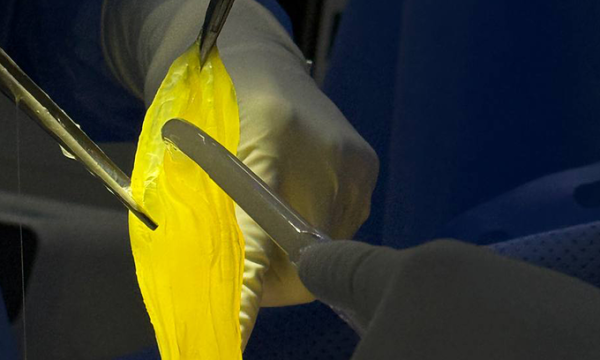
Breast implant rupture is commonly associated with factors such as material aging, trauma, capsular contracture, or surgical complications. Some patients experience rupture after five to 10 years, and in certain cases only one implant ruptures while the other remains intact.
According to MD, MSc. Ho Cao Vu, uneven mechanical pressure within the implant pocket may contribute to differences in implant longevity.
|
Right-side textured breast implant rupture, with the left implant still intact. Photo courtesy Dr. Ho Cao Vu |
Signs that may indicate uneven pressure
Changes in breast appearance may suggest that an implant is being subjected to uneven pressure, although these changes do not necessarily indicate a rupture.
Based on experience from more than 1,000 revision breast surgeries, including implant exchange and pocket reconstruction procedures, Vu said patients can observe four areas of each breast: the upper inner, upper outer, lower inner, and lower outer quadrants.
Ideally, the implant remains evenly positioned within the pocket, creating a balanced breast shape.
While standing with both arms relaxed, signs such as implant malposition, unusual fullness in the upper breast, asymmetry, or an implant shifting noticeably to one side may suggest that the implant pocket is no longer providing optimal support.
When lying down, excessive movement of the implant toward the armpit or noticeable differences in movement between the two breasts may indicate that the pocket has gradually stretched or changed over time.
Vu noted that these signs do not confirm implant rupture but may reflect changes in the implant pocket that could increase the risk of implant folding, friction, and reduced implant durability. Patients experiencing these symptoms are advised to seek evaluation from a qualified specialist.
 |
|
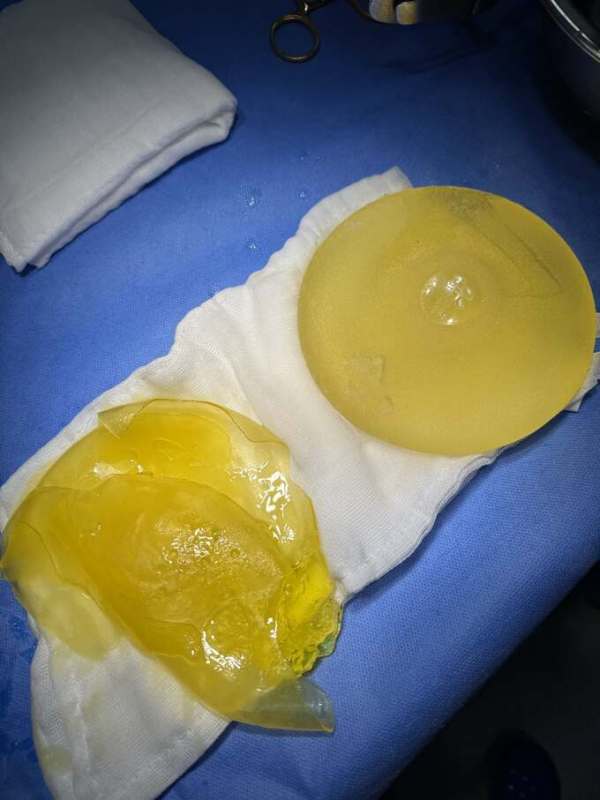
Textured breast implant rupture after 8 years. Photo courtesy Dr. Ho Cao Vu |
Why one implant may rupture earlier
According to Vu, many patients undergoing revision surgery experienced rupture in only one implant because pressure within the two implant pockets was distributed differently.
An implant pocket that is too tight or too loose may place uneven stress on the implant. Factors such as chest wall anatomy, muscle contraction, and bleeding during surgery may also influence pocket formation and increase the likelihood of capsular contracture.
In patients with aging or ruptured implants, Vu said he frequently observed thickened capsule tissue and grade III or IV capsular contracture, conditions that may subject parts of the implant shell to prolonged mechanical stress.
Over time, repeated compression may create folds in the implant shell, potentially accelerating material fatigue and increasing the likelihood of rupture. Vu said rupture is often found in the upper inner portion of the implant, an area that may experience greater pressure when the implant pocket is not evenly balanced.
Challenges of revision surgery
Replacing a ruptured implant often involves more than simply exchanging the device.
According to Vu, the upper part of the implant pocket is frequently deficient while the lower or outer portion has become overstretched. After removing the ruptured implant and cleaning the pocket, surgeons must determine whether immediate reimplantation is appropriate.
Repairing deficiencies in the upper pocket requires careful tissue dissection while minimizing trauma and bleeding. Vu said point-dissection techniques combined with ultrasonic surgical instruments may help surgeons release tissue and reconstruct the implant pocket before inserting a new implant.
If the implant has shifted downward or toward the side of the chest, the enlarged pocket may also require reconstruction to restore proper implant positioning. Surgeons then select a replacement implant that matches the patient’s goals and the condition of the revised pocket.
However, immediate replacement is not always recommended. Vu said reimplantation may be postponed in patients with severely enlarged pockets and grade IV capsular contracture because inserting a new implant under those conditions could increase the risk of recurrent complications.
|
Breast implant rupture 7 years after breast augmentation. Photo courtesy Dr. Ho Cao Vu |
Importance of precise pocket creation
Vu said successful breast augmentation depends not only on the implant itself but also on creating an implant pocket that distributes pressure evenly.
Before surgery, surgeons typically evaluate factors such as chest wall anatomy, soft tissue thickness, tissue elasticity, fibrosis, fascial characteristics, and implant dimensions to determine the most appropriate pocket design for each patient.
When these factors are considered together, pressure may be distributed more evenly across the implant surface, potentially reducing the risk of folding, prolonged compression, and friction during daily activities.
According to Vu, precise implant pocket creation is an important factor in reducing long-term complications such as capsular contracture, implant malposition, implant displacement, and early implant rupture, while potentially improving implant longevity and reducing the need for future revision surgery.